An archipelago adrift on three currents
The Galápagos Islands, also called the Colón archipelago, are a set of thirteen major islands, nine medium ones, and more than a hundred smaller islets and rocks in the Pacific Ocean, 972 km off mainland Ecuador. Together with the Malay archipelago, they are among the few in the world with territory in both the northern and southern hemispheres: the equator crosses the northern tip of Isabela Island.
Their position at the meeting point of three ocean currents — the cold Humboldt, the warm Panama, and the deep Cromwell — explains much of their biodiversity. Species from cold and warm climates coexist in the same archipelago, something exceptional on the equator.
- Distance from mainland Ecuador
- 972 km
- Major islands (over 10 km²)
- 13
- Medium islands (1 to 10 km²)
- 9
- Smaller islets and rocks
- over 100
Found by accident
The islands were discovered in 1535 by the crew of Friar Tomás de Berlanga, who was sailing to Peru when the currents dragged his ship out to sea. In his letter to King Charles V, Berlanga described a land he had not set out to find: "many sea lions, turtles, iguanas, gálapagos".
Many sea lions, turtles, iguanas, gálapagos.
Friar Tomás de Berlanga, letter to King Charles V, 1535
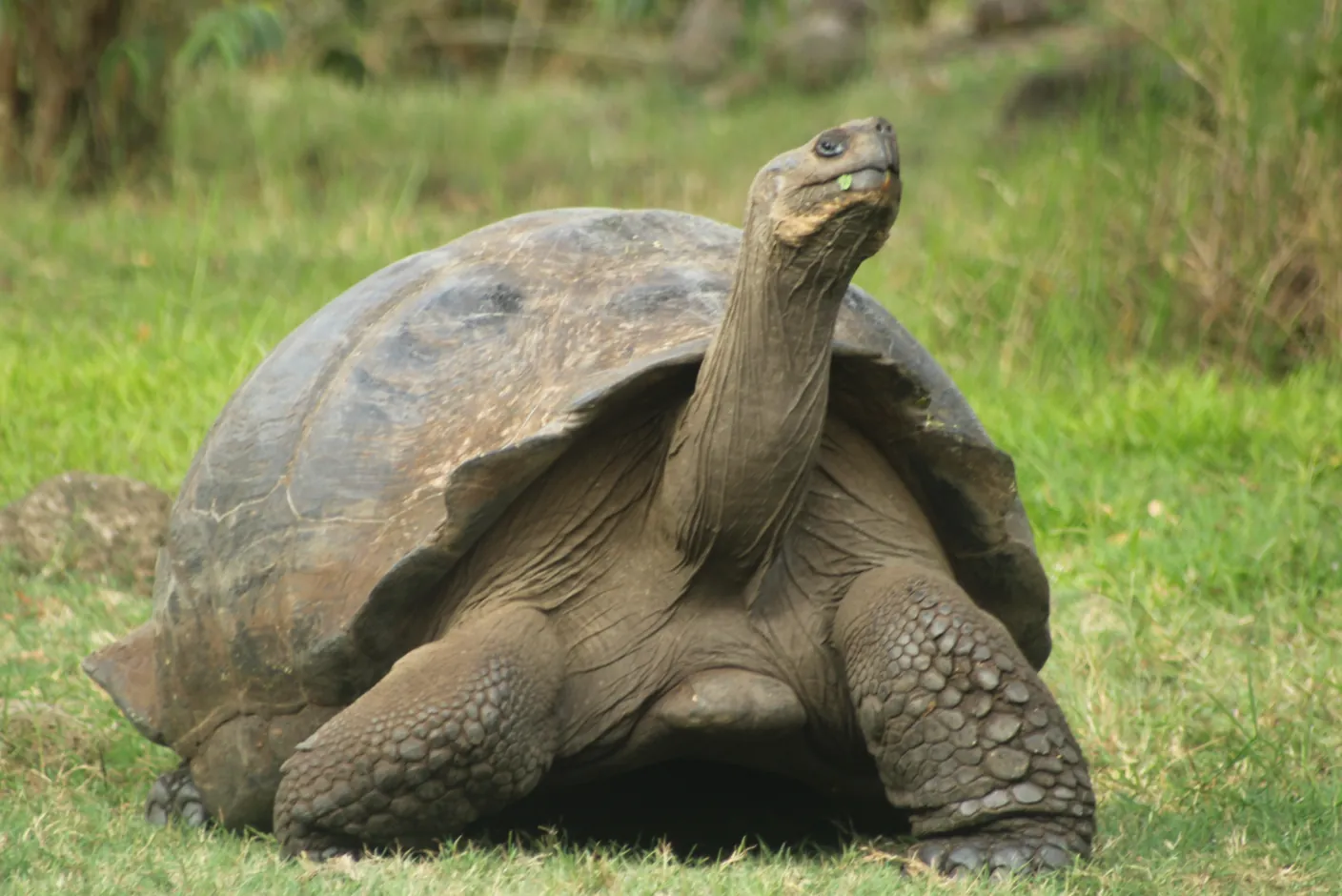
That last word, gálapago — the old Spanish word for tortoise — gave the archipelago its name. It also happens to be the Spanish word for a type of saddle whose shape resembles a giant tortoise’s shell, likely no coincidence: Berlanga used the term alongside "tortugas" to distinguish sea turtles from their enormous land counterparts.
The voyage that rewrote biology
In 1835, Charles Darwin came ashore during the voyage of HMS Beagle. He was 26. He noticed that finches and giant tortoises changed shape from one island to the next, and that question haunted him for more than twenty years until it became the theory of evolution by natural selection, published in On the Origin of Species in 1859.
Since then, Galápagos has been studied as an evolutionary laboratory still at work: a place where the processes that explain the origin of species can still be observed, not only reconstructed.
Geology: the second most volcanically active archipelago on Earth
The first island formed more than five million years ago, the result of tectonic activity over a hotspot in the Earth’s mantle. The youngest islands, Isabela and Fernandina, are still forming: the most recent recorded eruption was in 2020.
Galápagos is the second most volcanically active archipelago in the world, surpassed only by Hawaiʻi. Its most active volcanoes are Cerro Azul and Sierra Negra on Isabela, Marchena, and La Cumbre on Fernandina, one of the most active on the planet.
The Galápagos National Park
On 4 July 1959, an executive decree declared 97% of the archipelago’s land surface a national park, marking the centenary of the publication of On the Origin of Species. It became Ecuador’s first protected area. The decree excluded from the reserve land already settled by colonists and land the State had already legalized.
- National Park established
- 4 July 1959
- Protected land surface
- 97%
- National Park area
- 7,970 km² (land portion only)
To organize the territory, the Galápagos National Park Directorate zoned the archipelago’s 330 islands, islets, and rocks into three categories: zones of absolute protection, with no known human impact; zones of ecosystem conservation and restoration, showing some degree of alteration; and zones of impact reduction, on the periphery adjacent to urban or agricultural areas.
A World Heritage Site
UNESCO inscribed the Galápagos Islands on the World Heritage List in 1978, under criteria (vii), (viii), (ix), and (x): a unique natural site for its wildlife value, its active geological processes, and outstanding examples of the evolution of ecosystems and habitats for the in-situ conservation of biological diversity.
The recognition was not for a landscape alone: it was for an evolutionary laboratory still at work, with processes found nowhere else on the planet.
Governance: a province of Ecuador
On 12 February 1832, under President Juan José Flores, the Galápagos Islands were annexed to Ecuador. Since 18 February 1973 they have formed a province, divided into three cantons named after their most populated islands: San Cristóbal, Santa Cruz, and Isabela.
Only five islands have any human settlement. Santa Cruz, the most central in the archipelago, concentrates the greatest commercial and transport development. San Cristóbal is the provincial capital and home to most government offices. Isabela, the largest island and one of the most diverse, has developed community-driven ecotourism in recent years. Floreana, the archipelago’s first inhabited island, has fewer than 120 residents. Baltra, an arid island, hosted a U.S. air base during World War II and today belongs almost entirely to the National System of Protected Areas.
Biodiversity found nowhere else
More than 45 endemic bird species, 42 reptile species, 15 mammal species, and 79 fish species live in Galápagos. Endemic flora reaches 500 species among vascular plants, bryophytes, and algae. Giant tortoises, which give the archipelago its name, along with sea turtles, marine iguanas, dolphins, hammerhead sharks, whales, frigatebirds, flightless cormorants, albatrosses, sea lions, and penguins share a territory where wildlife lives alongside people without fear.
There were originally 14 giant tortoise species. Predation by pirates and whalers during the 18th century drove three to extinction; eruptions of the La Cumbre volcano, on Fernandina, naturally wiped out that island’s own species.
Farewell to Lonesome George
Lonesome George, the only known specimen of the Pinta giant tortoise (Chelonoidis abingdonii), was discovered in complete solitude on his island in 1971. From then on, the Galápagos National Park Directorate focused efforts on breeding him to save the species. George died of natural causes on 24 June 2012, at the Giant Tortoise Breeding Center on Santa Cruz, after 40 years in captivity.
His story ended quietly, but it turned Galápagos into the world’s symbol of everything that can still be protected. That sustained work keeps 95% of the originally recorded flora and fauna in good condition today.
When to visit
The archipelago can be visited year-round. The warm season, from December to May, brings clear skies and intense sun, though Galápagos is not tropical despite sitting on the equator: temperatures range from 21 to 30°C, with scarce rainfall. The dry season, from June to November, brings cooler temperatures but the best conditions for diving in the marine reserve.
- Temperature
- 69– 84°F (21–30°C) year-round
- Warm season
- December to May
- Dry season
- June to November
A trip to the essentials
In Galápagos there are iguanas that not only climb rocks but dive; penguins that defied the map and live in the tropics; cormorants that gave up flying; and tortoises that seem to have the patience of time itself. It is a living enigma, and also a global model of sustainable tourism: every visit counts, and every visit has a purpose.
- Galápagos is not just visited: it is inhabited, honored, protected.
- The archipelago receives around 200,000 tourists a year, and tourism is its main source of income.
- Ecotourism has also grown, aimed at preserving the species that make the archipelago unique.