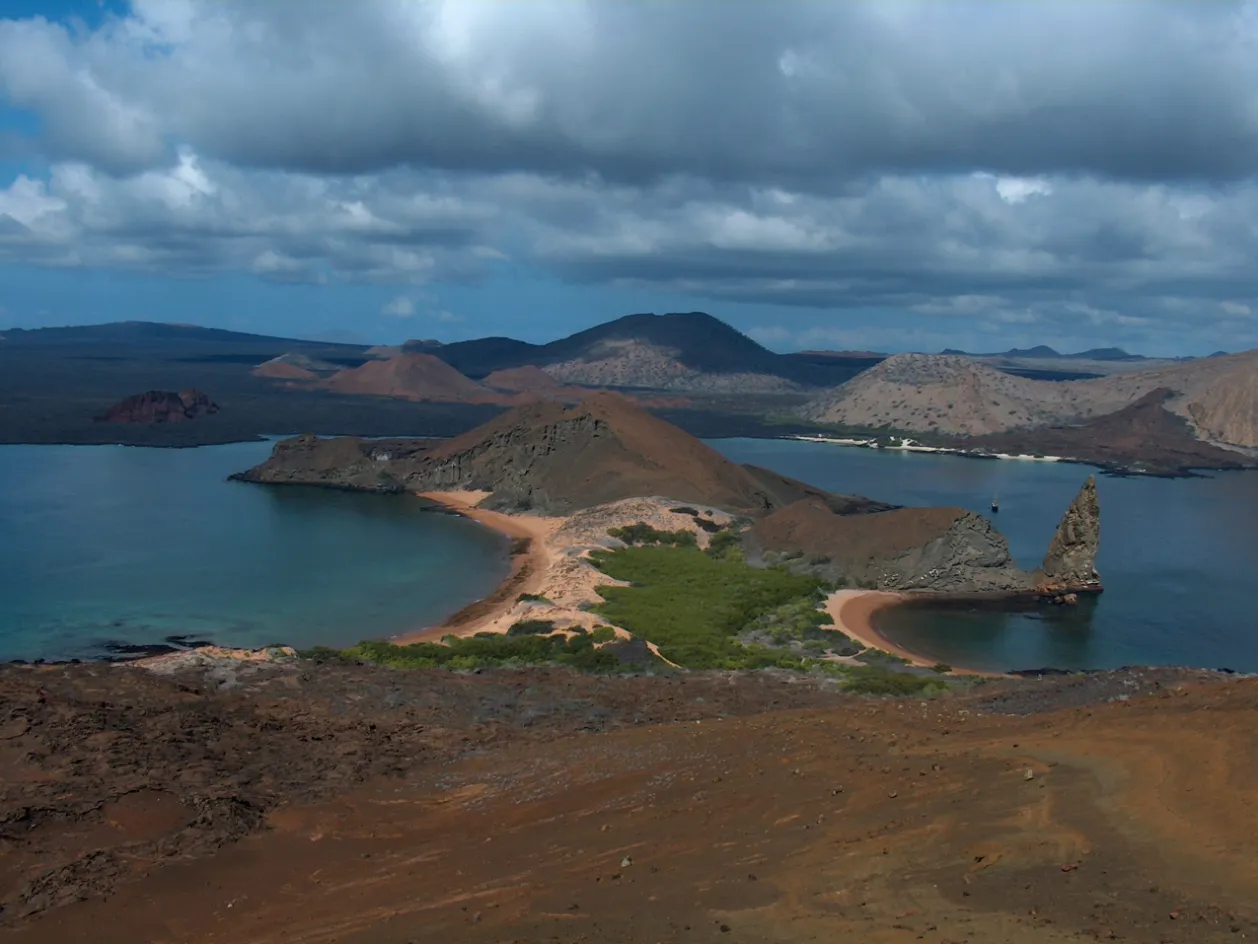
A landscape east of Santiago
Bartolomé lies in the Sullivan Bay setting east of Santiago Island. Its place within this sector makes it possible to frame the island as part of a landscape where volcanic relief and ocean are read together.
Essential information
- Geographic setting
- Sullivan Bay setting, east of Santiago Island
- Landscape
- Arid relief of volcanic origin
- Geological landmark
- Pinnacle Rock, a basaltic formation associated with submarine volcanic processes
- coordinates
- -0.285000, -90.548611
Traces of volcanic origin
Bartolomé’s appearance preserves signs of the volcanic processes that shaped the land. The islet’s aridity and exposed forms of relief help reveal an insular geology marked by the contrast among rock, coast, and ocean.
Pinnacle Rock belongs to this reading of the landscape. Institutional sources describe it as a structure connected to volcanic activity beneath the sea and made up of basalt layers, allowing its presence to be interpreted without turning it into a promise of access or a tourism experience.
Name and historical context
- The institutional source attributes the island’s name to Sir Bartholomew James Sulivan, a friend of Charles Darwin who served as principal surveyor and second lieutenant aboard HMS Beagle.
- This attribution remains part of the island’s historical framing and is not information about current visits, routes, or activities.
Continuity between coast and ocean
Bartolomé’s setting can be interpreted through the relationship between its exposed volcanic forms and the waters around it. That continuity makes it possible to describe the island as a landscape where land and marine dimensions belong to the same environmental reading.
The wildlife referenced by the sources contributes context to that interpretation without replacing responsible observation or asserting current presence. Public content therefore keeps its focus on the ecological value of the setting rather than making experience promises.
An insular geological identity
Bartolomé brings together arid relief, volcanic formation, and a coastal setting that contribute to the landscape diversity of Galápagos. Its editorial representation can foreground this geological identity and the need to treat the island environment with care.