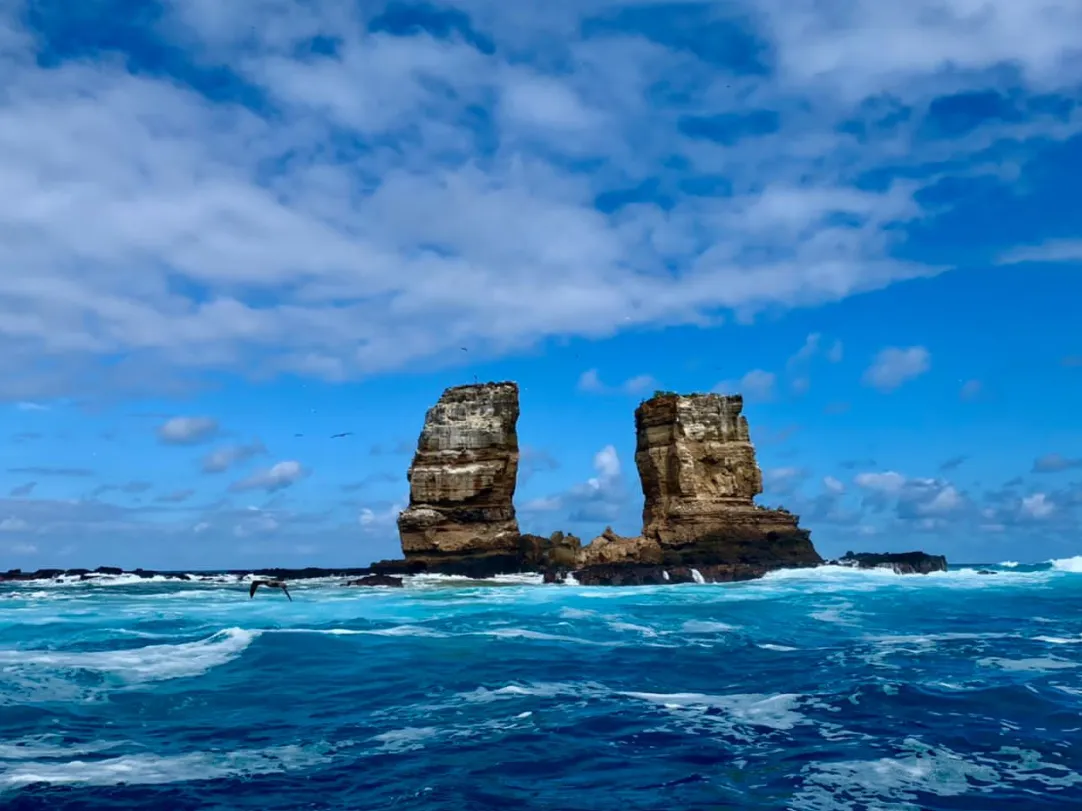
With no resident human population, the island and its surrounding waters invite an editorial reading centered on protecting a sensitive marine environment.
The northern edge of the archipelago
Darwin occupies a remote position at the northern edge of the Galápagos archipelago. Together with Wolf, it forms part of a northern sector associated with the Wolf-Darwin Ridge, where geographic isolation helps frame the importance of ocean processes and conservation.
Essential information
- Location
- Northern edge of the Galápagos archipelago
- Inhabited territory
- No resident human population
- Formation
- Exposed part of a largely submarine extinct volcano
- coordinates
- 1.677989, -92.003194
An emergent volcanic landscape
The island is the part above sea level of an extinct volcano whose greater extent remains beneath the ocean. This makes it possible to describe Darwin as a small land expression within a far broader marine geology.
The land area provides space for seabirds, while the surrounding ocean brings together ecological processes connected to the marine setting of northern Galápagos. The contrast between emerging land and ocean helps recognize the natural value of both environments.
Name and historical record
- The island bears Charles Darwin's name. The consulted institutional reference clarifies that the naturalist did not reach the island himself.
- Galápagos Conservancy records that year as the first known land visit.
Conservation in a remote sector
Darwin's conservation should be read together with that of its surrounding waters. The sources identify unregulated or illegal fishing as pressure on this environment, reinforcing the importance of protecting the marine setting.
The presence of seabirds on land and marine life in the surrounding ocean makes it possible to recognize the continuity between island and sea. Darwin is therefore presented as a remote and vulnerable landscape in northern Galápagos.
Landscape and marine context
Darwin brings together volcanic land and a marine setting that forms part of the identity of northern Galápagos. Its public representation can highlight geological context, seabirds, and the need for environmental care.