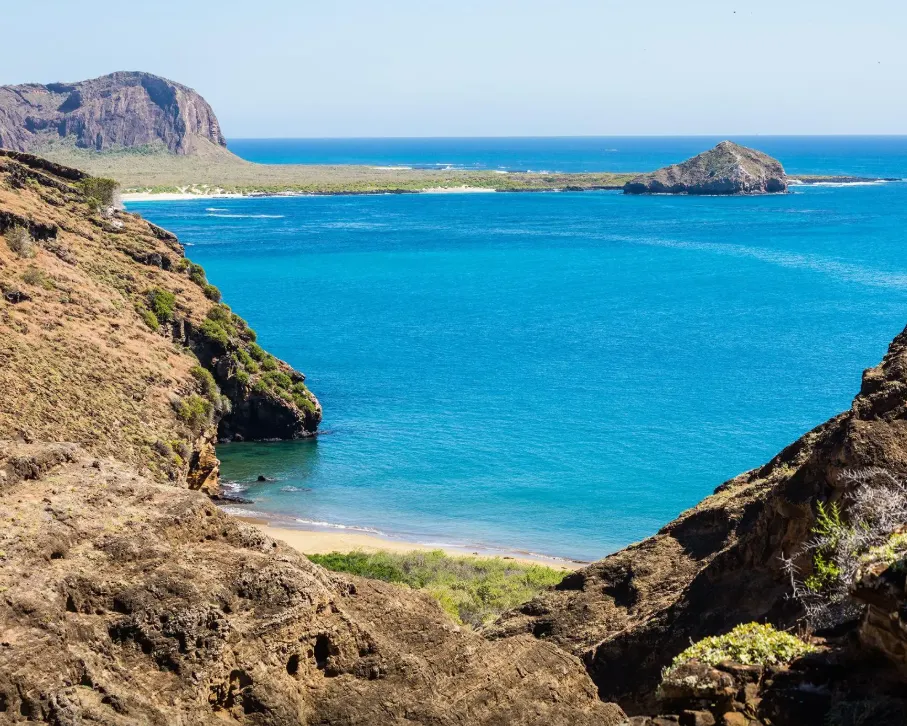
Its horseshoe-shaped caldera, linked to Darwin Bay, and the Lake Arcturus salt crater lake provide an editorial frame for a landscape where geology, sparse vegetation, and a seabird setting are connected without promises of access or sightings.
A caldera open to the sea
In the northeastern part of the archipelago, Genovesa traces a horseshoe shape associated with the collapse of one side of a shield-volcano caldera. The flooded crater forms Darwin Bay and is bordered by cliffs, linking volcanic relief with the sea.
Essential information
- Geographic setting
- Northeastern Galápagos archipelago
- Landscape form
- Horseshoe-shaped shield-volcano caldera
- Relief references
- Darwin Bay, Lake Arcturus, and cliffs
- Coordinates
- 0.316667, -89.950000
Darwin Bay and Lake Arcturus
Darwin Bay occupies the flooded crater associated with the caldera’s open edge. Its mention describes a geological relationship between relief and sea, without turning it into an access, landing, or activity statement.
Lake Arcturus is a saltwater crater lake in the island’s centre. Its sediment layers, younger than 6,000 years, provide a reference to Genovesa’s recent geological past.
A contrast in volcanic history
The geological history described for Genovesa holds a contrast: no historical eruptions are recorded, while young lava flows occur on the volcano’s flanks. Together with the lake’s sediments, these traces make it possible to recognize volcanic episodes of different ages without asserting a current volcanic status.
Seabirds as ecological context
Cliffs, volcanic relief, seabirds, and marine iguanas are presented as part of Genovesa’s ecological context. The sources also include references to red-footed boobies, frigatebirds, storm petrels, swallow-tailed gulls, finches, and the Galápagos short-eared owl; together, they help interpret the island’s natural setting.
Sparse vegetation and exposed forms
Sparse vegetation is part of the contrast between exposed volcanic surfaces and the coastal environment. Shrubs, mangroves, and palo santo add a restrained reading of the landscape.
A name shaped by history
- The institutional source relates the name Genovesa to the Italian city of Genoa in honour of Christopher Columbus.
- This reference remains part of the island’s historical framing and is not information about current visits, routes, or activities.
A volcanic landscape across time
The caldera, the lake’s sediments, and traces of young lava make it possible to read Genovesa as a landscape formed through different volcanic moments. This editorial perspective foregrounds the relationship among geology, sparse vegetation, and the surrounding marine setting.