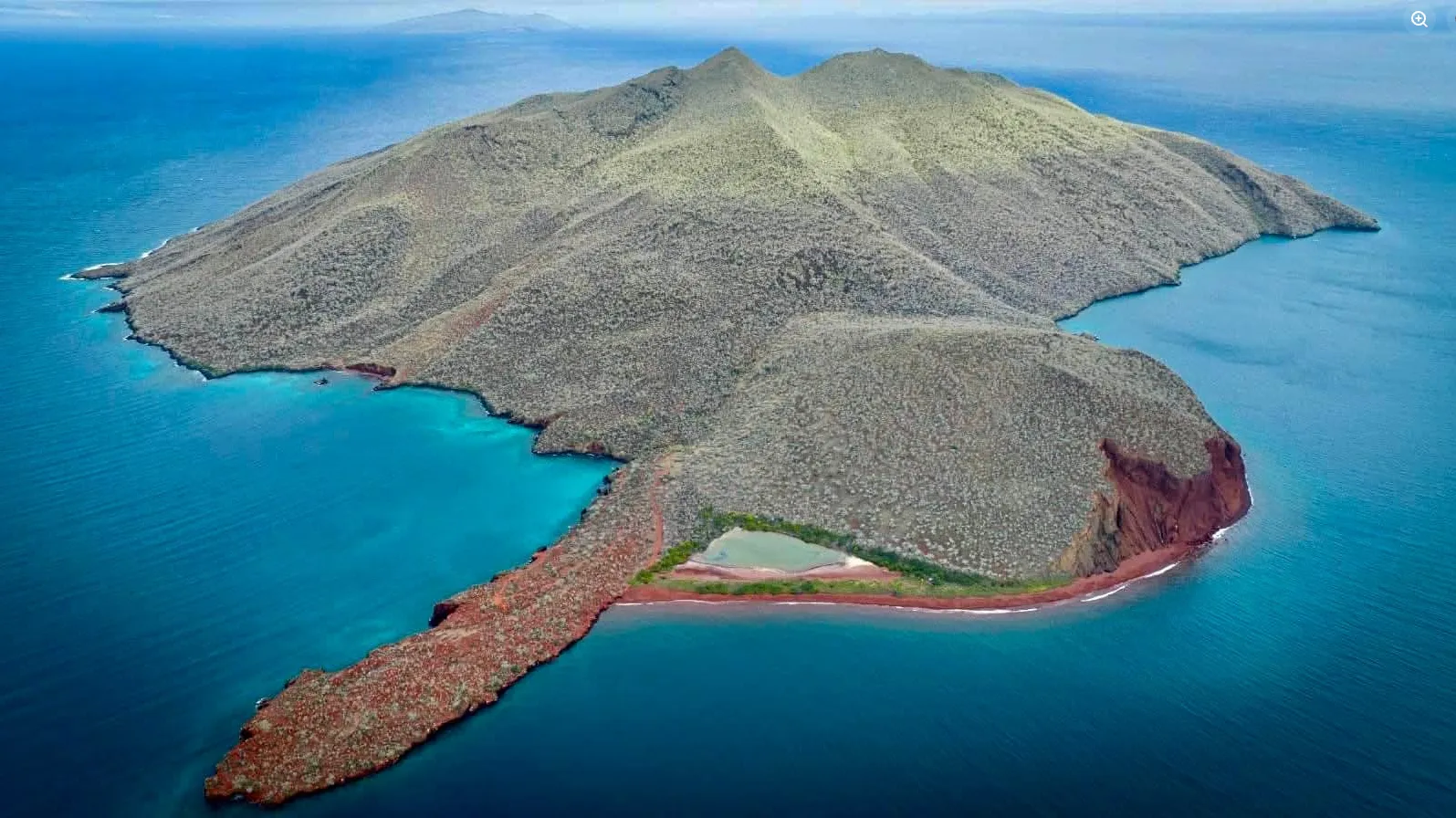
High iron levels in the lava contribute to its distinctive reddish colour, while Opuntia, palo santo, and shrub vegetation provide references for its terrestrial landscape.
An island in the central sector
Rábida Island lies in the central part of the Galápagos archipelago, south of Santiago. This location makes it possible to present the island within its insular setting without introducing distances, routes, or access guidance.
Essential information
- Location
- Central part of the archipelago, south of Santiago
- Area
- 4.9 km²
- Maximum altitude
- 367 m
- Distinctive colour
- Reddish because of high iron levels in the lava
- coordinates
- -0.413056°, -90.708889°
Iron-rich lava and reddish colour
High iron levels in the lava contribute to Rábida’s distinctive reddish colour. This feature connects the landscape’s colour with its volcanic diversity without reducing the island to an age, a timeline, or a crater count.
Arid relief and characteristic vegetation
Rábida is a relatively small, arid island with steep slopes and considerable volcanic diversity. This synthesis describes the relief in qualitative terms and does not constitute access or use information.
Opuntia, palo santo, and shrub vegetation are references for its terrestrial landscape. Together with the relief and reddish lava, they support a sober reading of an insular environment without presenting an exhaustive inventory or abundance claims.
Rábida and Jervis
- Rábida is the island’s official Ecuadorian name.
- Jervis is a historical name associated with Admiral John Jervis.
Wildlife in ecological context
Coastal birds, flamingos, marine iguanas, and sea lions form part of Rábida’s ecological context. This reference frames the relationship between land, coast, and sea without promising sightings, presenting counts, describing behaviours, or claiming current nesting.
Conservation with evidence limits
Conservation is presented here with evidence limits: the record recognizes only the natural context described by the preceding blocks and does not turn isolated background into claims about current conditions, measures, or outcomes.