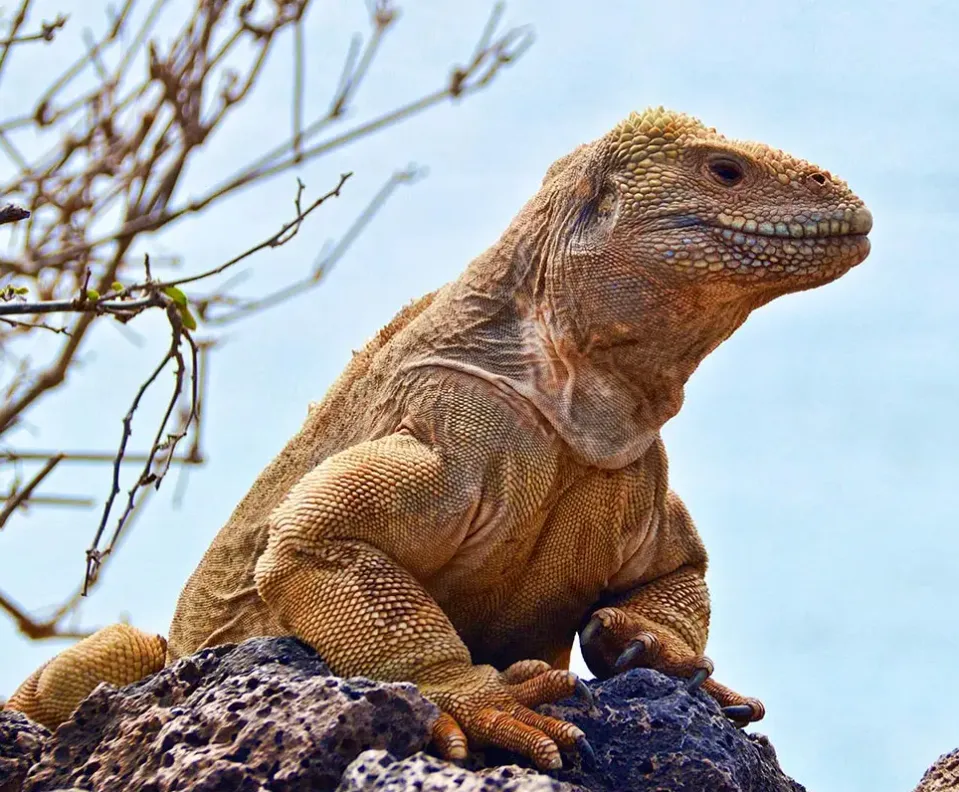
Its ecological context includes the Santa Fe land iguana (Conolophus pallidus) and the Santa Fe rice rat as endemic references.
An island in the central archipelago
Santa Fe Island lies in the central part of the Galápagos archipelago, southeast of Santa Cruz. This location makes it possible to present the island as a territory connected to the central island group without turning the record into travel guidance.
Essential information
- Location
- Central part of the archipelago, southeast of Santa Cruz
- Area
- 24 km²
- Maximum altitude
- 259 m
- Relief
- Old and relatively flat volcanic relief
- coordinates
- -0.82, -90.06
Old relief and characteristic vegetation
Santa Fe’s relief is an old, relatively flat volcanic form within the archipelago. This condition makes it possible to describe the island as one of the oldest in qualitative terms, without reducing its history to an age figure.
Large Opuntia echios and palo santo are among the island’s vegetation references. Together with the relief, they support a sober reading of an insular terrestrial landscape.
Historical names and endemic references
- Barrington is a historical name connected with Admiral Samuel Barrington.
- Conolophus pallidus is an endemic reference associated with the island.
- This species is referred to by its common name as an endemic reference associated with the island.
Cliff birds in ecological context
Cliff birds form part of Santa Fe’s ecological context. This reference frames the relationship between relief and wildlife without promising observations or presenting an exhaustive species list.
A historical reference to giant tortoises and restoration
Giant tortoises and restoration are retained here as a sober historical reference for the island setting. They do not describe a current operational status or outcomes of present actions.