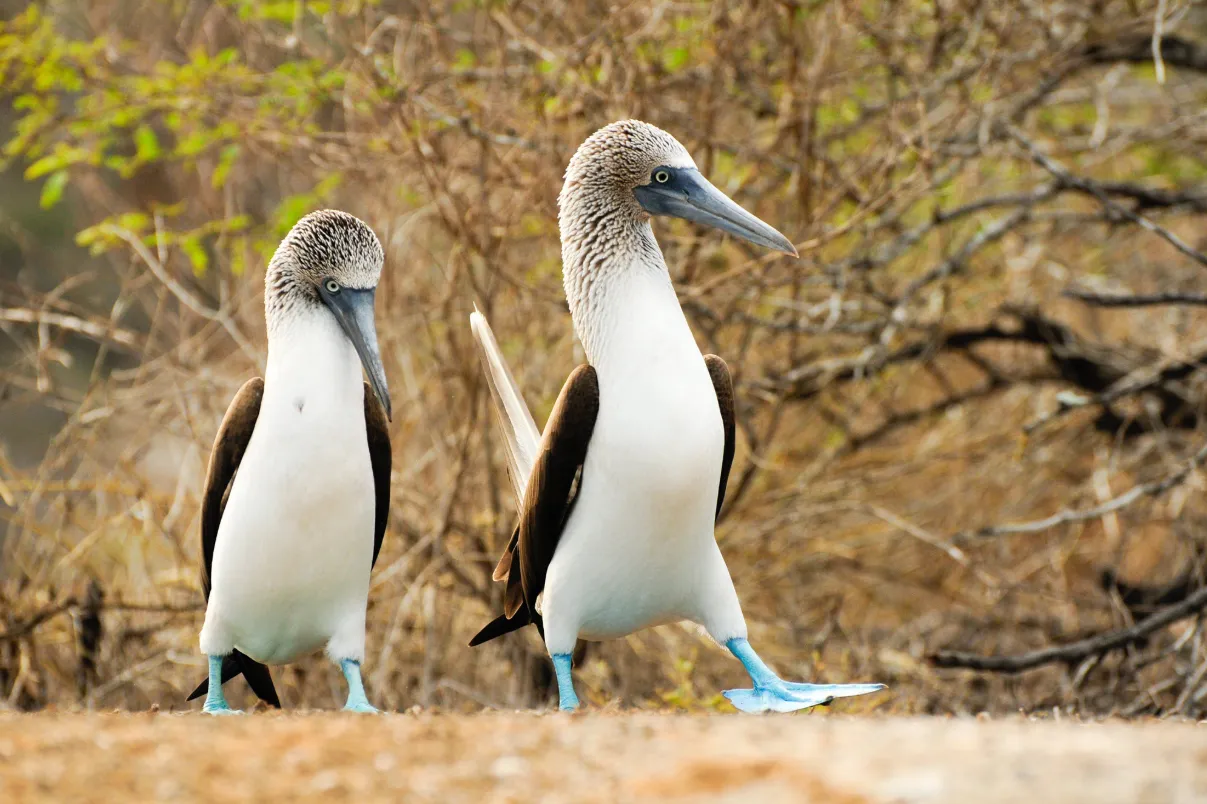
Its origin in uplifted submarine lava, low and bushy vegetation, and the history of land iguanas transferred from Baltra provide an editorial context for connecting geology, ecology, and conservation without presenting current operational information.
Flat relief within the archipelago
North Seymour Island is qualitatively associated with Baltra, also known as South Seymour, within the Galápagos archipelago. That relationship places the island in a shared insular sector without introducing distances, routes, or access guidance.
Essential information
- Island relationship
- Associated with Baltra or South Seymour
- Maximum altitude
- 28 m
- Vegetation
- Low and bushy
- coordinates
- -0.3915, -90.2841
Uplifted submarine lava and flat plateaus
North Seymour’s relief formed through the uplift of a submarine lava formation. Alongside Baltra and the northeastern part of Santa Cruz, these processes produced flat plateaus that distinguish this island landscape.
Low and bushy vegetation accompanies that terrain. Together, the relief and vegetation provide a sober reading of a low-elevation island environment without turning it into visitor information.
A name and a land-iguana history
- The island is named in honour of Lord Hugh Seymour.
- Baltra is also known as South Seymour and forms part of the island’s qualitative geographic context.
- Members of the Hancock Expeditions transferred approximately 70 land iguanas from Baltra to North Seymour. Land iguanas are not native to North Seymour.
La documentación institucional también registra que Seymour Norte fue una población fuente en una reintroducción histórica hacia Santiago. Esta referencia se presenta sólo como antecedente y no describe una operación, un censo ni un programa actual.
Un contexto ecológico terrestre y marino
Las fuentes institucionales asocian el entorno de Seymour Norte con piqueros de patas azules, gaviotas de cola bifurcada, charranes pardos y fragatas. También mencionan iguanas marinas, piqueros de Nazca y pelícanos como parte del contexto ecológico de la isla.
Estas referencias describen un conjunto ecológico relacionado con la tierra, la costa y el mar. No constituyen una garantía de observación, un conteo de fauna ni una descripción de condiciones de visita.
Conservación con límites de evidencia
La historia de las iguanas terrestres permite reconocer que el cuidado de un entorno insular puede relacionar geología, vegetación y fauna. Esta lectura editorial evita convertir antecedentes de manejo, censos o controles en afirmaciones sobre el estado actual de la isla.