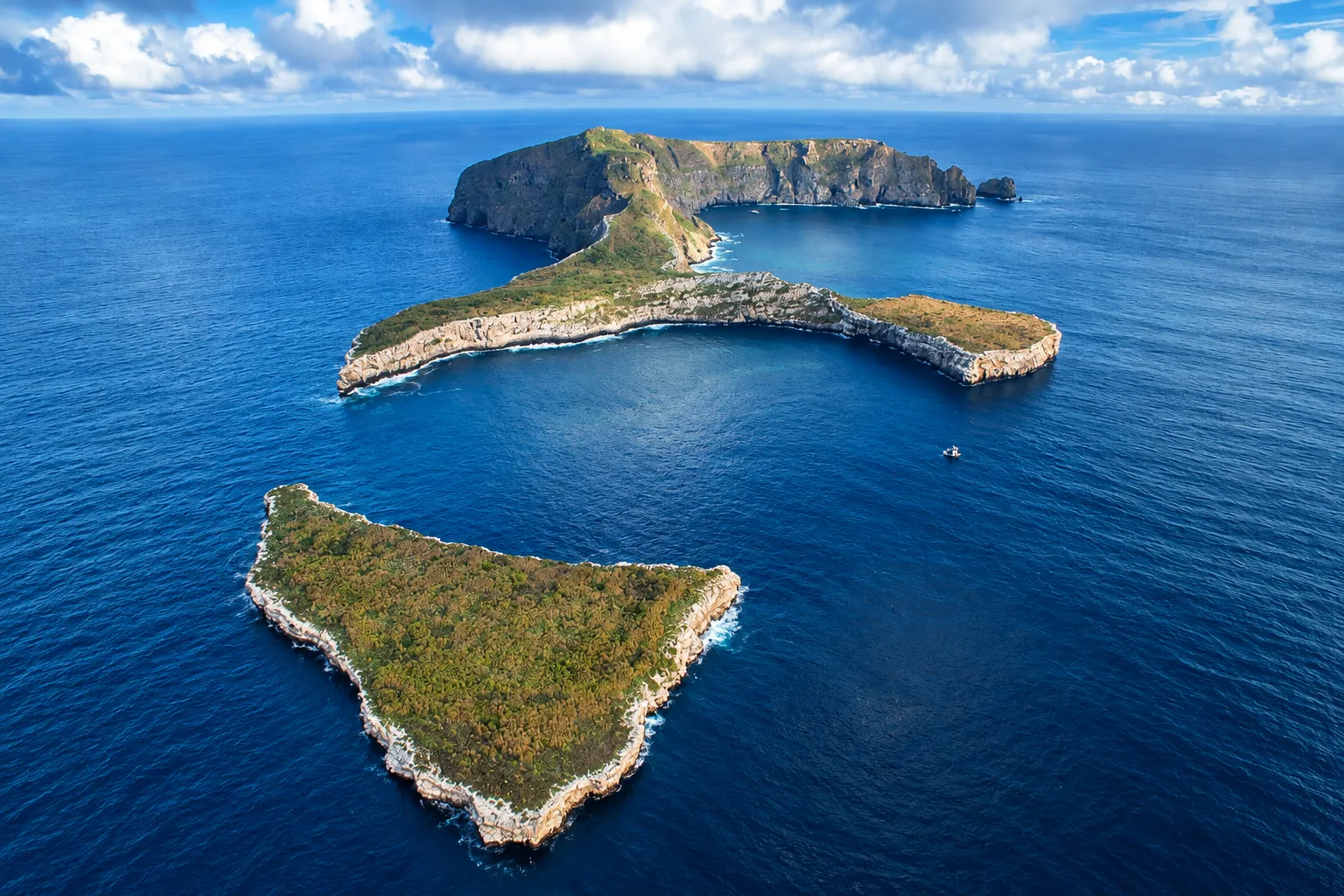
With no resident human population, it reaches a maximum altitude of 253 m and frames the relationship between volcanic relief, seabirds, and marine-environment conservation.
A remote island and reference data
Wolf Island lies in the northern sector of the Galápagos archipelago and is associated with the Wolf–Darwin Ridge. Its remoteness helps frame an editorial reading that connects emergent relief with a broader ocean setting.
Essential information
- Location
- Northern sector of the Galápagos archipelago
- Maximum altitude
- 253 m
- Inhabited territory
- No resident human population
- coordinates
- 1.38250, -91.81500
Emergent volcanic relief
Wolf is the part above sea level of an extinct volcano whose greater extent remains below the ocean. This relationship between land and submerged relief makes it possible to describe the island as part of a larger marine geology.
The emerging volcanic form should not be read in isolation: its editorial value also lies in the continuity between the land surface, the surrounding ocean, and ecological processes associated with northern Galápagos.
Name and historical record
- The island is named in honor of the German geologist Theodor Wolf, also associated with Wolf Volcano on Isabela.
- This historical name is documented as an earlier name for the island.
- Galápagos Conservancy records that year as the first known land visit.
The island–sea connection
The remote waters associated with Wolf form part of an ecological context in which the sources mention hammerhead sharks, Galápagos sharks, turtles, manta rays, and pelagic wildlife.
Seabirds on the island and the ecological richness attributed to the ocean setting make it possible to recognize continuity between land and sea. That relationship positions Wolf as a landscape where emerging land and the marine setting belong to the same ecological reading.
Conservation of a remote environment
The sources identify unregulated or illegal fishing pressure in these remote waters. Marine-environment protection is therefore part of Wolf’s conservation context.