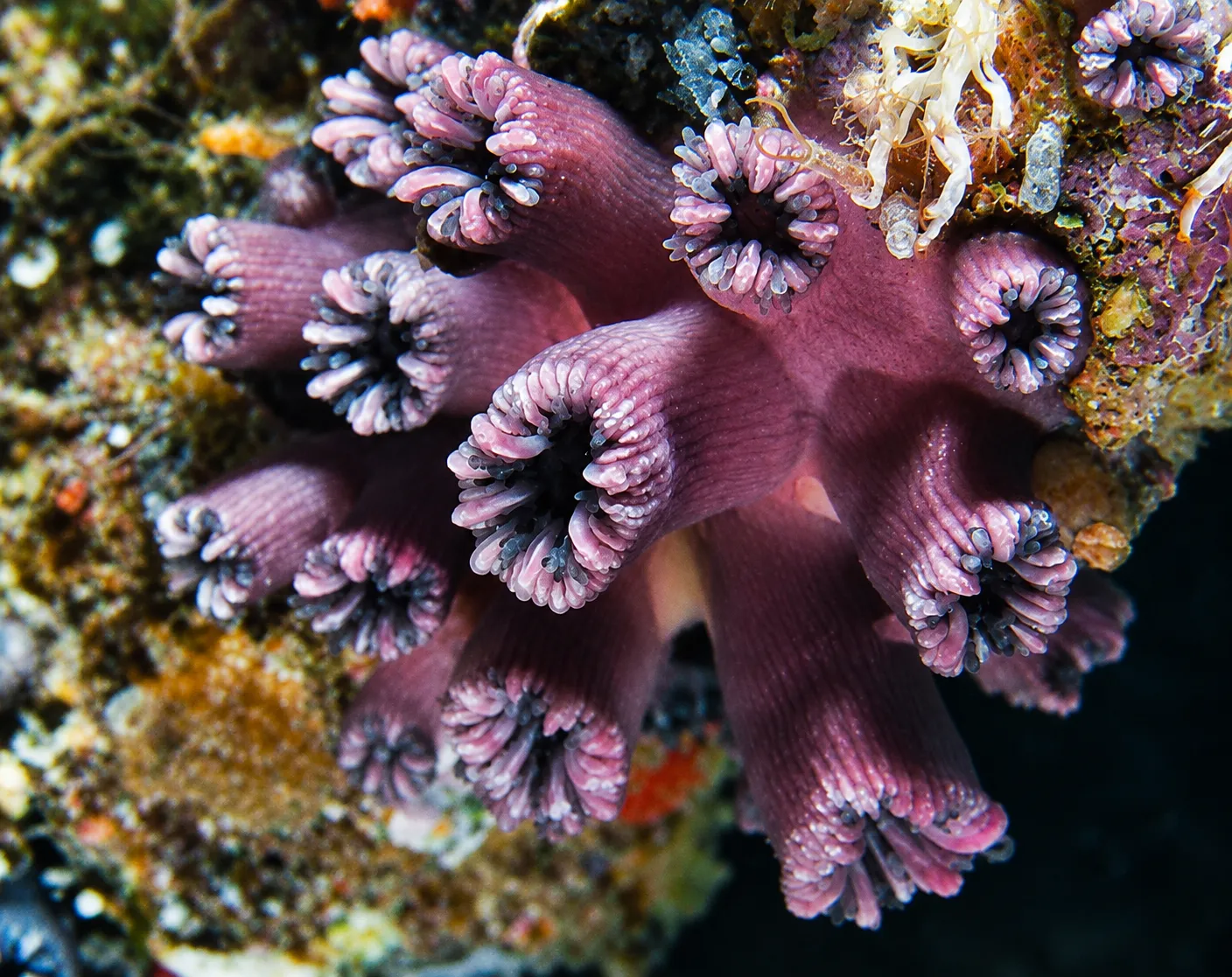
Some species disappear with a bang, and others fade away quietly, until someone asks about them and discovers no one has seen them for 25 years. That is the story of Galápagos' solitary coral (Rhizopsammia wellingtoni): a small, endemic coral of the archipelago that went a quarter of a century without records, to the point of being feared lost forever.
More than 250 live colonies
In 2024, scientific expeditions by the Charles Darwin Foundation and the Galápagos National Park Directorate, in collaboration with the California Academy of Sciences, found it again. It turned up in underwater caves and vertical walls of Isabela and Fernandina, where researchers identified more than 250 live colonies.
Finding a species that had gone decades without records — and finding it in numbers — is an encouraging signal about the resilience of the archipelago's marine ecosystems. It is also proof of why long-term monitoring programs matter: without them, the coral would still be there, but no one would know.
An ocean thermometer
The solitary coral is no ordinary coral: it is highly sensitive to climate change, and its presence can act as an early indicator of changes in ocean temperature. That it reappears just as seas grow warmer provides key evidence for conservation and for the adaptive management of Galápagos' marine ecosystems.
What the finding is good for
The expedition's data already feed concrete processes: the archipelago's zoning, the update of the IUCN Red List, and the design of national climate-change adaptation strategies. It is an example of what collaborative science can achieve when different institutions row together.
The Galápagos National Park, part of the Ministry of Environment, Water and Ecological Transition, works hand in hand with its scientific partners to protect the biodiversity of this Natural World Heritage Site. Stories like the solitary coral's are a reminder of why that work never stops: there are still things worth finding under the water.