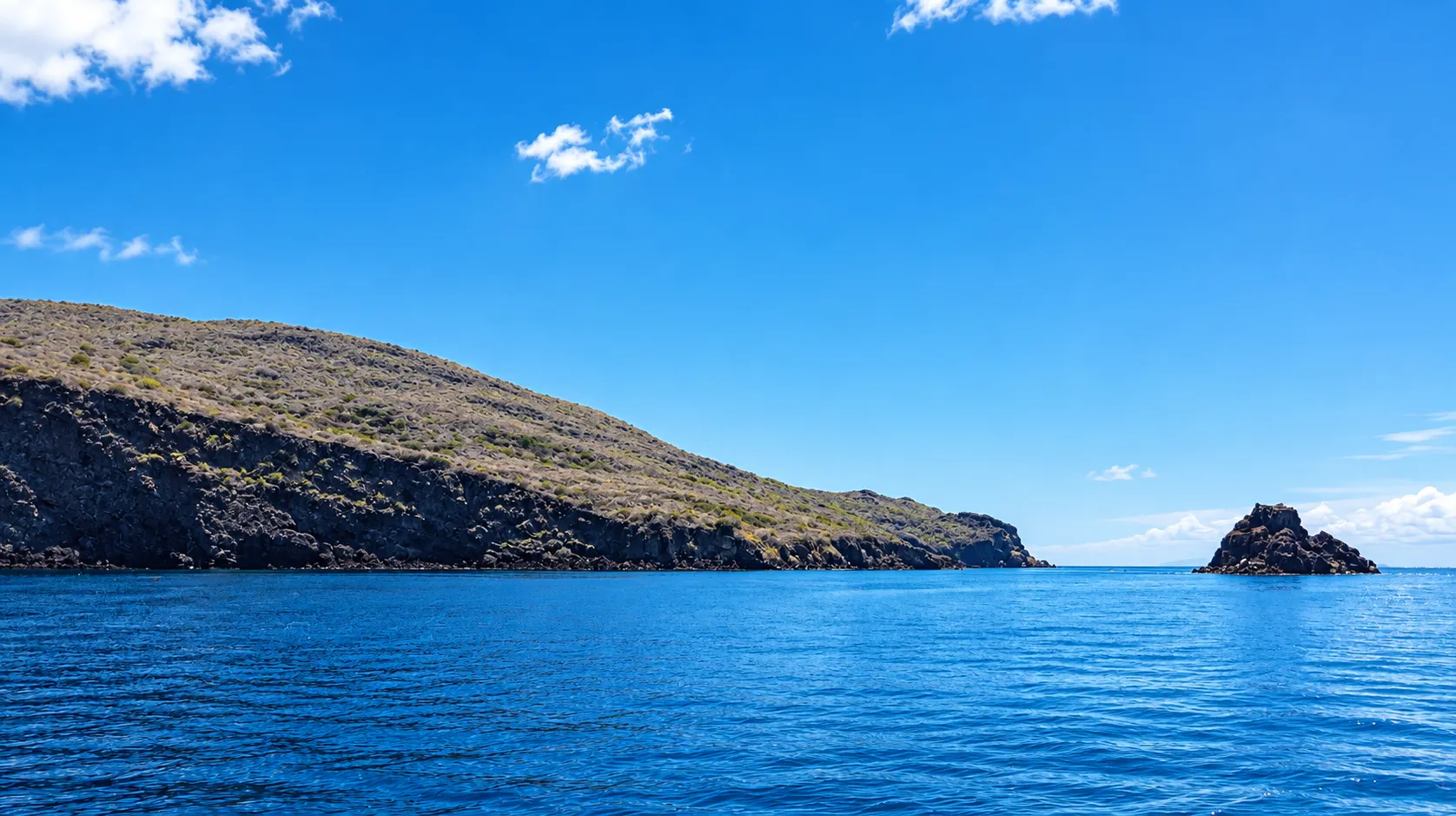
Surrounded by deep waters, it has no human population and no approved visitor sites; its elevated interior catches the garúa and supports the Daisy Tree forest in the humid zone, and its conservation history is shaped by the giant tortoise programme begun in 1965.
A central island, isolated by deep waters
Pinzón Island lies in the central archipelago of Galápagos, west of Santa Cruz and between that island and Isabela. The deep waters surrounding it kept it isolated from the rest of the islands for millennia, a condition that shaped its wildlife and explains both its solitary character and the steepness of its coasts.
Essential information
- Location
- Central archipelago, west of Santa Cruz
- Area
- 18 km²
- Maximum altitude
- 458 m
- Human population
- 0
- English name
- Duncan
- Relief
- Collapsed volcano with coastal cliffs over 100 m
The island's names
The island's Spanish name honours the Pinzón brothers, Martín Alonso Pinzón and Vicente Yáñez Pinzón, captains of La Pinta and La Niña, the two caravels that sailed alongside the Santa María on Christopher Columbus's first voyage. Its English name, Duncan, recalls Admiral Adam Duncan. Neither name has any connection with the archipelago's famous group of finches: the island is not named after those birds.
The garúa and the highland vegetation
Although much of the island shows rocks and low, thorny vegetation, its interior rises above most of the other arid islands of the archipelago and catches the garúa, the dense fog that bathes the elevated zones during the dry season. That sustained moisture allows numerous epiphytes to thrive, plants that grow on others without depending on their nutrients, including ferns and bromeliads that establish themselves even on Opuntia cacti.
In the humid zone grows the Daisy Tree forest, the characteristic formation of the Scalesia genus that distinguishes the highlands of Pinzón within the archipelago's landscape.
Wildlife in ecological context
Among the wildlife that may be found on Pinzón are Darwin's finches, Galápagos doves, vermilion flycatchers, Galápagos snakes, Galápagos hawks, lava lizards, sea lions, and marine iguanas. This reference has the character of ecological context: it implies no counts, guarantees no sightings, and does not exhaust the island's species inventory.
The island also hosts two endemic forms of its own: the Pinzón lava lizard and the Pinzón giant tortoise, distinct lineages that its prolonged isolation separated from the rest of the archipelago.
The giant tortoise and conservation as a documented process
The natural reproduction of the Pinzón giant tortoise was practically interrupted for much of the last century by the predation of black rats, an introduced species. In response, a conservation programme was started that collects eggs from natural nests to incubate them at the Fausto Llerena centre, on Santa Cruz, and that has repatriated tortoises raised under human care across successive campaigns. The programme is documented in the historical milestones that close this record, and its results are presented as a recorded process, not as a current status.
An island with no approved visitor sites
Pinzón has no approved visitor sites, either on land or at sea, and access requires a permit granted by the Ecuadorian authorities. For that reason, landing is reserved in practice for scientists and researchers who justify their entry. The surrounding deep waters are used by local fishers, and its coasts, ringed by cliffs over a hundred metres tall around a collapsed volcano, reinforce that isolation.
History
The following milestones summarize the documented history of the island and of its conservation programme.
- Black rats reach the island and almost completely interrupt the natural reproduction of the giant tortoise for much of the following century.
- An expedition of the California Academy of Sciences collects Pinzón tortoises for its scientific collections.
- Two aircraft from the American base at Baltra crash on the island; their wreckage is still preserved there.
- The first eggs are collected from natural tortoise nests and the breeding programme begins, with incubation at the Fausto Llerena centre, on Santa Cruz.
- The first tortoises raised at the breeding centre are repatriated.
- A first attempt to eradicate the black rats fails; after several months without sightings, the rodents reappear.
- A campaign of poisoned bait dropped from a helicopter is carried out to eliminate the rats from the island.
- A tortoise study records, for the first time in more than a century, a considerable number of hatchlings born in situ, evidence of natural reproduction on the island.