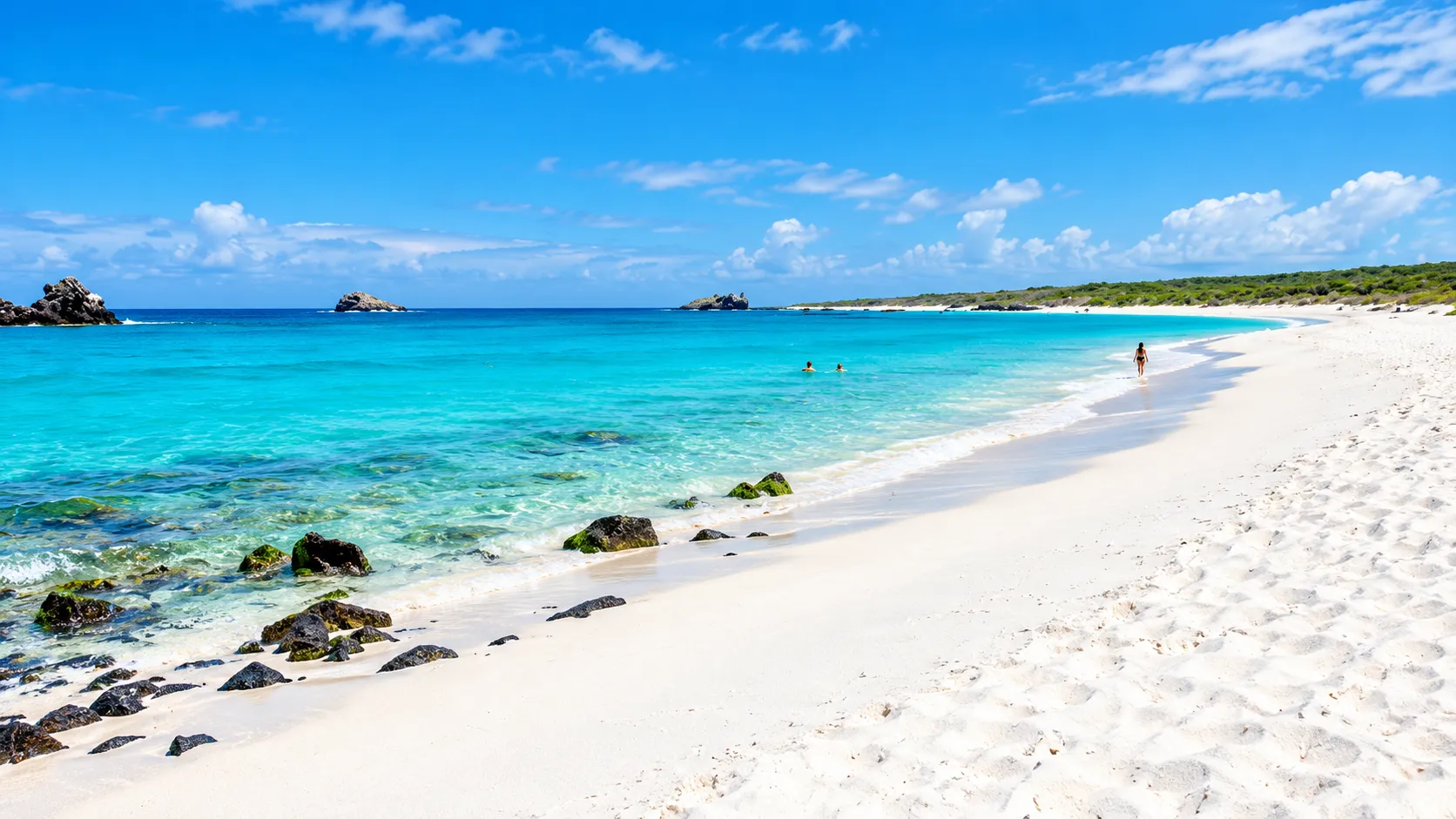
The visit arrives by sea, with a wet landing directly on the sand, and runs without inland trails: the day stays on the beach, among sea lions resting in the sun, a curious mockingbird that approaches without fear, and finches working the vegetation along the shore. On the rocks, marine iguanas bask and Sally Lightfoot crabs move about, and in the clear water green turtles swim. Off the sand, a small semi-submerged islet appears, a tuff cone whose surroundings are the usual setting for snorkelling at the site. It is, above all, a place to stay: to look, to walk barefoot, and to share, with respect, the beach the sea lions chose for resting.
A white beach on the coast of Española
Gardner Bay opens onto the coast of Española island, in the far southeast of the archipelago, one of the oldest islands in Galápagos. It is an extensive stretch of white sand born of the sea: its grains come from coral and shells that time ground and polished until they turned soft. Behind lies the low vegetation of the arid zone; in front, turquoise water that turns clearer as it approaches the shore.
The landing on the sand
The visit arrives by sea and lands directly on the beach: there is no dock, and the landing is wet, with feet touching the water and, a few steps later, the sand. That simple arrival defines the character of the site. Without inland trails, the visit stays on the beach, with the sea on one side and the vegetation on the other, and the landscape is walked on foot and unhurried.
The beach of the sea lions
The beach's hosts are the sea lions, Zalophus wollebaeki, the Galápagos sea lion. Lying on the sand, in groups that touch and overlap, they spend most of the day resting in the sun: a young one stretches, an adult turns over to find the shade, another moves with an awkward gait towards the water. They are numerous and so at ease in this place that sharing the beach with them is part of the visit: walking around them with distance, not interrupting their rest, leaving the ways to the water clear, and looking without approaching, so that the colony carries on with its own day and the beach keeps the calm atmosphere that sets it apart.
Essential information
- Identity
- Gardner Bay, visitor site on the coast of Española island
- Location
- Coast of Española island, in the far southeast of the archipelago
- Beach and water
- Extensive stretch of white sand of coral and shell origin, with shallow turquoise water by the shore
- Landing
- Wet landing on the sand, without a dock
- Trails
- No inland trails: the visit stays on the sand
- Sea lion
- Galápagos sea lion (Zalophus wollebaeki), resting in groups on the beach
- Mockingbird
- Española mockingbird, a curious bird that may approach visitors
- Shore birds
- Three species of Darwin finches, the Galápagos hawk, blue-footed boobies, and shorebirds such as the turnstone, as a possibility
- Iguanas and crabs
- Marine iguanas (Amblyrhynchus cristatus) and Sally Lightfoot crabs on the rocks, with lava lizards
- Green turtle
- Green turtle (Chelonia mydas agassizii) in the shallow water; the bay is a nesting area for the species
- Islet
- Small semi-submerged islet, a tuff cone off the beach
- Activities
- Snorkelling by the islet, kayaking, and swimming subject to sea conditions, within the protected-area guidelines
- Conduct
- Stay on the sand, respect resting sea lions and nesting zones, keep distance, and do not feed or touch wildlife
The curious mockingbird
Among the shore vegetation lives the Española mockingbird, a bird unafraid of people. It often approaches visitors with a curiosity that surprises: it walks across the sand, inspects backpacks and towels, and watches everything happening around it. That confidence has a limit the visit must hold: distance from wildlife is kept just the same with a bird that approaches on its own, and it is neither fed nor touched.
Finches and birds of the coast
In the low vegetation move the Darwin finches, represented at the bay by three species told apart by beak size and habits. On the shoreline rocks, marine iguanas, Amblyrhynchus cristatus, the species endemic to Galápagos, bask in the sun, and Sally Lightfoot crabs move about in their bright colours, while lava lizards dart between the stones.
The sky and the water add scenes of their own: blue-footed boobies plunging close to the coast, shorebirds such as the turnstone working the waterline and, now and then, the silhouette of the Galápagos hawk crossing the sky. None of these appearances is assured: each visit shows a different combination.
The turquoise water and the turtles
The water along the beach is shallow and a clear turquoise: over the sandy bottom, every passing shadow can be told apart. Those shadows are often green turtles, Chelonia mydas agassizii, the turtle of Galápagos, rising to breathe and diving again, or drifting with the bay's gentle current.
The bay is also a nesting area for the green turtle: females come out of the sea to bury their eggs in the sand. That is why the beach is walked with attention, watching each step and respecting the zones where nests may be, without marking the sand or moving away from the open setting of the visit.
Snorkelling by the islet
When sea conditions allow, the bay's water invites swimming and snorkelling, and the site's snorkelling concentrates off the beach: around the small semi-submerged islet. Swimming and snorkelling are possibilities subject to the state of the sea; no condition is guaranteed, and caution accompanies every decision.
The islet is a semi-submerged tuff cone, an eroded remnant of the island's volcanism that shows as a low silhouette off the sand. Underwater, its walls and the surrounding rocks shelter reef fish, rays, and white-tip reef sharks, which travel the edge between the pale bottom and the deep blue. It is the other half of Gardner Bay: the one seen only from the water.
Kayak and the day on the beach
Among the activities the site may offer is kayaking, always within the protected-area guidelines and subject to sea conditions. But the heart of the visit needs no gear or hurry: it is the day on the sand, with time to walk the shoreline, watch the sea lions, be visited by the mockingbird, and return to the water when the sun grows strong. Gardner Bay is enjoyed slowly.
A visit inside the protected area
Gardner Bay is part of the Galápagos protected area. Staying on the sand, not entering the vegetation, respecting resting sea lions and nesting zones, keeping distance from all wildlife, not feeding or touching the animals, not touching or pulling up plants, and neither taking sand nor leaving waste is the expected conduct, so that the place keeps the life that sets it apart.
Frequently asked questions
- A visitor site on the coast of Española island, with an extensive white-sand beach, shallow turquoise water, and a small semi-submerged islet off the shore.
- By sea, with a wet landing directly on the sand; there is no dock.
- No. The visit stays on the beach, without inland trails.
- As a possibility: sea lions, the curious Española mockingbird, three species of Darwin finches, marine iguanas, Sally Lightfoot crabs, lava lizards, blue-footed boobies, shorebirds such as the turnstone, the Galápagos hawk, and green turtles in the water.
- When sea conditions allow; swimming and snorkelling are possibilities subject to the state of the sea, with no safety guarantee.
- A semi-submerged tuff cone whose surroundings are the usual setting for snorkelling; there, white-tip reef sharks, rays, and reef fish may appear, always as a possibility.
- It is a curious bird unafraid of people; even when it approaches on its own, distance is kept, and it is neither fed nor touched.
- By staying on the sand, respecting resting sea lions and nesting zones, keeping distance, and not feeding or touching wildlife.