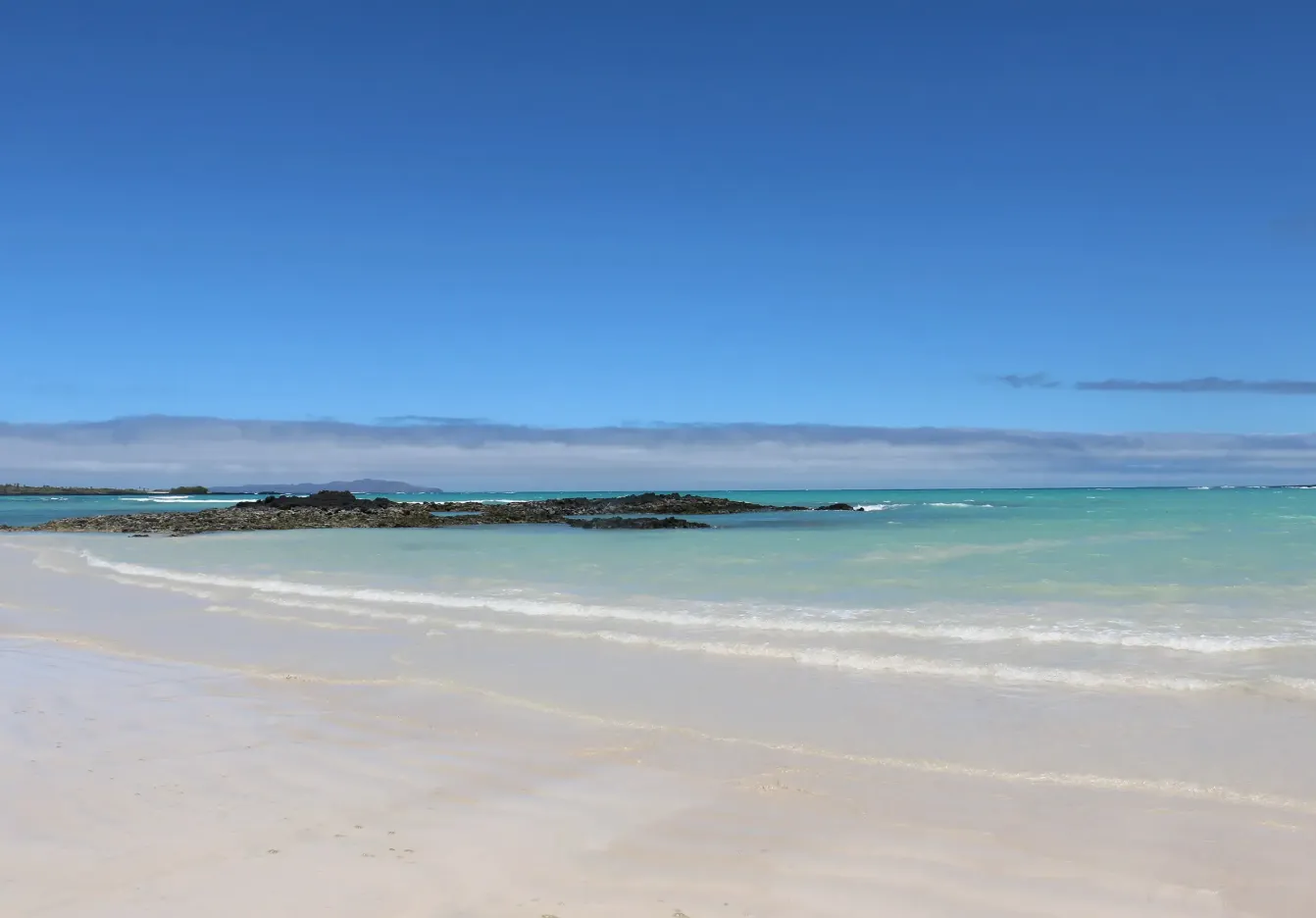
It is reached from the rural highlands passing through the Bellavista area and, from the car park, along a pedestrian trail that crosses the arid zone, among Opuntia cacti, palo santo, and poison apple trees, with Galápagos finches and lava lizards as possible companions along the way; a maritime access route is also mentioned. Behind the beach lies a mangrove-fringed lagoon where flamingos and wading birds such as herons, stilts, oystercatchers, and white-cheeked pintails may appear, always as a possibility and never as a guarantee. Along the shore and in the sea, marine iguanas, sea lions, Sally Lightfoot crabs and ghost crabs, blue-footed boobies, frigatebirds, sea turtles, and reef fish may appear. Swimming, snorkelling, kayaking, birdwatching, and walking are possible activities of the site; camping belongs solely to the protected-area rule and is possible only with Galápagos National Park authorisation. The beach is also used by the local community as a recreation site, without this entry asserting anything about how many people visit it. Sand colour, beach length, lagoon water type, times, distances, prices, schedules, climate data, guide requirements, and visitor numbers present documentary divergences, are not resolved by inference, and are not asserted in this entry. The site's description rests on material provided without URLs, consistent across versions, and pending editorial verification.
A beach set apart to the east of Puerto Ayora
El Garrapatero is a beach on the east coast of Santa Cruz, in the island's rural area. It lies far from Puerto Ayora and away from any settlement, and that relative isolation is part of its character: the beach opens onto a wide bay and is fringed by mangroves, with the island's arid ground at its back.
The material reviewed agrees in describing it as a natural site away from the populated centres, and also mentions that it is used by the local community as a recreation place. This entry records that community use as it appears, without asserting anything about how many people visit the beach or when.
The way through Bellavista and the arid-zone trail
Land access is described in general terms: from Puerto Ayora, a route through the rural highlands of Santa Cruz that passes through the Bellavista area. The material reviewed mentions taxi, bicycle, and bus as possible means for that journey, without this entry fixing times, distances, or costs.
From the car park, a pedestrian trail crosses the arid zone down to the shore. The way passes among Opuntia cacti, palo santo, and poison apple trees, and the material reviewed mentions Galápagos finches and lava lizards as possible companions along the way, always as a possibility and never as a guarantee.
Essential information
- Identity
- El Garrapatero, a beach on the east coast of Santa Cruz
- General location
- Rural area of Santa Cruz, to the east of Puerto Ayora, in the Bellavista area
- Site type
- Remote beach, fringed by mangroves, opening onto a wide bay
- Access trail
- Pedestrian trail from the car park to the beach, across the arid zone
- Surrounding vegetation
- Opuntia cacti, palo santo, and poison apple trees in the arid zone; mangroves along the beach's edge
- Lagoon
- Lagoon behind the beach, fringed by mangroves
- Lagoon birds
- Flamingos and wading birds such as herons, stilts, oystercatchers, and white-cheeked pintails, as a possibility
- Beach and sea fauna
- Marine iguanas, sea lions, Sally Lightfoot crabs and ghost crabs, blue-footed boobies, frigatebirds, sea turtles, and reef fish, as a possibility
- Possible activities
- Swimming, snorkelling, kayaking, birdwatching, and walking
- Camping
- Only with Galápagos National Park authorisation
- Community use
- Recreation site also used by the local community
- General access
- Overland route from Puerto Ayora through the rural area passing Bellavista, and also by sea, according to the material reviewed
- Level of documentary support
- Material provided without URLs, consistent across versions, and pending editorial verification
The beach and the mangroves
The beach opens onto a wide bay and is fringed by mangroves, part of the immediate landscape together with the arid-zone vegetation that precedes it. That meeting of sea, sand, mangrove, and dry ground gives the place a continuous transition between environments.
On the colour of the sand and the length of the beach, the material reviewed contradicts itself: it describes the sand in different ways in different passages and offers lengths incompatible with each other. This entry publishes neither a colour nor a measure, and does not choose between the versions.
The lagoon and its birds
Behind the sand lies a lagoon fringed by mangroves, which the material reviewed describes as one of the site's features. The lagoon's water type is not asserted in this entry, because the material's versions contradict each other.
The lagoon may receive flamingos, and the material also mentions wading birds such as herons, stilts, oystercatchers, and white-cheeked pintails. None of those presences is guaranteed: they are possibilities of the site, and what is actually seen depends on each visit.
Shore and marine life, always as a possibility
Along the shore, marine iguanas, sea lions, Sally Lightfoot crabs, and ghost crabs may appear; in the air and over the water, blue-footed boobies and frigatebirds; in the water, sea turtles and reef fish. This entry promises no sightings, describes no behaviours, and does not present wildlife activity as a permanent state of the place.
The Galápagos penguin deserves a separate mention: a single version of the material names it, and that same mention describes it as uncommon. For that reason this entry does not present it as an expected sighting.
Activities and protected-area rules
Swimming, snorkelling, kayaking, birdwatching, and walking along the beach are among the activities the material reviewed describes as possible at the site. This entry does not claim that swimming is safe and does not guarantee sea conditions at any given moment.
Camping belongs solely to the protected-area rule: it is possible only with Galápagos National Park authorisation. It is not a service of the site nor a travel recommendation, and this entry adds no conditions or procedures the material does not allow asserting.
Access, in general terms
Taken together, access is described as follows: an overland route from Puerto Ayora crossing the rural area of Santa Cruz past Bellavista, and a pedestrian trail from the car park to the beach; the material reviewed also mentions a route by sea. There is no single itinerary and no schedule this entry can fix.
This entry fixes no times, distances, prices, schedules, or operators, because the material reviewed offers values incompatible with each other on all those points, and it proposes no route combining the beach with other sites.
Frequently asked questions
- A remote beach on the east coast of Santa Cruz, fringed by mangroves, with a lagoon behind the sand and an access trail that crosses the arid zone.
- They may appear in the lagoon, together with wading birds such as herons, stilts, oystercatchers, and white-cheeked pintails, always as a possibility and never as a guarantee.
- Along the shore and in the sea, marine iguanas, sea lions, Sally Lightfoot crabs and ghost crabs, blue-footed boobies, frigatebirds, sea turtles, and reef fish may appear. No presence is guaranteed and none is described by its behaviour.
- These are possible activities of the site, but this entry does not claim that swimming is safe and does not guarantee sea conditions.
- Only with Galápagos National Park authorisation, as a protected-area rule. It is not a service of the site.
- Overland from Puerto Ayora, crossing the rural area past Bellavista, and then on foot from the car park; the material reviewed also mentions a route by sea. This entry fixes no times, distances, or prices.