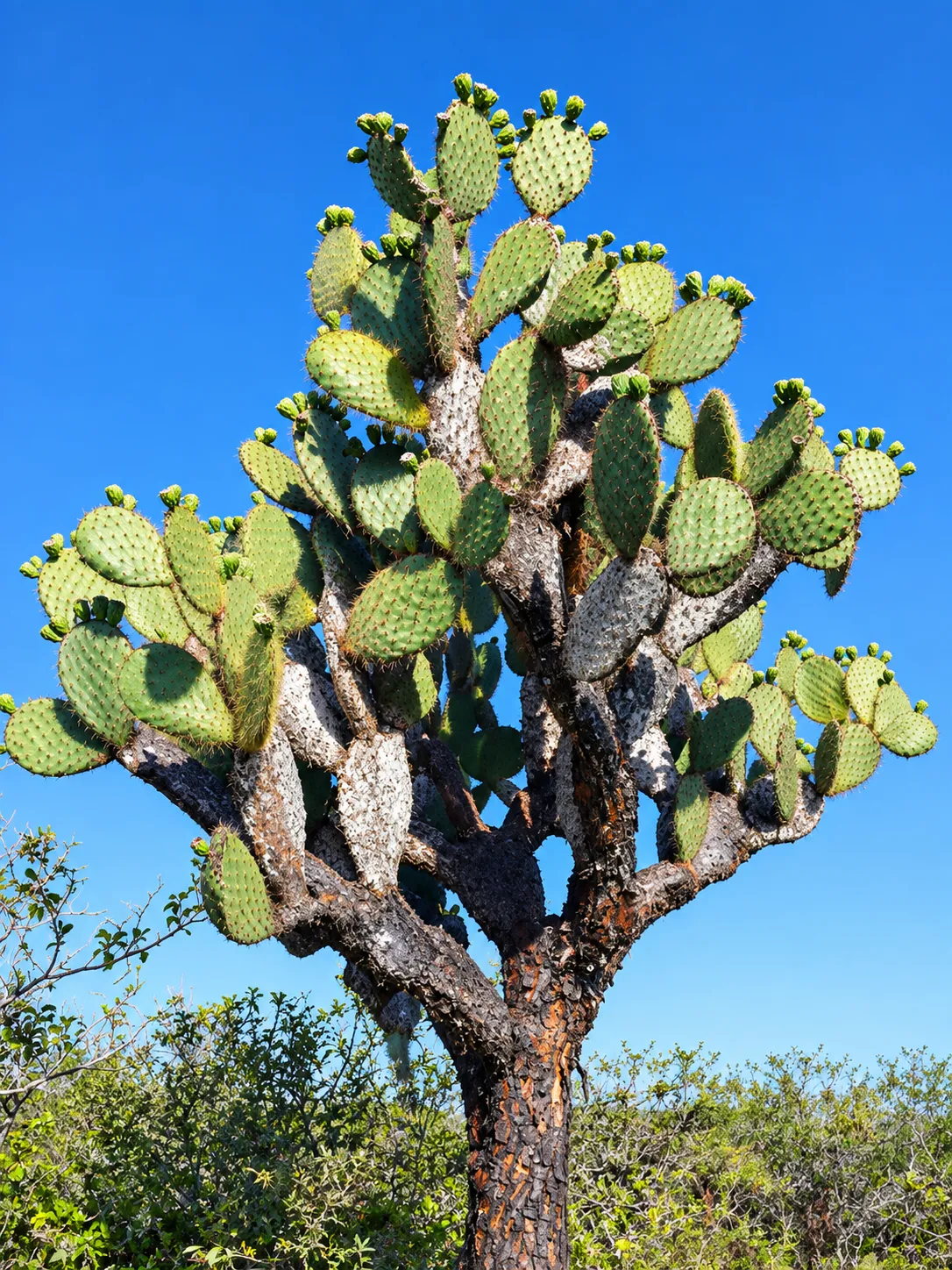
Galápagos hosts endemic prickly-pear cactus species of the Opuntia genus, and the surrounding plants include palo santo, muyuyo, button mangrove, and manzanillo, a tree with toxic sap whose leaves and fruit must not be touched. The site is usually covered on foot, by a trail that descends from the island's southern agricultural area towards the coast. The site meets the shore at a beach the material cites as Playa de Veinte Varas, where snorkelling appears as a possibility, and with areas that can flood seasonally, a feature of the landscape rather than a fixed condition. Wildlife is presented as a possibility and never as a guarantee: the San Cristóbal mockingbird (Mimus melanotis), a bird found on this island, and Darwin's finches are among the possible presences, and walking and botanical interpretation are the activities with which the place is explored.
A landscape of giant cacti in the arid south of San Cristóbal
Opuntia Garden is a coastal site in the arid south of San Cristóbal island. The place's name points to its most visible feature: giant cacti of the Opuntia genus that the material describes as the leading feature of the landscape. Galápagos hosts endemic prickly-pear cactus species, and their presence is part of the place's character, although it cannot be asserted which one occurs at the site.
The usual access on foot
The site is usually covered on foot, by a trail that descends from the island's southern agricultural area towards the coast. The way advances through the arid zone's vegetation down to the shore.
Essential information
- Identity
- Opuntia Garden, on San Cristóbal
- General location
- Arid south of San Cristóbal island
- Site type
- Coastal site in the arid zone, with a trail towards the coast
- Cactus landscape
- Giant cacti of the Opuntia genus as the leading feature of the landscape
- Surrounding vegetation
- Palo santo, muyuyo, button mangrove, and manzanillo are among the plants of the surroundings
- Manzanillo
- A tree with toxic sap; its leaves and fruit must not be touched
- Usual access
- The site is usually covered on foot, by a trail that descends from the island's southern agricultural area towards the coast
- Trail terrain
- A descent to the coast through the arid zone's vegetation
- Playa de Veinte Varas
- A beach on the site's coast, cited in the material as Playa de Veinte Varas
- Activities
- Walking and botanical interpretation as the site's activities; snorkelling appears as a possibility at the beach
- Seasonal flooding
- Areas of the site that can flood seasonally
- Cited birds
- The San Cristóbal mockingbird (Mimus melanotis) and Darwin's finches are among the possible birds of the surroundings
The vegetation of the arid zone
The vegetation of the surroundings includes, among other plants, palo santo, muyuyo, and button mangrove. The manzanillo is also part of the landscape: it is a tree with toxic sap, and its leaves and fruit must not be touched. The list is presented as representative of the surroundings and not as a complete inventory.
The trail and Playa de Veinte Varas
The trail reaches the coast at a beach the material cites as Playa de Veinte Varas. The beach is a feature of the same site, and snorkelling appears there as a possibility, without a guarantee of conditions.
Some areas of the site can flood seasonally. That behaviour of the terrain is part of the character of the landscape and is not a fixed condition of the place.
Birds of the site, always as a possibility
The San Cristóbal mockingbird (Mimus melanotis), a bird found on this island, and Darwin's finches are among the possible presences of the surroundings. None of those presences is assured: they are possibilities of the site, not an offer the place fulfils on every visit.
Frequently asked questions
- A coastal site in the arid south of San Cristóbal island, where giant cacti of the Opuntia genus are the leading feature of the landscape.
- The name points to the giant cacti of the Opuntia genus described at the place; Galápagos hosts endemic prickly-pear cactus species, although it cannot be asserted which one occurs at the site.
- On foot, by a trail that descends from the island's southern agricultural area towards the coast.
- It is a tree with toxic sap: its leaves and fruit must not be touched.
- Walking and botanical interpretation are the activities with which the place is explored, and snorkelling appears as a possibility at Playa de Veinte Varas.
- The San Cristóbal mockingbird (Mimus melanotis), a bird found on this island, and Darwin's finches are among the possible birds, always as a possibility and never as a guarantee.