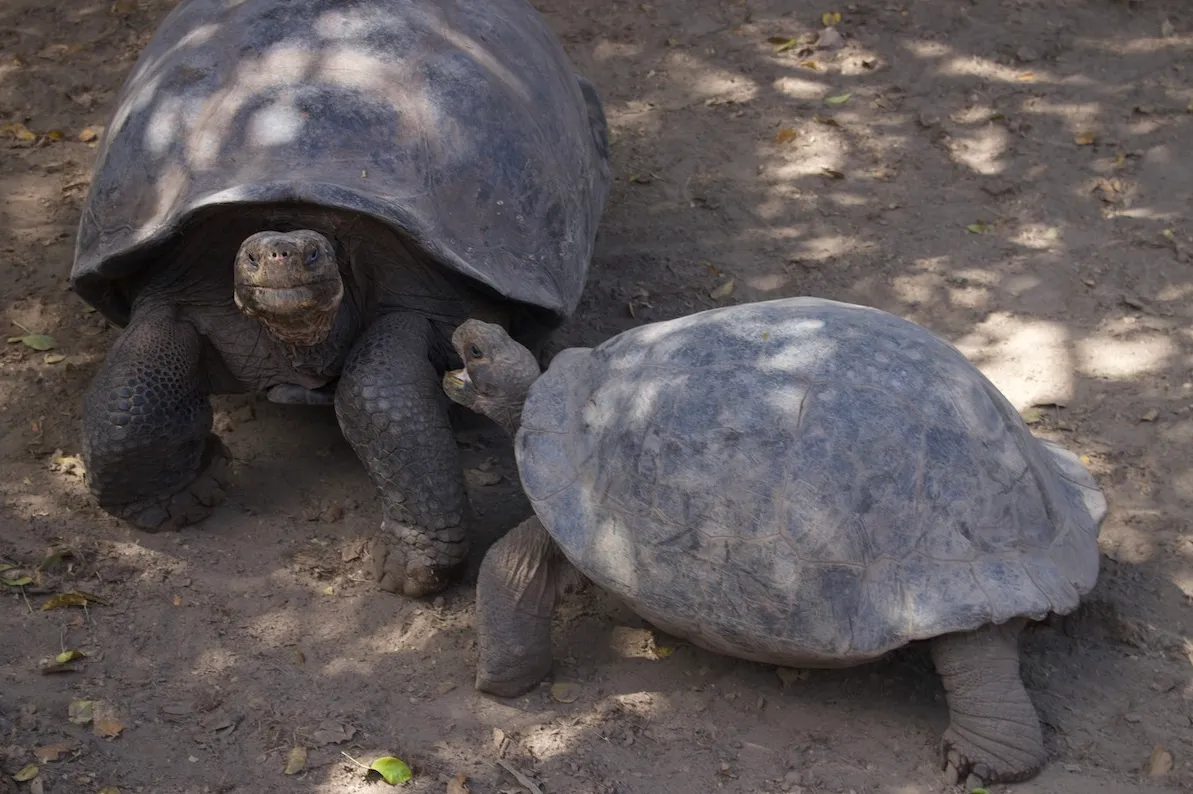
A visit may invite respectful observation at a distance and, depending on current circumstances, recognition of giant tortoises, management processes, learning, or interpretation without turning any of them into certainties. The route, animal presence, vegetation, access, and any interpretive space depend on current signage, closures, conditions, and guidance; encountering the site without demanding outcomes helps distinguish conservation from spectacle.
Arriving at a space where conservation sets the pace
La Galapaguera, also referred to as Cerro Colorado, is associated with San Cristóbal. Arrival need not rely on an exact route to suggest another form of attention: a space related to giant tortoise breeding or conservation asks visitors first to notice present conditions, signage, and the margin that the place allows that day.
No fixed scene is owed at its entrance. Giant tortoises may be present depending on current circumstances, and the setting may offer moments of management, learning, or interpretation without any of them being assured. A visit begins more carefully when it accepts that the place has its own timings and protocols.
Essential information
- Identity
- La Galapaguera, also referred to as Cerro Colorado
- Association
- San Cristóbal
- Presented purpose
- A space associated with giant tortoise breeding or conservation
- Observation
- Giant tortoises may be seen depending on current circumstances
- Interpretation
- Possible processes of management, learning, or interpretation
- Route
- Subject to current signage, closures, conditions, and guidance
A possible interpretation, not a promise
The site may include opportunities for learning or interpretation linked to conservation, but that possibility does not confirm a centre, an official name, or a defined activity. Information available at the time of a visit, signage, and current instructions determine what may be learned and how.
Understanding does not require intervention. Listening to an explanation when one is available, reading a notice, or stopping when the route changes can provide context without assuming that every visit will have the same content. Management processes, if they are perceived, are not turned into a demonstration for visitors.
Giant tortoises: observing without demanding proximity
Depending on current circumstances, giant tortoises may be seen in the setting. Their presence, distance, movement, and number are not guaranteed outcomes. An observation may be brief, happen from afar, or not occur; each possibility requires leaving space for the animals and for the conditions that order the site.
Respectful distance avoids turning tortoises into an attraction or a scene that must be repeated. They are not touched, fed, surrounded, pursued, or approached in an attempt to change their behaviour. Current rules, signage, and instructions take priority without this dossier declaring a precise regulation.
An authorised route, defined by the day’s conditions
A visit to La Galapaguera depends on authorised routes, signage, closures, conditions, and current guidance. The site should not be treated as a fixed itinerary, nor should every section, space, or view be assumed to be available. A current notice may change how visitors proceed, pause, or return.
Following the permitted route helps care for the setting and avoids opening new passages near vegetation, birds, or other elements that need attention. A closure is not a limit to overcome: it is a visiting condition that calls for adjusting the plan. Returning can also be part of respecting the route.
Vegetation and variable presence in San Cristóbal
San Cristóbal vegetation accompanies the route as part of a setting that is not reduced to animals. Its appearance, bird presence, and the shape of access may change with the day, use, and actual conditions. There is no need to turn the landscape into an inventory to recognise that it supports attentive observation.
Plants, ground, birds, and other elements of the site are viewed without touching, collecting, or altering them. A texture, shadow, or sound can locate a visit without promising species or encounters. Keeping distance allows both what is visible and what remains out of sight to retain their own space.
Conservation is not spectacle
A place associated with conservation does not offer results on demand. The possibility of seeing giant tortoises or finding a moment of learning does not turn animals, management processes, or the route into a spectacle. Attention shifts from obtaining an image to recognising the limits that protect the setting.
That distinction also matters in small actions: proximity is not forced, interaction is not requested, and the route is not altered to seek a scene. Current site decisions may prioritise needs that are not visible to someone arriving. Respecting them is part of understanding conservation.
Preparing without assuming services or outcomes
A visit should be planned without assuming schedules, fees, reservations, transport, parking, establishments, services, or infrastructure. Current information, signage, and guidance take priority over every expectation. General preparation should be adapted to actual conditions without being presented as a guarantee of access, comfort, or safety.
The place should not be presented as a commercial activity, nor should any mode of arrival be asserted. Site conditions may vary, and a current notice may modify the plan. Checking verifiable information before travelling does not replace the instructions received on arrival.
Frequently asked questions
- It is a place associated with San Cristóbal, also referred to as Cerro Colorado, presented as a space for giant tortoise breeding or conservation.
- No. They may be seen depending on current circumstances, but their presence, number, distance, species, and behaviour are not guaranteed.
- At a distance and without demanding proximity. Current rules, signage, and instructions should be followed.
- No. Animals are not touched, fed, surrounded, pursued, or approached in an attempt to alter them. Current instructions take priority.
- A visit depends on authorised routes, signage, closures, conditions, and current guidance. Paths, length, difficulty, accessibility, and constant availability vary and should be checked on site.
- Services, schedules, fees, reservations, transport, parking, establishments, and infrastructure vary. Current notices should be checked before a visit.
- With general preparation adapted to actual conditions and attention to current signage and instructions. Recommendations are not presented as a guarantee of access, safety, or comfort.
The return: letting the place keep its own pace
On the return, a visit may retain an observation from afar, an authorised section, or a sign that helped change a plan. None has to fulfil a planned image. La Galapaguera is understood more precisely when the return recognises that care for the setting also defines what did not happen.
Memory may hold the possible presence of a giant tortoise, San Cristóbal vegetation, or the act of pausing at a current instruction. These are not evidence of permanent availability. Leaving room for actual conditions makes it possible to return without confusing conservation with the consumption of outcomes.