Water, visibility, birds, access, and the route depend on actual conditions, signage, closures, and path status; observing without promising outcomes is a respectful way to encounter the place.
When the coast begins to rise towards the highlands
From the setting of Puerto Baquerizo Moreno, the idea of ascent may be felt before the lagoon appears. Coastal air and urban references fall behind gradually while the landscape becomes higher, more open, and, depending on the day, cooler. The journey need not become an exact route to reveal the change: the island begins to be read through different humidity, wind, and clouds.
The transition does not guarantee a fixed scene. Light may soften, fog may move in or draw back, and rain may have left the ground with a different texture. Reaching the highlands invites an adjustment of expectation: the value of the route does not depend on the crater being fully visible or on weather meeting a prior plan.
Essential information
- Location
- Highlands of San Cristóbal
- Landscape
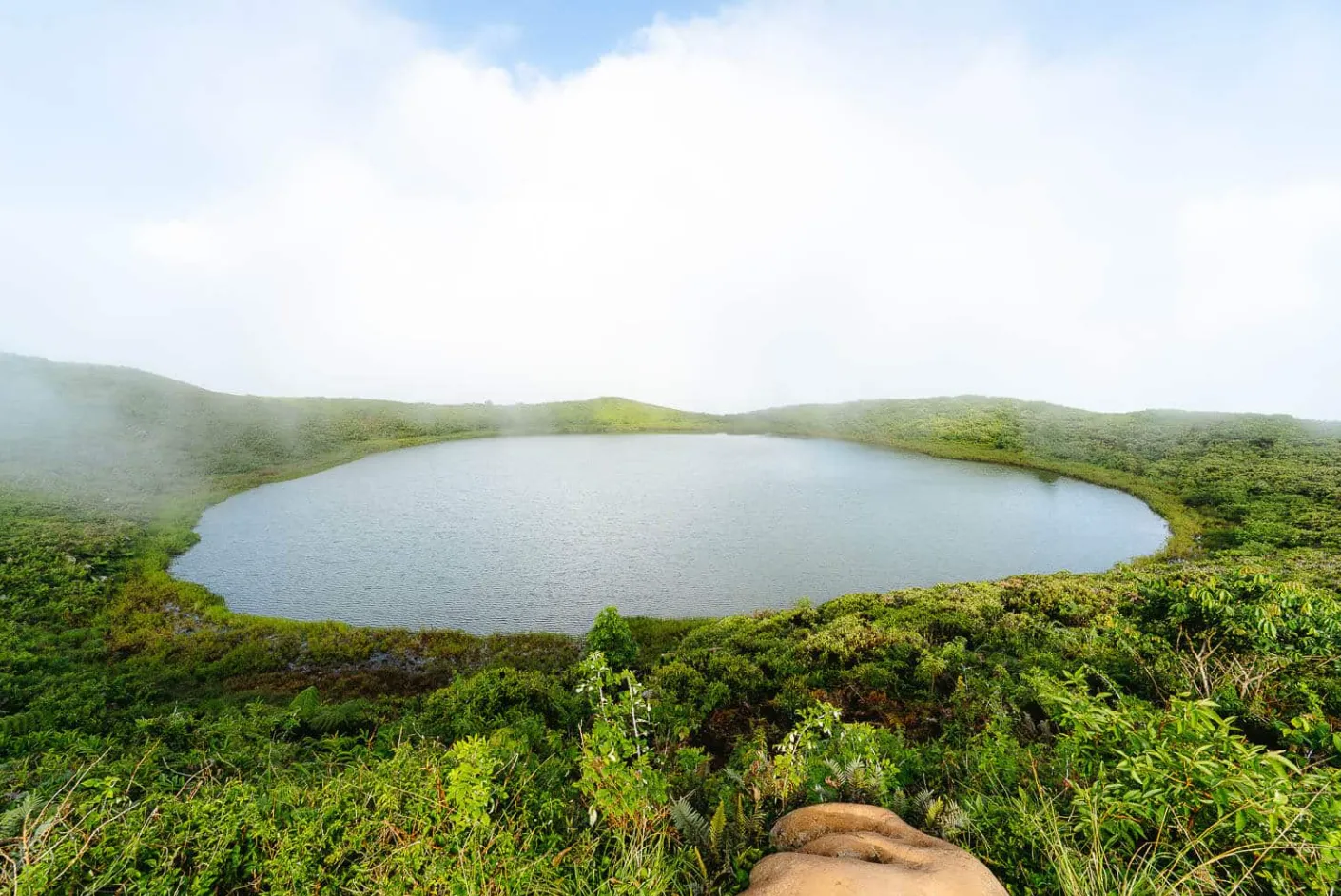
- A freshwater lagoon or reservoir contained in a crater of extinct volcanic origin
- Water
- Fed by rain
- Atmosphere
- A setting that may feel cooler, humid, cloudy, or foggy
- Birds
- Birds may appear; frigatebirds may approach the water
- Route
- Subject to signage, closures, conditions, and path status
Arrival: a crater that holds rainwater
Laguna El Junco appears in the highlands as a freshwater basin held within a crater of extinct volcanic origin. The shape of the terrain offers a pause: before looking for a complete view, it is worth noticing how slopes, edge, and water surface change with cloud and wind. The lagoon is fed by rain, but that basis does not authorise promises about a particular appearance, level, or clarity.
At times the scene may open widely; at others, fog may cut across the landscape and leave water visible only in fragments. Neither version is a lack of the other. The crater-lagoon is better understood as a setting that changes with the day, not as an image obliged to remain visible or still.
Clouds and wind: conditions that also tell the visit
In this setting, humidity may become present in clothing, ground, or distance. Wind may shift clouds, change the felt temperature, and alter the water surface. Fog may limit a view or, variably, allow part of the crater to emerge. Preparing for that margin means observing before continuing and accepting that slowing down or stopping is also part of the route.
Weather should not become a promise or a scheduled disappointment. A clear day does not guarantee a better experience, and an overcast day does not cancel the place. Each condition reveals different relationships between water, relief, vegetation, and sky, without ensuring visibility, a dry path, or continuous access.
Birds over water, without turning observation into certainty
Water and the crater edge may attract birds at certain times. Frigatebirds may approach the water, although their presence, distance, and behaviour should not be assumed or explained through a cause the place must fulfil. A shape may cross the sky, remain far away, or not appear during a visit.
Respectful observation works with the margin available. An image is not pursued, an approach is not forced, and an authorised route is not left for a new angle. Watching from a distance lets the encounter remain a possibility of the setting rather than a demand placed on wildlife.
An authorised route for reading the edge without forcing it
A visit to Laguna El Junco depends on authorised routes, signage, closures, conditions, and path status. The crater edge should not be treated as a fixed itinerary or every section, viewpoint, or crossing assumed to be available. Ground can change with humidity, rain, and use; a current notice reshapes the day’s route.
Following the permitted line helps protect highland vegetation and avoids opening new marks in ground that may be wet. A closure is not a challenge to overcome: it is a visiting condition that asks for a different plan. The experience may consist of remaining, observing, and returning without turning movement into a test of reach.
Wet vegetation and highland details
Around the lagoon, highland vegetation is part of the change of setting from the coast. Humidity, cloud, and relief may give it a different presence from one moment to another. There is no need to turn that vegetation into an inventory to recognise that it accompanies the crater, ground, and transitions of the view.
Plants and ground are observed without touching, collecting, or opening new passageways. A detail beside the route—a damp texture, a low shadow, a shape emerging through fog—may be enough to perceive the setting without taking possession of it. Distance also protects what is not immediately visible.
Preparing for a visit that may change form
A visit should be planned without assuming services, drinking water, schedules, admission, transport, commercial routes, or infrastructure. Current information, signage, and actual conditions take priority over every expectation. Clothing suited to shifts in humidity and wind, rain protection when relevant, and footwear appropriate to variable ground are part of general preparation, not a guarantee of access or comfort.
The place should not be turned into an offer of hiking, cycling, or another activity. Walking within an authorised route may be a form of observing the setting when conditions allow it, but it is not presented as a service or promise. Adjusting the visit to available notices is care, not a limitation of experience.
Simple rules for a shared crater
Current signage, closures, and rules take priority over every expectation of continuing, approaching the edge, or seeking a view. Plants, water, soil, and other natural elements are not collected. Every piece of waste leaves with the person who brought it, including small fragments that can remain on a route or in vegetation.
Wildlife needs distance and quiet. It is not touched, fed, surrounded, pursued, or disturbed by changing the route to get closer. Drones are not used unless current rules and applicable authorisation permit them. Before bringing one, current conditions must be checked and an exception should never be assumed.
Frequently asked questions
- It is a freshwater lagoon or reservoir in the highlands of San Cristóbal, contained within a crater of extinct volcanic origin.
- It is fed by rain. Whether it is potable, supplies a population, or holds a constant level is not stated here.
- No. The setting may be cooler, humid, cloudy, or foggy in variable ways. Visibility depends on actual conditions.
- Birds may appear and frigatebirds may approach the water. No species, number, proximity, or behaviour is guaranteed.
- No cause is attributed here. The approach, if it occurs, is treated only as a possible observation.
- The visit depends on authorised routes, signage, closures, conditions, and path status. No length, stairs, duration, or accessibility is set.
- Activities are not presented as an offer. Walking may be a form of observation only within an authorised route and when conditions allow it.
- Schedules, fees, free admission, routes, transport, toilets, drinking water, food, and other services vary. Current notices should be checked before a visit.
- Preparation for humidity, wind, and variable ground, according to actual conditions. Recommendations are not presented as a guarantee of access, safety, or comfort.
The return: when the highlands give the coast another scale
On the return, the lagoon may remain as an open surface, barely visible among clouds, or marked by wind. The descent does not erase the crater or wet vegetation: it makes clear that coast and highlands belong to one island with different conditions. Nearness does not require their landscapes to resemble one another.
Memory may hold an edge of water, a moving cloud, a distant frigatebird, or wind across the route. None needs to happen as a promise. Laguna El Junco becomes more precise when visited with room for weather, wildlife, and changing a plan.