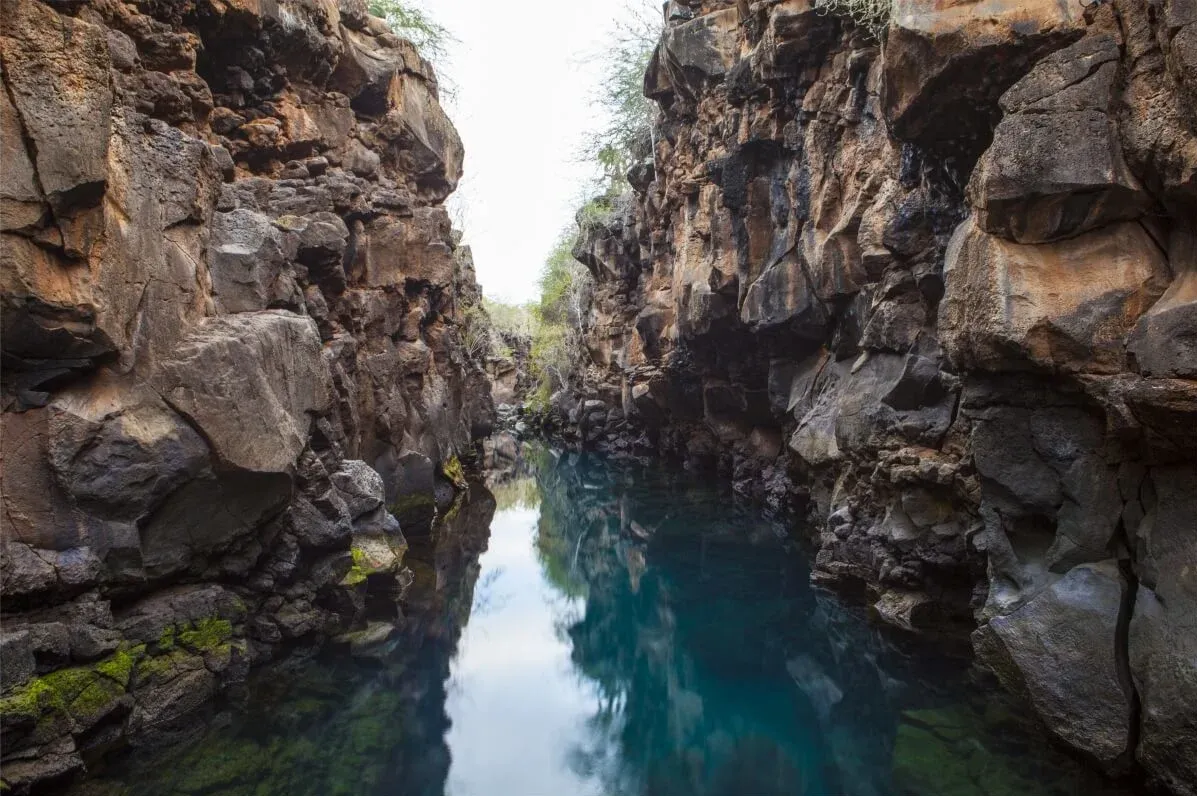
Access combines a water-taxi crossing from Puerto Ayora and a subsequent walk along a volcanic rock and dirt trail that passes salt-water pools and lagoons and coastal vegetation. The place may attract visitors wishing to swim, snorkel, or free-dive, and to observe landscape, flora, and fauna, always subject to Galápagos National Park rules and to variable conditions and capacity. Access costs, whether a guide is required, schedules, and exact figures for distance, depth, or temperature are not confirmed unanimously across sources and require editorial verification before publication.
Crossing Academy Bay from Puerto Ayora
Las Grietas is associated with Santa Cruz and is located in the setting of Punta Estrada, across Academy Bay from Puerto Ayora. Access is consistently described as a water-taxi crossing followed by a walk along a volcanic rock and dirt trail, without this dossier confirming an exact distance, a travel time, or a set cost for the crossing. Moving forward without relying on a figure allows attention to the conditions in effect on that day and to the information offered at the departure point.
The crossing to the other side of the bay precedes the walk as a transition: it leaves the urban waterfront of Puerto Ayora behind and approaches a coastal territory where the trail passes salt-water pools and lagoons and vegetation typical of the littoral zone. Before reaching the main formation, that stretch already allows a landscape different from the harbour to be observed, without the experience becoming a programmed offer or a promise of a fixed itinerary.
Essential information
- Identity
- Las Grietas, in Santa Cruz
- Location
- Setting of Punta Estrada, across Academy Bay from Puerto Ayora
- Formation
- Lava fissures with tall walls and brackish water in chained natural pools
- Access
- Water-taxi crossing from Puerto Ayora and a subsequent walk along a volcanic rock and dirt trail
- Possible activities
- Swimming, snorkelling, or free-diving, and observing landscape, flora, and fauna
- Regulation
- Subject to Galápagos National Park rules and to variable conditions and capacity
The coastal trail, between salt-water pools and vegetation
After the crossing, the trail moves over volcanic rock and dirt, in a route consistently described as close to the coast. Along the way, salt-water pools and lagoons and coastal vegetation can be observed, their composition varying by stretch and season. This dossier does not fix an exact distance or walking time, since the available sources do not agree on those figures.
The walk itself is already part of the place's experience: it is not merely a transit towards the main formation, but a stretch where the coastal landscape, the salt-water pools, and the vegetation coexist before the lava walls become visible.
The lava formation and its chained pools
Las Grietas is a volcanic geological formation: lava fissures forming tall walls, between which brackish water accumulates, the result of filtered fresh water mixing with seawater. That water gives rise to chained natural pools, present as the place's distinctive feature, without this dossier confirming exact figures for depth, width, or number of pools beyond what is described in general terms.
The contrast between the volcanic rock walls and the accumulated brackish water is what visually defines the place. That contrast does not depend on a specific figure to be recognised: it is the reason the formation stands as a reference within Santa Cruz, even as several of its numerical details remain without unanimous editorial verification.
Swimming and observing, with caution
The place may attract visitors wishing to swim, snorkel, or free-dive in the chained pools. Any entry into the water should take the surrounding rocks and the conditions for entering and exiting the water into account, without this dossier guaranteeing a calm surface or the absence of marine fauna at any given moment. Observing the landscape, without necessarily entering the water, is equally a valid way to experience the place.
Caution in the water and on the rocks does not diminish the experience: it recognises that actual conditions vary and that each visit depends on the situation in effect that day, rather than on a fixed promise of safety or comfort.
Flora and fauna of the coastal and island setting
Depending on actual conditions at the place and time of the visit, there may be varied coastal and island vegetation present, such as lava cactus or mangrove among other species, and possible fauna, such as marine iguanas, coastal or migratory birds, and Galápagos land birds. This possibility is presented conditionally, without guaranteeing observation or fixing a closed list of species.
Observing that flora and fauna respectfully, without disturbing their surroundings, complements the place's geological experience without replacing it: the brackish-water pools and the coastal life that may surround them are part of the same volcanic and island landscape.
Frequently asked questions
- It is a volcanic geological formation in Santa Cruz: lava fissures with tall walls where brackish water accumulates, forming chained natural pools.
- Access combines a water-taxi crossing over Academy Bay and a subsequent walk along a volcanic rock and dirt trail that passes salt-water pools and lagoons.
- Visitors may swim, snorkel, or free-dive in the chained pools, and observe the landscape, flora, and fauna of the setting; entering the water should take the rocks and the entry and exit conditions into account.
- Depending on actual conditions, there may be coastal and island vegetation and fauna such as marine iguanas or birds, without this guaranteeing their observation or fixing a closed list of species.
The return towards Puerto Ayora
On leaving Las Grietas, the return retraces the same coastal trail past the salt-water pools and vegetation, to the water-taxi crossing point back towards Puerto Ayora. That stretch allows the visit to close without depending on a time figure or a set cost, paying attention to the current conditions of the route and the crossing.
The memory of the visit may retain the contrast between the lava walls and the brackish water, the possibility of having swum or snorkelled with caution, or the observation of coastal and island flora and fauna. None of these elements replaces the editorial verification of figures, costs, whether a guide is required, or schedules before any publication.