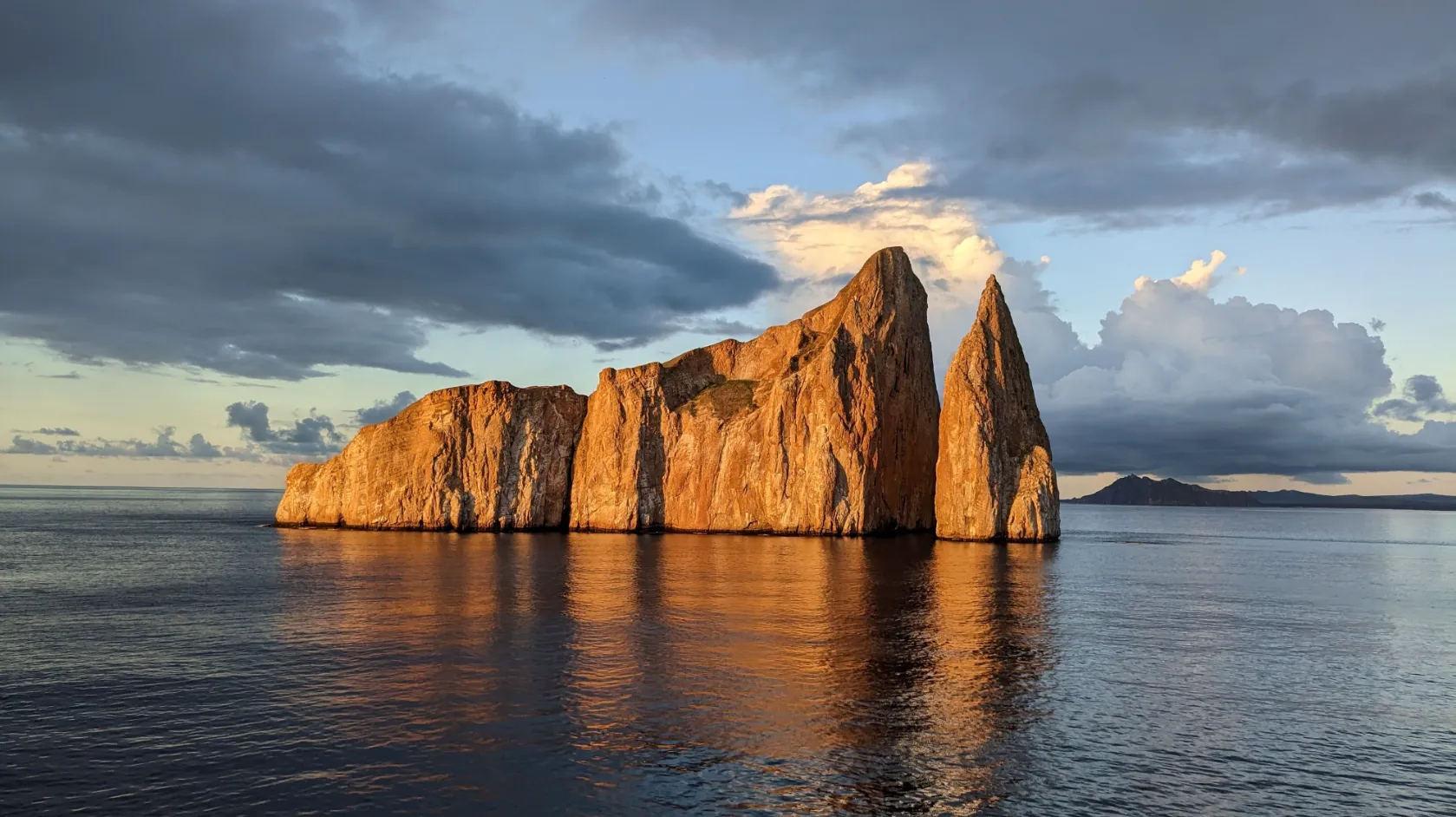
The sea has shaped a profile that may resemble a sleeping lion from one viewpoint and a boot from another, while the rock continues below the surface into a dynamic marine setting. The experience unfolds from a boat and, when conditions and the guide’s assessment allow, through responsible snorkelling or diving, always with honest expectations of wildlife that remains entirely wild and never guaranteed.
A rock that changes shape as you move
As the coast of San Cristóbal recedes, the horizon begins to gather around a dark form rising directly from the Pacific. At first it may be little more than a vertical interruption in the line of the sea. Then the angle changes, the rock gains volume, separates into two immense masses, and reveals the water between them. Kicker Rock is not discovered all at once; it assembles itself slowly in front of the viewer.
Its two names come from that play of perspectives. From one direction, the profile recalls a sleeping lion; from another, its outline can suggest a boot, giving rise to the name Kicker Rock. These are not separate destinations, but two ways of recognising the same formation. No added legend is needed: the changing relationship between sea, distance, and movement tells the story.
Essential information
- Name
- Kicker Rock / León Dormido
- Location
- Off the coast of San Cristóbal
- Formation
- Volcanic tuff eroded by the sea
- Visible height
- Approximately 150 m above the sea
- Structure
- Two large rock walls or masses separated by a natural channel
- Access
- A marine experience with no landing on the formation
The discovery begins before arrival
Kicker Rock is reached by sea from Puerto Baquerizo Moreno, but the crossing should not be reduced to a stopwatch. Its duration can vary and does not define the experience. What matters is the progression: the coast falls behind, the scale of the ocean becomes more apparent, and the formation moves from a distant outline to an almost architectural presence filling the field of view.
From the boat, the approach makes the separation between the masses, the outline of the walls, and surfaces exposed to the sea easier to read. Birds may appear as moving points on the rock or in the surrounding sky, but their presence, number, and behaviour change. Responsible observation means attending to what the day offers rather than demanding a scene rehearsed in advance.
The sound changes as well. The engine may yield to wind, water striking the tuff, and the movement of swell between the walls. Together they show that the formation is not a monument isolated from its setting. Its character depends on the sea around it and on the conditions that determine how close an approach remains appropriate.
Volcanic tuff, sea, and time
Kicker Rock is a volcanic tuff formation eroded by the sea into two immense walls or rock masses divided by a natural channel. The description sounds simple until the rock supplies the scale: approximately 150 metres rise above the water, while the base continues below the surface.
The sea has shaped the tuff into the configuration now recognised by the eye. Colour and shadow shift with light and distance, sometimes making the channel appear to close or open. Each change of perspective offers a different reading without altering the essential fact that this is a volcanic structure eroded by the sea.
The height remains deliberately approximate because the available measurements do not agree on one exact value. Saying that the formation rises about 150 metres conveys its scale without manufacturing false precision. Its underwater walls and channel are treated in the same way: no exact depth is assigned, because current, visible topography, and the guide’s orientation matter more to the experience than an isolated number.
Two walls and a living channel
The natural channel is the feature that completes the structure of Kicker Rock. From some angles, the two masses appear to be one. When the opening aligns with the viewer, the ocean is framed by rock, and the formation becomes more than a silhouette: it becomes a space crossed by water, light, and movement.
The walls continue beneath the surface, where the rock becomes part of the marine landscape. The channel can concentrate water movement and alter the felt strength of the current. That energy adds to the experience, but it also prevents the site from being treated like a predictable pool. Conditions on the day decide whether an area can be observed, followed, or left outside the activity.
There is no landing on the formation. Kicker Rock is a protected and regulated marine site, and responsible access takes place from a boat or in the water with an authorised guide. The absence of a trail over the rock does not limit discovery; it directs attention towards the scale of the cliffs, the channel, the sea surface, and the world continuing below it.
Three ways to approach, three distinct experiences
Watching from the boat, snorkelling, and diving are not interchangeable versions of one activity. Each changes the viewpoint, proximity to the water, personal demands, and the way the formation is perceived. Understanding those differences creates realistic expectations without imposing a prefabricated script.
Observation from the boat
The boat offers the broadest view of the outline and its relationship with the horizon. From here, a figure resembling a sleeping lion can become a boot-like shape, the separation between the walls comes into view, and birds using the rocky and marine setting may be observed.
This is not a lesser experience or a pause between in-water activities. It makes room for visible geology, varied photographic compositions, and a sense of scale without entering the sea. Conditions still matter: they shape stability, distance, and available angles, and the assessment of the guide and responsible crew always takes priority.
Snorkelling in open water
Once in the water, the formation changes scale. The surface is no longer a line seen from above but a moving boundary between sky and depth. Walls that dominated the horizon continue underwater, where light may reveal rock, fish, and silhouettes crossing the blue.
Snorkelling takes place in open water and may require confidence in the sea. Current, swell, visibility, and temperature vary, so it should never be described as uniformly easy. The authorised guide assesses conditions, explains entry and exit, and may alter or cancel a section if the channel or another area does not provide an appropriate margin for the group.
Well-fitted equipment allows attention to settle on calm breathing and observation rather than pursuit. A wetsuit may be appropriate for the temperature and conditions of the day. Staying close to instructions, maintaining a stable position, and avoiding contact between hands or feet and rock or seabed protect both the person and the environment.
Diving beside walls that continue into depth
Underwater, Kicker Rock is no longer only a formation rising from the sea; it becomes a structure continuing below it. The walls orient the eye, while the channel and currents may connect the relief with passing pelagic fish, rays, turtles, and sharks. None of those appearances is guaranteed.
Diving requires certification, suitable experience, and an honest assessment of the day’s conditions. Current can change the demands of a dive, and the topography is never a reason to ignore personal limits or the plan set by the guide. This guide fixes no route, depth, or number of sessions: those decisions depend on the sea, the group, and the authorised operating framework.
The richest underwater reading does not come from getting as close as possible, but from maintaining control, distance, and awareness. Buoyancy, communication, and following the guide make observation possible without touching rock, blocking an animal’s path, or turning a wild encounter into a chase.
Wildlife enters the scene on its own terms
Kicker Rock may bring together reef wildlife and species moving through open water. That possibility is part of its pull, but the site is not a programmed stage. Visibility, current, water productivity, and the movement of wild animals change from day to day and even during a single experience.
Hammerhead sharks, Galápagos sharks, and whitetip reef sharks are among the species that may appear. Their inclusion describes a reasonable possibility, not a promise. They should be watched with respect: never fed, touched, or pursued, and never reduced to claims that they are absolutely harmless. Distance and the guide’s instructions take priority over a photograph or the desire to move closer.
Green sea turtles, eagle rays and other rays, sea lions, reef fish, and pelagic fish may also pass through the setting. Sometimes an animal is recognised immediately; at other times, only a shadow or movement slips away into the blue. The experience deepens when that uncertainty is accepted and the whole scene is observed: rock, light, current, and the animals choosing whether to cross it.
Above the water and around the walls, blue-footed boobies, Nazca boobies, frigatebirds, and tropicbirds may be present. No numbers, proximity, nesting, or specific behaviour are promised. From the boat, responsible photography works with the distance available and does not disturb the direction or rest of wildlife.
Two seasons, no calendar of guarantees
From approximately December to May, the water is generally warmer and can often be calmer or clearer. These tendencies may create a different surface experience, but they do not remove swell, current, or daily variability.
From approximately June to November, the water is generally colder and more productive under the influence of nutrient-rich currents. Swell or currents may become more demanding and change the sensation of being in the water. A wetsuit suited to the conditions can provide comfort without replacing the guide’s assessment.
No season guarantees hammerhead sharks, a particular level of visibility, or calm water. Choosing a time of year means accepting a group of tendencies, not purchasing an outcome. Kicker Rock keeps its character precisely because the ocean does not follow a calendar of certainty.
Reading the sea before entering
Responsible preparation begins before contact with the water. Watching the swell, listening to the briefing on currents, and confirming entry and exit procedures help make sense of the day’s plan. If conditions change, the route can change with them; that adaptation is a form of care, not a diminished experience.
Mask, fins, regulator, buoyancy equipment, and wetsuit — as relevant to the activity — should fit properly before the start. Sun protection should be compatible with marine ecosystems, hydration deserves attention, and seasickness prevention can be considered in advance according to personal needs, with appropriate individual advice where relevant. This dossier does not replace professional guidance or personal assessment.
A camera should be secured so it cannot be lost or strike the rock. No image justifies leaving the group, cutting across an animal’s path, or ignoring a signal. Wildlife must not be touched, fed, or pursued, and hands and feet should not be placed on rock or seabed. The best photograph is one that leaves the remembered scene intact.
Honest expectations in a wild place
The wildlife of Kicker Rock is wild. Animals may appear in remarkable combinations or remain beyond view. No percentage turns an encounter into certainty, and no season, activity, or part of the site guarantees a particular species.
The channel may be unavailable for safety reasons. Current, swell, visibility, the group’s experience, and operational decisions can alter the route or keep the activity on another face of the formation. The priority is to respond to the actual sea that day, not to complete a preconceived image.
Boat-based observation may become the main experience when entering the water is not appropriate. Snorkelling may be shortened, adjusted, or omitted. Diving brings its own limits of certification, experience, and conditions. None of these differences makes an option incomplete; each reveals a different scale of the same place.
A memorable experience does not depend on accumulating species or passing through an exact point. It may remain vivid because of the moment the two walls separate, the sound of water in the channel, an unexpected shadow beneath the surface, or simply the scale of the rock against the ocean.
Frequently asked questions
- No. They are two names for the same formation. One viewpoint recalls a sleeping lion, while another can suggest a boot.
- No. The experience takes place from a boat and, when authorised and conditions allow, in the water with a guide.
- No. Observation and photography from the boat provide a complete reading of the silhouette. Snorkelling and diving add underwater perspectives with different demands.
- No. It takes place in open water and may demand confidence in the sea. Current, swell, temperature, and visibility must be assessed on the day.
- Certification, appropriate experience, well-fitted equipment, attention to the plan, and an assessment of conditions. No route, depth, or fixed number of sessions is promised.
- No single time is given because it can vary. Sea conditions and the responsible operation of the day influence the journey.
- They may appear, as may the other species mentioned in this guide, but they are not guaranteed in any season.
- No. Availability depends on conditions and the safety assessment. The route may change without diminishing the experience.
- There is no universal answer. The warm season generally brings milder water that is often calmer or clearer; the cool season generally brings colder, more productive water and currents that may be more demanding.
- Follow the guide, maintain distance, never touch, feed, or pursue animals, and do not place hands or feet on rock or seabed.
When the rock becomes horizon again
On departure, Kicker Rock reverses the discovery. The channel narrows, the two walls merge again, and scale returns to distance. What had been texture, current, and sound becomes a silhouette once more.
Memory no longer sees a motionless rock, however. It holds a place made of perspectives: lion and boot, wall and depth, sky and water, waiting and appearance. Its wonder needs no guarantee. It comes from paying attention to a volcanic landscape still being shaped by the sea and to wildlife that always retains the freedom to enter the scene — or not.