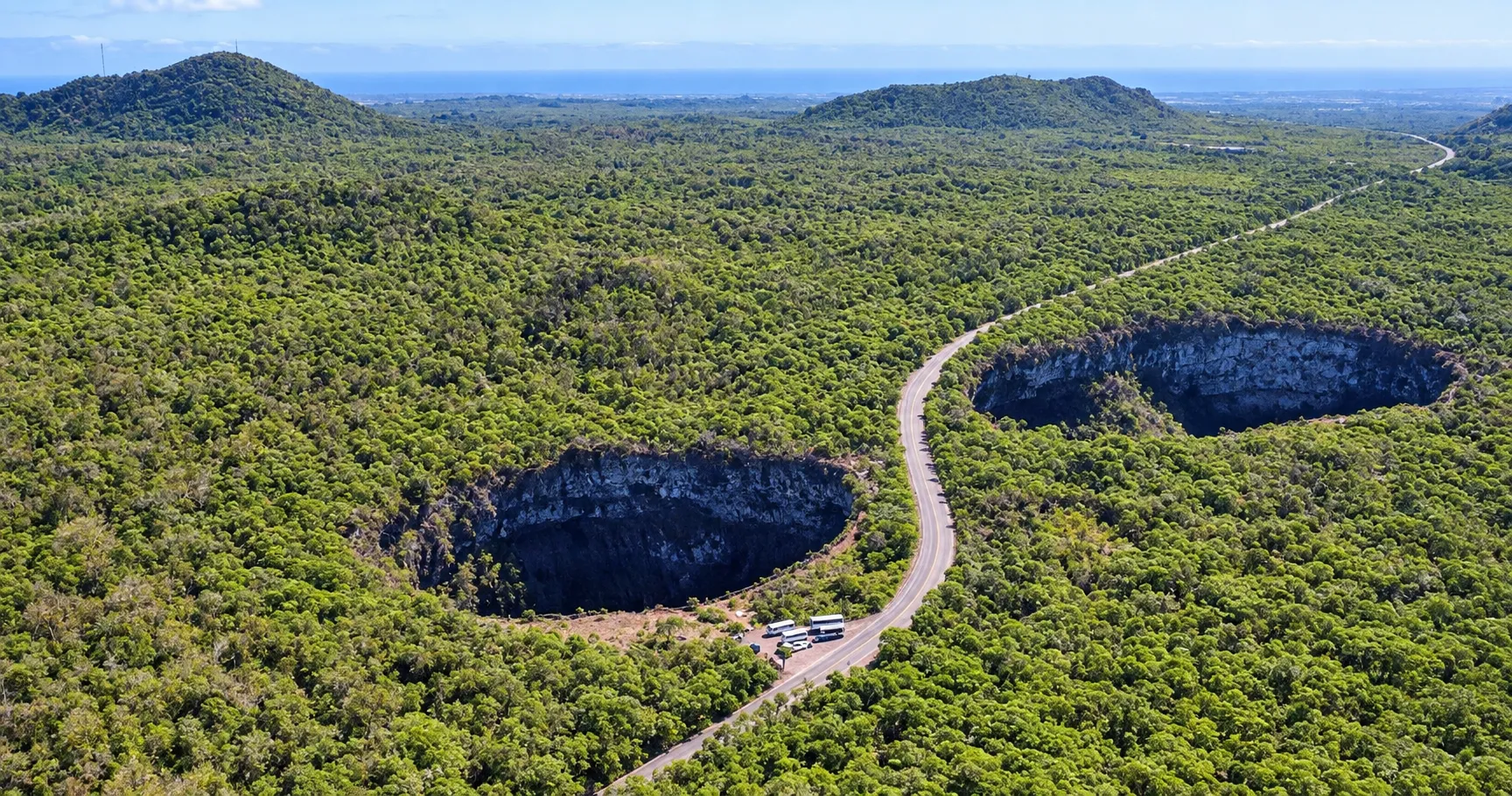
The institutional sources consulted describe them as sinkholes or collapse pit craters rather than eruptive craters: they formed through the collapse of the surface over subterranean cavities or chambers that had been emptied out. Both depressions are surrounded by Scalesia forest, dominated by the endemic tree Scalesia pedunculata, known as the tree daisy or daisy tree, and the Scalesia zone is a humid highland forest beneath whose canopy mosses, bromeliads, epiphytes, and orchids thrive. The area is recognised as one of the best-known places to observe Scalesia forest in Santa Cruz. This species grows in cohorts of similar age and height, so entire populations may die and regenerate together within a natural cycle of renewal, and El Niño events, droughts, and floods can collapse whole forests. The forest at the site has been severely affected by the historical change in agricultural land use and by introduced plants and animals, among them the invasive blackberry Rubus niveus, which grows vigorously in the highlands, prevents the recruitment of native seedlings, and can turn a species-rich forest into scrub. There is a documented history of blackberry control and of forest restoration with nursery-grown seedlings, accompanied by scientific monitoring of vegetation, invertebrates, and birds; that history describes a process, not an outcome or a current state. The forest is important for numerous invertebrates, for Darwin's finches, and for two flycatcher species, and the documentation reviewed records a decline of the vermilion flycatcher population in Santa Cruz, without that asserting presence, absence, or guaranteed observation at the site. Access is usually along the highland road from Puerto Ayora, by taxi, land transport, or bicycle, often combined with other visits in the highlands. Depth, diameter, altitude, distances, times, schedules, costs, species counts, and the forest's current state remain pending editorial verification and are not asserted in this entry.
Two large facing depressions in the highlands
In the Santa Cruz highlands, the road that crosses the highlands towards the north of the island runs between two large depressions in the terrain. Each one opens on one side of the road, and that facing arrangement, one across from the other, is what gave the site its name.
These are not two places separated by kilometres of forest, but two formations of the same set, close to each other and visible from the edge of their own walls. The road that separates them is part of the site's physiognomy and explains why they are usually described as a pair.
What they really are and how they formed
Although their circular shape and high walls invite the word crater, the institutional sources consulted do not describe them as eruptive craters. They are sinkholes or collapse pit craters: depressions that did not open through an explosion or through material rising out of the island's interior.
Their origin lies in the collapse of the surface over subterranean cavities or chambers that had been emptied out. With the internal support gone, the rock roof gave way and the terrain sank into itself, leaving these two large depressions amid the highland landscape.
Essential information
- Identity
- Los Gemelos, in Santa Cruz
- General location
- Santa Cruz highlands, one depression on each side of the road that crosses the highlands towards the north of the island
- Geological nature
- Sinkholes or collapse pit craters, not eruptive craters
- Formation
- Collapse of the surface over emptied subterranean cavities or chambers
- Surrounding vegetation
- Scalesia forest dominated by the endemic tree Scalesia pedunculata, known as the tree daisy
- Life zone
- Humid highland forest, with mosses, bromeliads, epiphytes, and orchids beneath the canopy
- Forest dynamics
- Growth in cohorts of similar age and height, with joint die-off and regeneration as a natural cycle of renewal
- Documented pressure
- Historical change in agricultural land use and introduced plants and animals, among them the invasive blackberry Rubus niveus
- Documented management
- History of blackberry control and forest restoration with nursery-grown seedlings, with monitoring of vegetation, invertebrates, and birds
- Forest fauna
- Forest important for numerous invertebrates, for Darwin's finches, and for two flycatcher species
- Typical access
- Highland road from Puerto Ayora, by taxi, land transport, or bicycle, often combined with other visits in the highlands
The Scalesia forest around them
Both depressions are surrounded by Scalesia forest, dominated by the endemic tree Scalesia pedunculata, known as the tree daisy or daisy tree. That forest is what gives the site its character: the walls of the depressions appear between slender trunks and open crowns, not between bare rock.
The Scalesia zone is a humid highland forest. Beneath the canopy, mosses, bromeliads, epiphytes, and orchids thrive, covering trunks and branches and sustaining the sense of permanent humidity inside the forest. The area is recognised as one of the best-known places to observe Scalesia forest in Santa Cruz.
A forest that renews itself in cohorts
Scalesia does not grow as a forest of mixed ages. It tends to establish itself in cohorts of similar age and height, so that large expanses move together through the same stages of growth and ageing.
That synchrony explains a trait that may surprise anyone arriving at the site: entire populations may die and regenerate together, within a natural cycle of renewal. El Niño events, droughts, and floods can collapse whole forests, and what is observed at any given moment may be a stage of that cycle rather than a permanent state of the forest.
The pressure from introduced species and the documented management
The Scalesia forest of this sector has been severely affected by the historical change in agricultural land use and by introduced plants and animals. Among those plants, the invasive blackberry Rubus niveus grows vigorously in the highlands, prevents the recruitment of native seedlings, and can turn a species-rich forest into scrub.
There is a documented management history at the site: the protected-area management authority has carried out blackberry control and restoration of the Scalesia forest with nursery-grown seedlings, and scientific teams have monitored the effects of that work on vegetation, invertebrates, and birds. That history describes a process and a sustained effort; it does not describe a consolidated outcome or the forest's current state, which remains pending verification.
The forest's fauna as context
The forest surrounding the depressions is important for numerous invertebrates, for Darwin's finches, and for two flycatcher species. That importance describes the stand's ecological value, not a list of sightings available to anyone visiting the site.
The documentation reviewed also records a decline of the vermilion flycatcher population in Santa Cruz. That documentary record does not describe the species' current state or assert its presence or absence at this site, and no wildlife observation can be taken for granted during a visit.
Access from the highlands
The site is reached along the highland road from Puerto Ayora, by taxi, land transport, or bicycle. The visit is usually combined with other points of interest in the same highland area, within a single tour of the island's interior.
Frequently asked questions
- Not in the eruptive sense. The institutional sources consulted describe them as sinkholes or collapse pit craters, formed by the sinking of the surface over emptied subterranean cavities or chambers, not by an eruption.
- Because they are two large facing depressions, one on each side of the road that crosses the highlands towards the north of the island, and that paired arrangement explains the name.
- A humid highland forest dominated by the endemic tree Scalesia pedunculata, the tree daisy, beneath whose canopy mosses, bromeliads, epiphytes, and orchids thrive.
- No. The documentation reviewed places Scalesia forest on several islands and in different sectors, and presents this site as one of the best-known places to observe it in Santa Cruz.
- Because Scalesia grows in cohorts of similar age and height, and entire populations may die and regenerate together within a natural cycle of renewal; El Niño events, droughts, and floods can collapse whole forests.
- The historical change in agricultural land use and introduced plants and animals, among them the invasive blackberry Rubus niveus, which prevents the recruitment of native seedlings and can turn a species-rich forest into scrub.
- There is a documented history of blackberry control and of restoration with nursery-grown seedlings, with monitoring of vegetation, invertebrates, and birds. That history describes a documented process and not a consolidated outcome or the forest's current state.
- The forest is important for numerous invertebrates, for Darwin's finches, and for two flycatcher species, but no observation is guaranteed during a visit.
- Along the highland road, by taxi, land transport, or bicycle, usually combined with other visits in the same highland area.