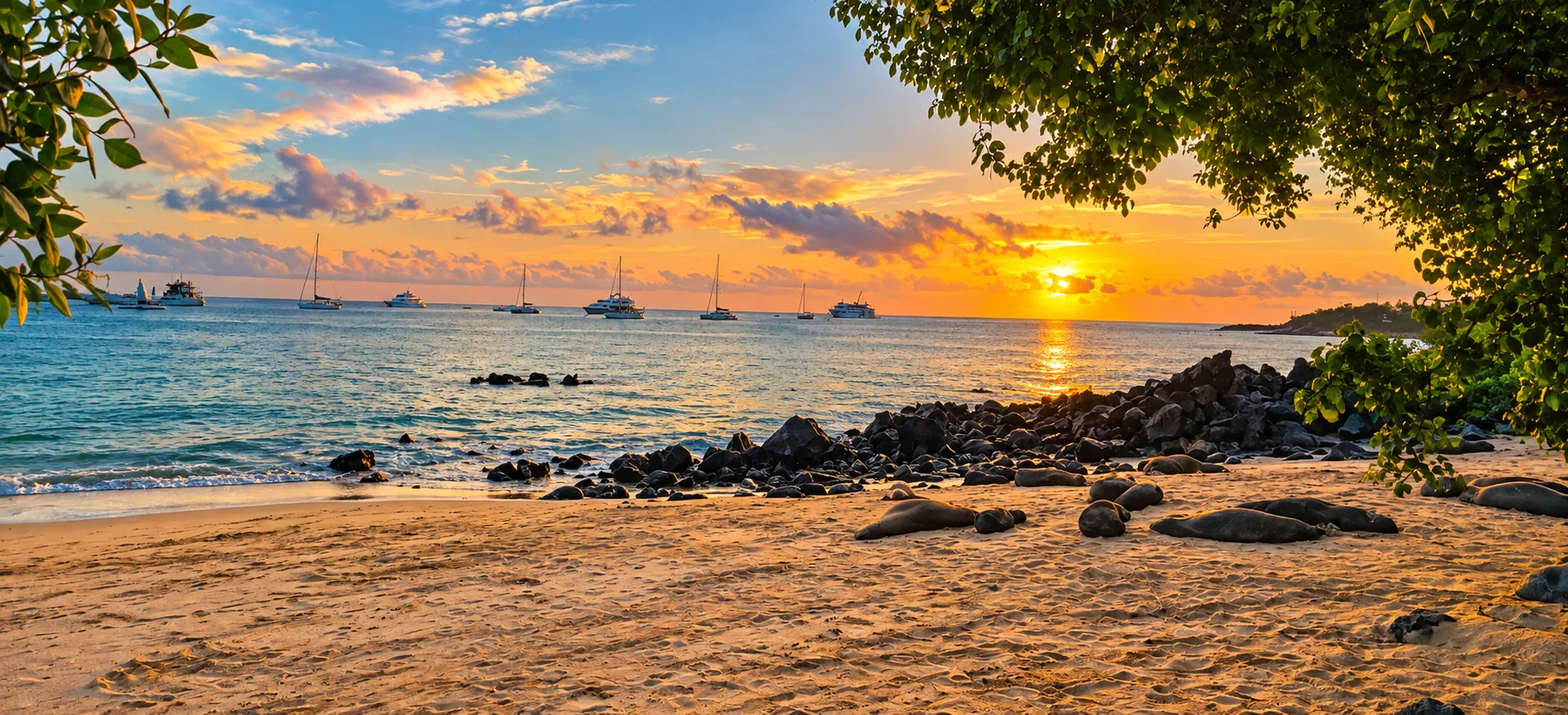
It is reached on foot from the town centre, and its white sand, formed by shell fragmentation, slopes gently down to water that can turn clear and allow snorkelling and swimming, always depending on sea conditions. Kayaking appears as a possibility when surf and current allow it. The shore's west-facing orientation makes it favourable to sunsets and photography, as a tendency and never as a promise. Sea lions may rest on the rocks or the sand and swim near visitors: their presence is a possibility that is met with distance, without touching them, without feeding them, and never blocking their route. Marine iguanas, frigatebirds, boobies, Galápagos gulls, Sally Lightfoot crabs, sea turtles, and, occasionally, dolphins complete the possible wildlife of the surroundings. A food area with small kiosks, bathrooms, and a lifeguard tower are among the site's reported services, all to be confirmed on the ground. From the town's edge, trails connect the area with neighbouring sites of the island, as context of the coastal landscape and not as a closed itinerary.
An urban beach on the northern edge of town
Playa Mann is a small urban beach on the northern edge of Puerto Baquerizo Moreno, on San Cristóbal island, in front of the Universidad San Francisco campus that hosts the Centro de Ciencias Galápagos. Its urban condition distinguishes it from the visitor sites away from town: the beach is woven into the life of the port, is reached on foot from its centre, and shares the neighbourhood's everyday life. That closeness does not turn it into a domestic space: it remains coastal habitat, and its use is framed by the rules that govern the archipelago's wildlife.
The sand and the shore
The beach is described with white sand formed by shell fragmentation, with a gentle slope and favourable for sunbathing. That clear sand is the shore's consistent character; rocky sectors may appear at the edges, a variable condition that does not define the beach but does accompany its outline.
Essential information
- Location
- Northern edge of Puerto Baquerizo Moreno, on San Cristóbal island, in front of the Universidad San Francisco campus (Centro de Ciencias Galápagos)
- Sand
- White sand formed by shell fragmentation, with possible rocky sectors at the edges as a variable condition
- Slope
- Gentle slope, favourable for sunbathing
- Water and activities
- Clarity that can allow snorkelling and swimming, always depending on conditions; kayaking appears as a possibility
- Sunset
- West-facing orientation, favourable to sunsets and photography
- Trails
- Trails leaving from the town's edge towards the Gianni Arismendy Interpretation Center, Cerro Tijeretas, Punta Carola Beach, and La Lobería
- Wildlife
- Sea lions, marine iguanas, frigatebirds, blue-footed and red-footed boobies, Galápagos gulls, Sally Lightfoot crabs (zayapas), sea turtles, and, occasionally, dolphins
- Services
- A food area with small kiosks, bathrooms, and a lifeguard tower, reported and to be confirmed on site
- Climate
- From December to May it tends to be warmer and more humid; from June to November, cooler and drier
- Coexistence rules
- Distance from wildlife, without touching or feeding it, and never blocking its route
The water, always depending on conditions
The water's clarity can allow snorkelling and swimming, but neither activity is guaranteed: surf, current, visibility, and the conditions for entering and leaving the water decide on each occasion. The beach offers no promise of calm; it offers a possibility that the sea enables or withdraws.
Kayaking appears among the possible activities when conditions allow it. This dossier does not describe rental logistics or operators: the activity is presented as a possibility of the site, not as a commercial offer.
Sea lions: a presence to be respected
Galápagos sea lions may rest on the rocks or the sand and swim near visitors. Their presence is possible, never guaranteed, and never a show: it is wild fauna in its habitat.
The respect rules are general and admit no exceptions: keep your distance, do not touch them, do not feed them, and never block their route to or from the water. Adult males can defend themselves if disturbed, and human contact can carry consequences for the animal. None of these rules depends on the animal looking calm.
The wildlife of the surroundings
Besides the sea lions, the beach's surroundings may present marine iguanas, frigatebirds, blue-footed and red-footed boobies, Galápagos gulls, Sally Lightfoot crabs, known locally as zayapas, sea turtles, and, occasionally, dolphins. All of those presences are possibilities of the site and none is guaranteed; none is presented as the place's current state.
Sunset and photography
The beach's west-facing orientation makes it favourable to sunsets and to photography at the end of the day. It is a favourable tendency, not a promise: cloud cover and each evening's weather decide the result.
Reported services, to be confirmed on site
The source material reports a food area with small kiosks, bathrooms, and a lifeguard tower. These services are presented as they were reported and must be confirmed on the ground: this dossier does not guarantee their availability or their current state, and publishes no exclusivity claims about any of them.
The climate through the year
The archipelago's seasonal trends reach the beach as well: from December to May the weather tends to be warmer and more humid, and from June to November it tends to be cooler and drier. These are general trends, not forecasts: any visit meets the weather of the day.
Trails that leave from town
From the town's edge, trails connect the area with neighbouring sites of the island: the Gianni Arismendy Interpretation Center, Cerro Tijeretas, Punta Carola Beach, and La Lobería. This mention is narrative context of the urban trail network and does not constitute a structured itinerary, a suggested continuation, or a CMS relationship between entries.
Frequently asked questions
The following questions summarise, in brief form, the factual scope admitted for the beach.
- A small urban beach on the northern edge of Puerto Baquerizo Moreno, on San Cristóbal island, in front of the Universidad San Francisco campus that hosts the Centro de Ciencias Galápagos.
- White sand formed by shell fragmentation, with a gentle slope and favourable for sunbathing, with possible rocky sectors at the edges as a variable condition.
- The water's clarity can allow it, always depending on conditions: surf, current, visibility, and the conditions for entering and leaving the water decide on each occasion; kayaking appears as a possibility when conditions allow it.
- Sea lions, marine iguanas, frigatebirds, blue-footed and red-footed boobies, Galápagos gulls, Sally Lightfoot crabs (zayapas), sea turtles, and, occasionally, dolphins; all are possible presences and none is guaranteed.
- By keeping distance, not touching them, not feeding them, and never blocking their route; adult males can defend themselves if disturbed, and human contact can carry consequences for the animal.
- A food area with small kiosks, bathrooms, and a lifeguard tower, reported by the source material and to be confirmed on site, with no guarantee of availability or current state.
- Because of its west-facing orientation, a favourable tendency for sunsets and photography, never a promise.
- From December to May it tends to be warmer and more humid, and from June to November cooler and drier, as a seasonal trend and not as a forecast.
- From the town's edge, trails lead to the Gianni Arismendy Interpretation Center, Cerro Tijeretas, Punta Carola Beach, and La Lobería, as narrative context and not as a structured itinerary.