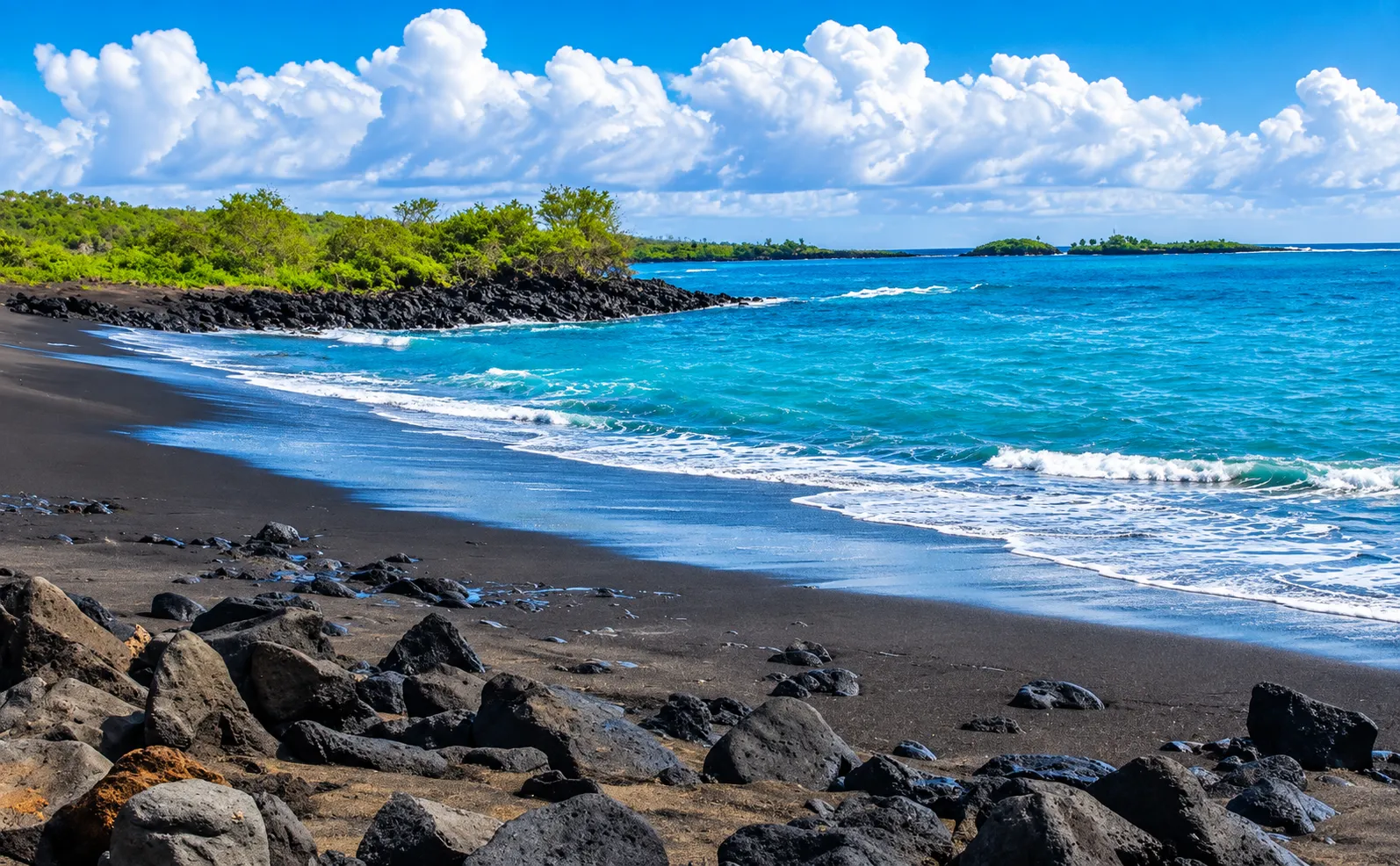
Sea lions rest on the sand and marine iguanas endemic to Galápagos walk along it; in the water, green turtles, rays, and fish may appear, while pelicans, frigatebirds, and blue-footed boobies fly over the coast. When the sea allows it, the bay offers the possibility of snorkelling among the rocky bottoms. The beach is also part of the island's memory: the first settlers are said to have come ashore here, drawn by the fresh water of the nearby highlands.
The island's threshold
Those who arrive in Floreana by sea come ashore at Black Beach. The beach opens on the shore where Puerto Velasco Ibarra, the island's port town, stands, and behind the strip of sand the town begins. It is, at once, a place of sea and a threshold: the first contact with the island and the starting point for exploring it.
The town behind the beach
The port town leans directly on the shore: the beach is its face to the sea and the point where the island receives those who arrive. Behind the sand the town begins, and the beach works at once as a natural shore and as the waterfront of the locality.
That closeness defines the landscape: the sand, the clear water, and the rocky formations coexist with the serene presence of the town, without the beach ceasing to be a corner of nature.
Volcanic sand and clear water
The sand of Black Beach is dark, of volcanic origin, and its deep tone contrasts with the clear water of the bay. That contrast defines the landscape of the shore: a sombre-toned beach beside water that reveals the bottom.
Around the beach, rocky formations rise from the shore. Among the rocks, rich underwater life finds shelter, and the shore combines sand and rock in short stretches, with a different corner at every step.
The life of the shore
On the sand and the rocks rest Galápagos sea lions, Zalophus wollebaeki, lying in the sun or coming in and out of the water. Along the same shore walk marine iguanas, Amblyrhynchus cristatus, endemic to Galápagos, whose dark skin blends with the lava.
Crabs work the rocky zone, and over the coast pelicans, frigatebirds, and blue-footed boobies fly across the bay or settle on the formations. In the water, green turtles, Chelonia mydas agassizii, the Galápagos green turtle, and rays gliding near the bottom may appear. None of these appearances is assured: each visit shows a different combination.
Essential information
- Identity
- Black Beach, the landing beach of Floreana island
- Location
- On the shore of Puerto Velasco Ibarra, Floreana's port town
- Beach
- Beach of dark volcanic sand beside clear water
- Rocks
- Rocky formations around the beach, with underwater life among them
- Sea lion
- Galápagos sea lion (Zalophus wollebaeki), on the sand and in the water
- Marine iguana
- Marine iguana (Amblyrhynchus cristatus), endemic to Galápagos, along the shore
- Green turtle
- Green turtle (Chelonia mydas agassizii), the Galápagos green turtle, in the bay
- Other species
- Rays, fish, crabs, pelicans, frigatebirds, and blue-footed boobies
- Arrival
- The beach where visitors come ashore to explore Floreana, with the town behind
- History
- Shore associated with the arrival of the first settlers, drawn by the fresh water of the highlands, associated with Asilo de la Paz
- Snorkelling
- Snorkelling among the rocky bottoms when sea conditions allow
- Conduct
- Keep your distance from the sea lions, do not touch or disturb the animals, and leave no waste
Under the water
When sea conditions are favourable, the bay offers the possibility of snorkelling among the rocky formations. The bottoms hold reef fish, and rays, green turtles, and sea lions swimming nearby may appear. Visibility, swell, and current change, and it is the conditions of each moment that decide whether entering the water is advisable.
A shore with memory
Black Beach is also part of the island's memory. The versions that relate the settlement of Floreana tell that the first settlers came ashore at this beach, and that the fresh water of the nearby highlands, associated with the site known as Asilo de la Paz, made that settlement possible. It is a story of the past: today's beach is described by its sand, its water, and its wildlife, and nothing from that era is presented as the current state.
A visit inside the protected area
Black Beach is part of the Galápagos protected area. Watching the sea lions quietly and from a distance, keeping distance from the animals, not touching or disturbing them, not pulling up plants, and neither taking sand nor leaving waste is the expected conduct, so that the life of the place carries on undisturbed.
Frequently asked questions
- The landing beach of Floreana island, on the shore where Puerto Velasco Ibarra stands, with dark volcanic sand and clear water.
- For the dark tone of its volcanic sand, which contrasts with the clear water of the bay.
- Sea lions, marine iguanas, green turtles, rays, fish, crabs, pelicans, frigatebirds, and blue-footed boobies, always as a possibility.
- Rocky formations that shelter rich underwater life, visible from the shore.
- No. It is a beach on Floreana island, on the shore where Puerto Velasco Ibarra stands, and it is treated as a place within the island.
- When sea conditions allow, the bay offers the possibility of snorkelling among the rocky bottoms.
- The versions of the settlement tell that the first settlers came ashore at this beach, drawn by the fresh water of the highlands, associated with Asilo de la Paz.
- Keeping your distance from the sea lions, without touching or disturbing the animals, and leaving no waste, as part of a visit inside the protected area.