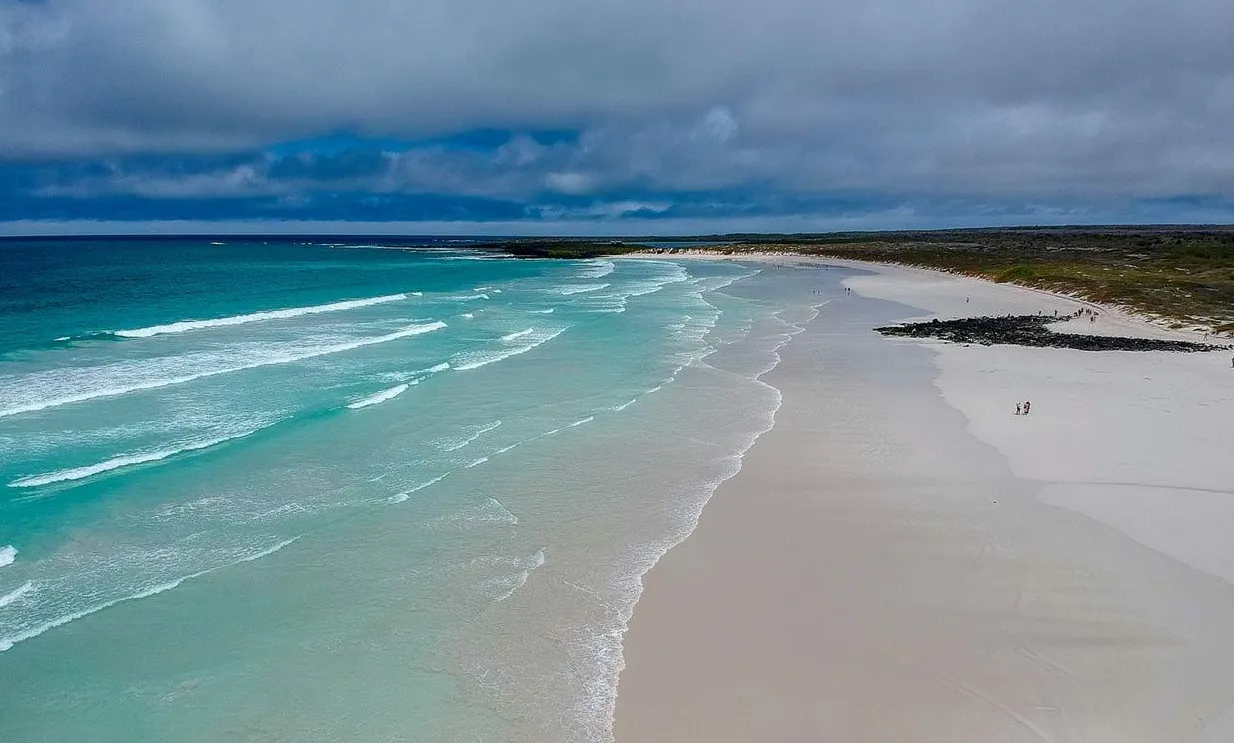
The beach is consistently divided into two sectors: Playa Brava, with strong surf and currents where swimming is not permitted, and Playa Mansa, more protected and calm, connected to the previous one by a stretch of beach or a short path through mangroves, where swimming, snorkelling, and kayaking are possible. There may be marine iguanas, sea turtles, coastal birds, and Sally Lightfoot crabs, always as a possibility conditional on actual conditions at the time, including possible seasonal turtle nesting in the dunes. Access is subject to registration at a Galápagos National Park post at the start of the trail, and there are no services such as food, water, restrooms, or umbrellas on the beach. Whether a guide is required, exact schedules, walking distance and time, observable shark species, the presence of flamingos, and the exact nesting date may vary and are worth confirming locally before a visit.
The trail from Puerto Ayora
Tortuga Bay is reached from Puerto Ayora by a pedestrian trail that leaves from the southern edge of town. No transport is needed to reach the starting point: the path begins at a well-known street and runs in a straight line towards the coast, marked along its entire length. Before entering the trail, a Galápagos National Park post asks every visitor to register, a step that manages the flow of visitors without turning the walk into a guided route.
Past the registration point, the trail runs through a strip of arid vegetation dominated by Opuntia cactus, with tall trunks and broad branches, and palo santo, with pale bark and twisted branches. The path is flat and paved for much of its length, and the landscape changes little along the way: the same dry vegetation accompanies the walk until the terrain opens up and the first view of the sea appears.
Essential information
- Identity
- Tortuga Bay, in Santa Cruz
- Location
- Southwest or south of Puerto Ayora, reached by a pedestrian trail from town
- Trail vegetation
- Arid area with Opuntia cactus and palo santo
- Beach division
- Playa Brava, with strong surf and currents, and Playa Mansa, more protected and calm, connected by a stretch of beach or a short path through mangroves
- Activities at Playa Brava
- Surfing; swimming is not permitted due to strong currents
- Activities at Playa Mansa
- Swimming, snorkelling, and kayaking, in more protected waters
- Access registration
- Mandatory registration at a Galápagos National Park post at the start of the trail
- Services on site
- No food, water, restroom, or umbrella services on the beach
- Possible wildlife
- Marine iguanas, sea turtles, coastal birds, and Sally Lightfoot crabs, depending on actual conditions at the time
Playa Brava and its surf
The trail ends at Playa Brava, a long stretch of white sand facing open ocean. The surf and currents in this sector are consistently strong, and for that reason swimming is not permitted at Playa Brava. The sector is used for surfing, where those practising that sport can read the waves and position themselves according to their experience.
Walking along Playa Brava without entering the water is still a complete way to experience the place: the sand stretches long and open, and the sound of the surf accompanies much of the walk towards the far end of the beach, where the landscape begins to change.
The crossing towards Playa Mansa, through mangroves
At the end of Playa Brava, a stretch of beach or a short path crosses an area of mangroves and leads to Playa Mansa. The landscape transforms along that stretch: mangrove roots emerge over the water and the vegetation becomes denser, in contrast with the arid vegetation of the initial trail.
Playa Mansa and its calm waters
Playa Mansa is sheltered from the open surf, and its waters are noticeably calmer than those of Playa Brava. In this sector, swimming, snorkelling, and kayaking are possible, always depending on actual conditions on the day. The clear water allows the bottom to be seen near the shore, and the nearby mangrove provides partial shade along some stretches.
The contrast between the two sectors is the key to the visit: Playa Brava for walking and watching the surf or surfers, Playa Mansa for entering the water calmly. Both share the same white sand and the same open sky, but each responds to a different kind of visit.
Possible wildlife on the beach and in the mangrove
Depending on actual conditions at the time, Tortuga Bay may have marine iguanas basking on the sand or rocks, sea turtles swimming near the coast or resting in the water, coastal birds such as pelicans and blue-footed boobies flying over the beach, and Sally Lightfoot crabs moving over the rocks near the mangrove. In the waters of Playa Mansa, a reef shark may also appear, as a general possibility, without its presence being guaranteed on every visit.
Observing this wildlife from a distance and without disturbing its surroundings is part of the expected behaviour at the place: no species approaches out of habit or follows a fixed pattern, and each encounter depends on the conditions of the day.
The dunes and turtle nesting
Behind the shoreline, the sand dunes serve a purpose that is not always visible at first glance: during a season of the year, sea turtles climb up to that point to nest. For that reason, stepping on or disturbing the dunes is not permitted, even when no nest is visible at the time of the visit.
Frequently asked questions
- No. Playa Brava has strong currents; swimming is not permitted there. At Playa Mansa the conditions are more protected.
- At Playa Mansa, a calmer and more protected sector reached after Playa Brava, crossing a stretch through mangroves.
- By a pedestrian trail that leaves from town and crosses an area of arid vegetation with Opuntia cactus and palo santo until reaching the beach.
- Yes. At the start of the trail there is a Galápagos National Park post where every visitor registers their entry.
- No. Tortuga Bay has no services on site, so it is worth bringing what is needed before starting the trail.
- Because during a season of the year sea turtles climb up there to nest, even when no nest is visible at the time of the visit.
The return towards Puerto Ayora
The return retraces the same trail, from Playa Mansa and Playa Brava back to the registration post and the exit street in Puerto Ayora. The path is walked in reverse without changes to its route, and the same arid vegetation accompanies the final stretch before reaching town again.
The memory of the visit may retain the contrast between the open surf of Playa Brava and the calm of Playa Mansa, the wildlife that appeared along the way, or the sight of the dunes where sea turtles nest. None of these elements depends on a promise of a fixed schedule, transport, or service to be complete.