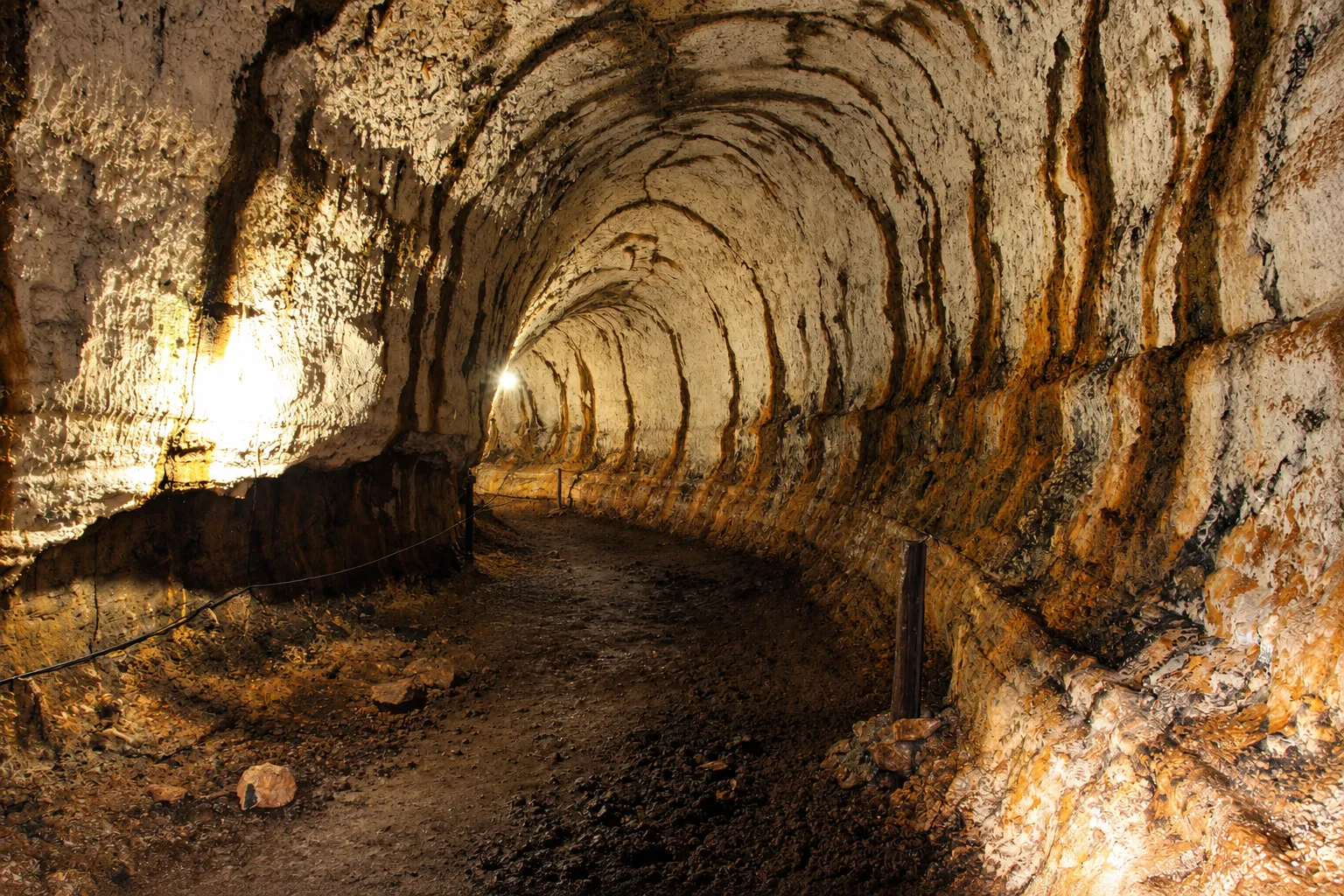
They form when the surface of a lava flow cools and solidifies on contact with the air while the fluid material keeps running underneath; once the eruption ends and the interior empties out, a hollow tube remains, whose roof may partially collapse from cooling, fissures, or seismic activity, exposing its interior. Walking through it means moving along an underground space with a floor of volcanic rock, and some stretches may require bending down or crawling. Lighting varies by tunnel: some have artificial light installed and others depend on a torch. Access is usually by taxi, tourist transport, or bicycle from Puerto Ayora, often combined with other highland visits, and there may be fauna adapted to the darkness, always as a possibility conditional on actual conditions at the time. Length, schedules, cost, and whether a guide is required may vary and are worth confirming locally before a visit.
A network of tunnels in the highlands
In the Santa Cruz highlands, on farms and ranches in the Bellavista and Santa Rosa areas, several visitable lava tunnels open up, with at least one additional site mentioned near the road to Baltra. This is not a single cavity but a category of formation that repeats at different points across the terrain, each with its own access and its own characteristics.
These formations do not depend on a single farm or a single entry point: anyone travelling through the highlands may find more than one signposted tunnel in different areas, each with its own landowner or local management.
How a lava tunnel forms
A lava tunnel forms when the surface of a lava flow cools and solidifies on contact with the air, while the fluid material keeps running beneath that already hardened crust. When the eruption ends and the interior material empties out, a hollow tube remains, running underground across the terrain.
Over time, the roof of that tube may partially collapse from cooling, from fissures, or from the area's seismic activity, and that collapse is what opens an entrance to the interior. So what is walked through today was once the interior of a molten rock flow.
Essential information
- Identity
- Lava Tunnels, in Santa Cruz
- General location
- Santa Cruz highlands, in the Bellavista and Santa Rosa areas, with at least one additional site near the road to Baltra
- Geological formation
- Hollow tube left by a lava flow as its surface cools and its interior empties out after the eruption
- Walk floor
- Volcanic rock; some stretches may require bending down or crawling
- Lighting
- Varies by tunnel: some have artificial light installed and others depend on a torch
- Fitness warning
- Not suitable for people with claustrophobia or reduced mobility
- Typical access
- Taxi, tourist transport, or bicycle from Puerto Ayora, often combined with other highland visits
- Possible fauna
- Possible presence of fauna adapted to the darkness, depending on actual conditions at the time
Access from Puerto Ayora
Access to the lava tunnels is usually by taxi, tourist transport, or bicycle from Puerto Ayora, following the road towards the highlands. The visit is usually combined with other points of interest in that same area, within a single tour of the island's interior.
Entering the underground space
Going down into a lava tunnel means leaving daylight behind and moving along a passage with an uneven floor, formed entirely of hardened volcanic rock. The air changes temperature and sound becomes more contained as soon as the entrance is crossed.
The walk does not always allow standing upright: depending on the tunnel, some stretches are high enough to walk through standing, while others force visitors to bend down or even crawl through a lower space. Lighting follows that same variation, with some tunnels having artificial light installed and others depending entirely on a torch.
The underground space is not suitable for people with claustrophobia or for those with reduced mobility, given that the walk combines close walls, a low roof in some stretches, and an uneven floor that demands constant attention while walking.
Possible fauna in the darkness
The closed, dark environment of a lava tunnel may host fauna adapted to those conditions, different from what is observed in broad daylight on the surface. Its presence depends on the actual conditions of each tunnel at the time of the visit, with no species guaranteed on the walk.
Frequently asked questions
- No. Several visitable tunnels exist at different locations in the highlands, mainly in the Bellavista and Santa Rosa areas, and each has its own access and characteristics.
- It depends on the site: some tunnels can be walked without a guide because they have a single route, while others offer or require one; it is worth confirming at the chosen site.
- It is worth bringing one. Some tunnels have artificial light installed, but others depend entirely on a torch, so bringing your own is a consistent recommendation regardless of the tunnel.
- In some stretches, yes. Depending on the tunnel, certain passages are high enough to walk through standing, while others are lower and require bending down or crawling.
- No. The walk is not suitable for people with claustrophobia or reduced mobility, due to the closed space, a low roof in some stretches, and an uneven floor.
- By taxi, tourist transport, or bicycle, following the road towards the highlands, usually combined with other visits in that same area.
The return to the surface
Leaving a lava tunnel brings back daylight and the warmth of the highlands all at once, in contrast with the temperature and darkness of the interior. The way back follows the same passage in reverse, with no changes to its route.
The memory of the visit may retain the contrast between the darkness of the interior and the light of the surface, the sense of moving through what was once the interior of a molten rock flow, or the fauna that may have appeared along the way. None of these elements depends on a promise of a fixed schedule, transport, or service to be complete.