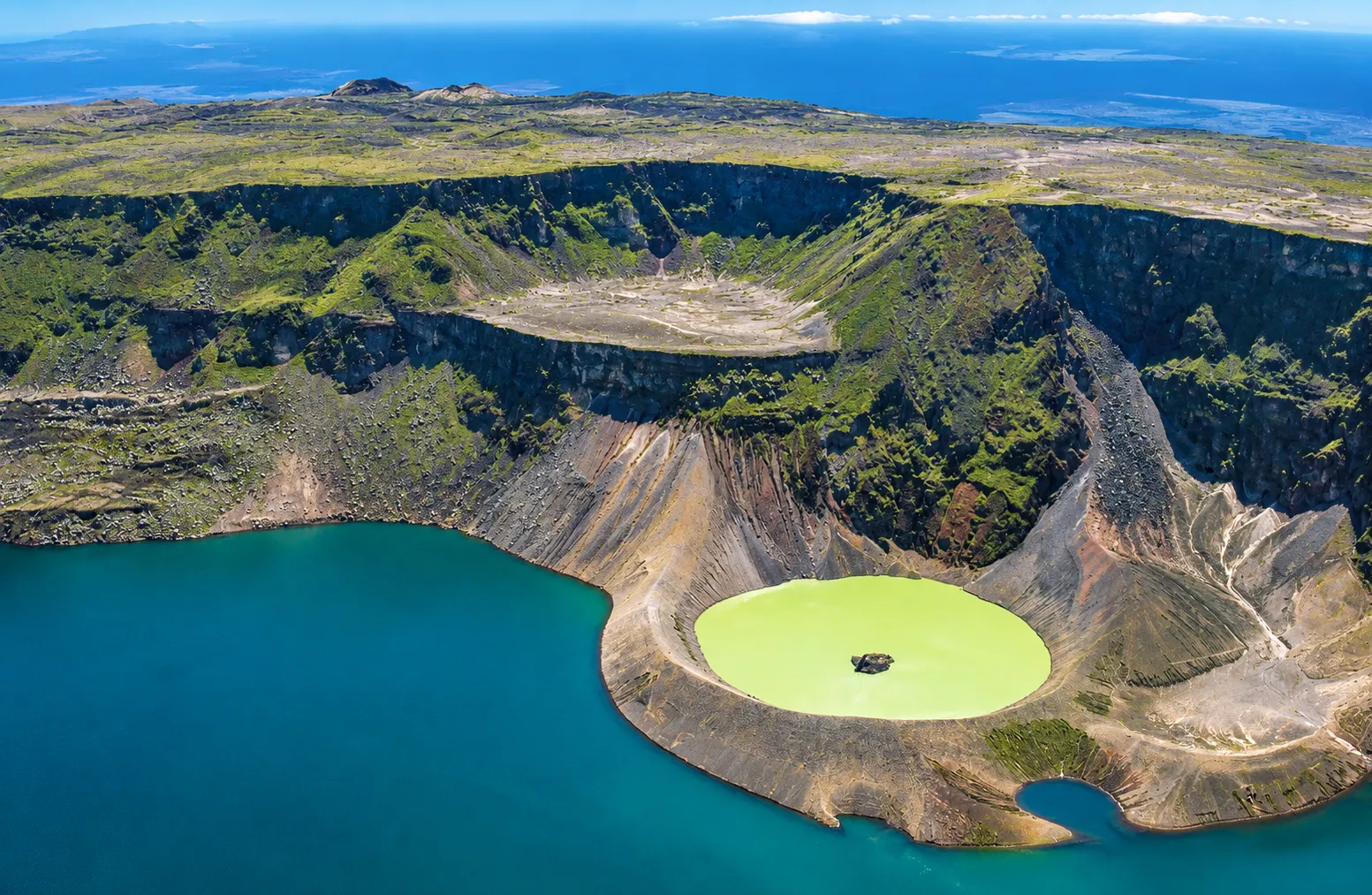
The effusive eruptions of this basaltic volcano have poured lava from the caldera and from fissures on its flanks, and the young lava fields contrast with the mountain's older structure. The visit does not reach the volcano: it is admired from the designated trails of the nearby sites and from the sea, where the neighbouring landscape of Punta Moreno shares the same volcanic belt. On the slopes live, as ecological context, the giant tortoise, the land iguanas, and the lava lizards, and the waters of the west coast, fed by a cold, deep current, sustain abundant marine life.
A shield volcano in southwestern Isabela
Cerro Azul Volcano is one of the great shield volcanoes that formed Isabela island, and it rises at its far southwestern end, southwest of Sierra Negra. Its broad shape and gentle slopes come from successive eruptions of very fluid lava, which spread in layers until they built a barely tilted shield. The name is no ornament: it picks up a quality of the landscape where, at certain moments of light, the volcano's slopes show a bluish tone.
The dark dome and its caldera
Seen from afar, the volcano reads as a great dark dome rising calmly from the island's southern landscape, moulded entirely by solidified lava flows and by cinder cones. At the summit opens a broad caldera, a depression of great scale that crowns the mountain and concentrates the eruptive memory of the place. The slopes climb evenly toward that rim, without abrupt walls, with the gentleness that sets shield volcanoes apart.
The contrast of the landscape lies in the age of the terrain. The younger lava fields, with dark surfaces and recent textures, spread over the mountain's much older structure, and that superposition can be read at a glance: the mountain shows, in a single landscape, its consolidated base and its renewed surface. It is a place where geological time needs no explanation, because it is written in the colour and the texture of the ground.
Eruptions that build the landscape
Cerro Azul is one of the most active volcanoes of the archipelago, and its activity has been effusive in character: basaltic eruptions that pour lava out rather than throw it. The lava advances from the caldera and from fissures on the flanks, travels down the slopes and, on several occasions, has reached the sea, where the meeting of incandescent material and water adds new territory to the coast.
That eruptive history is not presented here as a spectacle or a promise: the copy publishes no eruption dates or counts, and no visit is meant to witness one. What the landscape offers is the reading of its result: young lava fields covering the slopes, cinder cones marking the emission centres, and a terrain that still shows the traces of its volcanic past.
Essential information
- Identity
- Cerro Azul Volcano, a shield volcano on Isabela island
- Location
- Far southwestern end of Isabela island, southwest of Sierra Negra
- Type
- Shield volcano formed by eruptions of very fluid lava
- Activity
- Among the most active volcanoes of the archipelago
- Dome and caldera
- Great dark dome moulded by solidified lava flows and cinder cones, with a broad caldera at the summit
- Name
- Its name picks up a quality of the landscape: at certain moments of light, the slopes show a bluish tone
- Eruptions
- Effusive basaltic lava eruptions from the caldera and flank fissures, which on several occasions reached the sea
- Lava fields
- Young lava fields that contrast with the mountain's much older structure
- Coastal waters
- Waters of the west coast influenced by a cold, deep current, an especially rich feeding zone
- Marine wildlife
- Fish, whales, and dolphins in the feeding zone of the west coast, as a possibility
- Reptiles
- Giant tortoise, land iguanas, and lava lizards adapted to the volcanic terrain, as a possibility
- Birds
- Blue-footed booby, flightless cormorant, and swallow-tailed gull, as ecological context
- Visit
- No direct route: admired from the designated trails of the nearby sites and from the sea
- Punta Moreno
- Neighbouring site of the southwestern coast, between Sierra Negra and this volcano, sharing the belt of young volcanic landscape
- Protected area
- Contemplation on foot and from the sea inside the protected area, with careful conduct
The waters of the west coast
The west coast of Isabela, the one facing the volcano, is influenced by a cold, deep current that rises toward the surface and turns those waters into an especially rich feeding zone. Fish, whales, and dolphins find abundant food there, and the marine life of the zone is presented as a possibility: each day shows a different combination, and no appearance is assured.
A volcano viewed from its surroundings
There is no direct route to the volcano, and that condition defines the visit: Cerro Azul is admired from outside. The designated trails of the nearby sites open perspectives on its silhouette, and the sea offers another view, with the mountain rising above the coast. Punta Moreno, the neighbouring site of the southwestern coast, between Sierra Negra and this volcano, shares the same belt of young volcanic landscape and serves as context of the surroundings.
Viewing the volcano from its surroundings means accepting the pace of the landscape: the silhouette of the dome changes with the light, the lava fields stand out from the trails, and the marine horizon completes the scene. Contemplation does not require reaching the summit; the scale of the place is best perceived from a distance, and the nearby visitor sites exist precisely for that.
Life on the slopes and coasts
The volcano's slopes and their surroundings sustain a discreet life that is presented as a possibility. Through the volcanic landscape move reptiles adapted to the terrain: the giant tortoise, the land iguanas, and the lava lizards. On the coasts and in the air accompany birds such as the blue-footed booby, the flightless cormorant, and the swallow-tailed gull, and in the rich waters of the west coast appear, when their activity allows it, fish, whales, and dolphins. Every visit shows a different combination, and no appearance is assured.
A contemplation inside the protected area
Cerro Azul Volcano is part of the Galápagos protected area. Staying on the designated trails, keeping distance from all wildlife, not feeding or touching the animals, and not leaving waste is the expected conduct, so that the landscape keeps the strength that sets it apart and the wildlife remains owner of its territory.
Frequently asked questions
- A shield volcano at the far southwestern end of Isabela island, southwest of Sierra Negra, and one of the most active volcanoes of the archipelago.
- For a quality of its landscape: at certain moments of light, the volcano's slopes show a bluish tone.
- A great dark dome moulded by solidified lava flows and cinder cones, with broad gentle slopes, a broad caldera at the summit, and young lava fields that contrast with the mountain's older structure.
- Without a direct route: it is admired from the designated trails of the nearby sites and from the sea, with the calm that a protected landscape asks for.
- The neighbouring site of Isabela's southwestern coast, between Sierra Negra and this volcano, sharing the same belt of young volcanic landscape.
- As a possibility and ecological context: the giant tortoise, the land iguanas, and the lava lizards, reptiles adapted to the volcanic terrain.
- As ecological context: the blue-footed booby, the flightless cormorant, and the swallow-tailed gull, together with the rich waters of the west coast, where fish, whales, and dolphins appear when their activity allows it.
- By staying on the designated trails, keeping distance from wildlife, not feeding or touching the animals, and not leaving waste, so that the landscape keeps its strength and the wildlife remains owner of its territory.