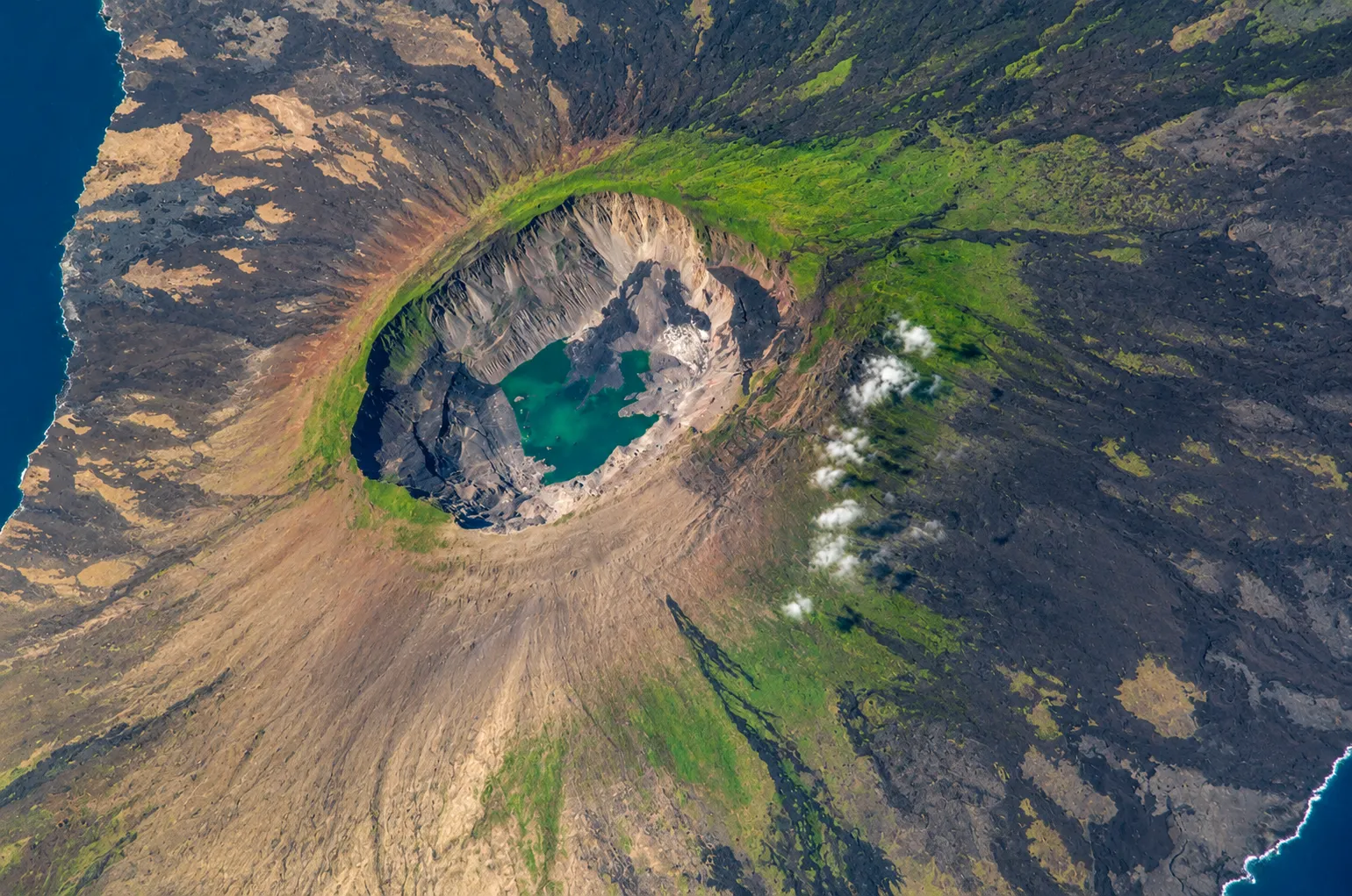
Its shield shape, with broad gentle slopes, comes from eruptions of very fluid lava and crowns in a broad caldera whose floor has known collapses. Its eruptions are effusive, basaltic in character: the accumulated magma opens its way through flank fissures, the lava travels down the slopes and, when it reaches the sea, adds new land to the coast in a landscape that never stops renewing itself. The visit does not reach the volcano: it is admired from the sea and from the surroundings, where Punta Espinoza, the neighbouring site on Fernandina's coast, shares the same young-lava island. On the coasts and slopes live, as a possibility, marine and land iguanas, Galápagos penguins, flightless cormorants, blue-footed boobies, sea turtles, and sea lions.
A shield volcano on Fernandina island
La Cumbre Volcano rises on Fernandina island, an uninhabited territory on the western edge of the archipelago and, at the same time, the youngest island in the archipelago. It is a shield volcano: its broad shape and gentle slopes come from successive eruptions of very fluid lava, which spread in layers until they built a barely tilted mountain. The whole island is a creation of its volcanism, and the surrounding landscape still tells that story.
The silhouette of the shield and its caldera
Seen from afar, the volcano draws the characteristic silhouette of a shield: a mountain of broad base and gentle slopes, moulded by very fluid lava that poured out again and again toward the coast. At the summit opens a broad caldera, a great depression that crowns the mountain and concentrates the eruptive memory of the place.
The floor of that caldera has known collapses, sinkings that renew the inner surface and recall that, beneath the mountain, the magma chamber keeps up its work. On the slopes, in turn, the young lava fields spread over the shield's much older structure, and that superposition can be read at a glance: the mountain shows, in a single landscape, its consolidated base and its renewed surface.
Eruptions that renew the landscape
La Cumbre is one of the most active volcanoes of the archipelago, and its activity is effusive in character: basaltic eruptions that pour lava out rather than throw it. As the magma accumulates, the mountain swells in a barely perceptible way, and the pressure opens its way through fissures on the flanks, through which the lava finds its exit. The rivers of lava advance down the slopes and, when they reach the sea, the meeting of incandescent material and water adds new land to the coast.
Each eruption renews the landscape: it covers ground with new lava, reshapes the coast, and transforms the habitat of the endemic vegetation, such as cacti and palo santo, and of animals such as the land iguana, whose surroundings can be affected where the flows advance; where the lava reaches the ocean, the marine life of the coast can also feel the change. That eruptive history is not presented as a spectacle or a promise: no visit is meant to witness an eruption, and the landscape offers the reading of its result, with young lava fields and a terrain that still shows the traces of its volcanic past.
Essential information
- Identity
- La Cumbre Volcano, a shield volcano on Fernandina island
- Location
- Fernandina island, on the western edge of the archipelago
- Uninhabited island
- Fernandina, the youngest island in the archipelago, is an uninhabited territory
- Type
- Shield volcano formed by eruptions of very fluid lava
- Activity
- Among the most active volcanoes of the archipelago
- Caldera and collapses
- Broad caldera at the summit, with collapses of its floor that renew the inner surface
- Eruptions
- Effusive basaltic lava eruptions that open through flank fissures
- Lava to the sea
- Flows that travel down the slopes and, on reaching the sea, add new land to the coast
- Landscape renewal
- Each eruption renews the terrain and can affect the endemic vegetation, such as cacti and palo santo, and habitats such as that of the land iguana
- Lava coasts
- Coasts of young lava beside the sea, with mangroves and shoreline pools as part of the landscape
- Coastal wildlife
- Marine iguanas, Galápagos penguins, flightless cormorants, blue-footed boobies, sea turtles, and sea lions, as a possibility
- Slope reptiles
- Land iguanas on the slopes and arid zones, as a possibility
- Visit
- No direct route: admired from the sea and from the surroundings
- Punta Espinoza
- Visitor site on Fernandina's coast sharing the same young-lava island
- Protected area
- Contemplation inside the protected area, with careful conduct
The life of the coasts and the slopes
The coasts and slopes of the volcano sustain a life that is presented as a possibility. On the lava shoreline appear marine iguanas, Galápagos penguins, flightless cormorants, and blue-footed boobies; in the surrounding waters appear, when their activity allows it, sea turtles and sea lions; and across the slopes and arid zones moves the land iguana. Every visit shows a different combination, and no appearance is assured.
A volcano viewed from the sea and from the surrou
There is no direct route to the volcano, and that condition defines the view: Fernandina island is uninhabited and La Cumbre is admired from outside. The sea offers the most open perspective, with the silhouette of the shield rising above the coast, and the surrounding landscape completes the scene with its young lava fields and its marine horizon.
Punta Espinoza, the visitor site on Fernandina's coast, shares the same island and serves as neighbouring context of the landscape: it is the geographic neighbour that helps imagine the young-lava surroundings around the volcano, though it never forms part of this entry. Viewing La Cumbre from the sea and from the surroundings means accepting the pace of the landscape: the viewing conditions change with the light and with the day, and contemplation does not include watching eruptions, which is not an attraction of the place.
A contemplation inside the protected area
La Cumbre Volcano is part of the Galápagos protected area. Staying on the designated trails, keeping distance from all wildlife, not feeding or touching the animals, and not leaving waste is the expected conduct, so that the island keeps the strength that sets it apart and its wildlife remains owner of its territory. The calm contemplation of the volcanic landscape is, in itself, the experience the place offers.
Frequently asked questions
- A shield volcano on Fernandina island, on the western edge of the archipelago, and one of the most active volcanoes of the archipelago.
- On Fernandina island, an uninhabited territory on the western edge of the archipelago and the youngest island in the archipelago.
- A shield volcano: a broad mountain with gentle slopes, formed by successive eruptions of very fluid lava.
- A broad depression crowning the summit, whose floor has known collapses that renew the volcano's inner surface.
- Effusively: the accumulated magma opens fissures on the flanks and the poured lava advances down the slopes until it reaches the sea.
- From the sea and from the surroundings: there is no direct route, and the calm contemplation of the landscape is the experience the island offers.
- As a possibility and ecological context: marine and land iguanas, Galápagos penguins, flightless cormorants, blue-footed boobies, sea turtles, and sea lions.
- By staying on the designated trails, keeping distance from wildlife, not feeding or touching the animals, and not leaving waste, so that the island keeps its strength and its wildlife remains owner of its territory.