The youngest island in the archipelago
At the western end of the archipelago, right above the hotspot that gave birth to Galápagos, Fernandina is still taking shape. It is the youngest of the group, has no human population, and ranks third in area: a territory where life takes hold on still-recent lava and where the cold waters arriving from the west surround its dark shores.
Essential information
- Location
- Western end of the archipelago
- Area
- 642 km²
- Maximum altitude
- 1,476 m
- Human population
- No human population
- Geological age
- Less than one million years
- Main volcano
- La Cumbre, a shield volcano
- Caldera
- About 6.5 km wide
Born of fire: La Cumbre
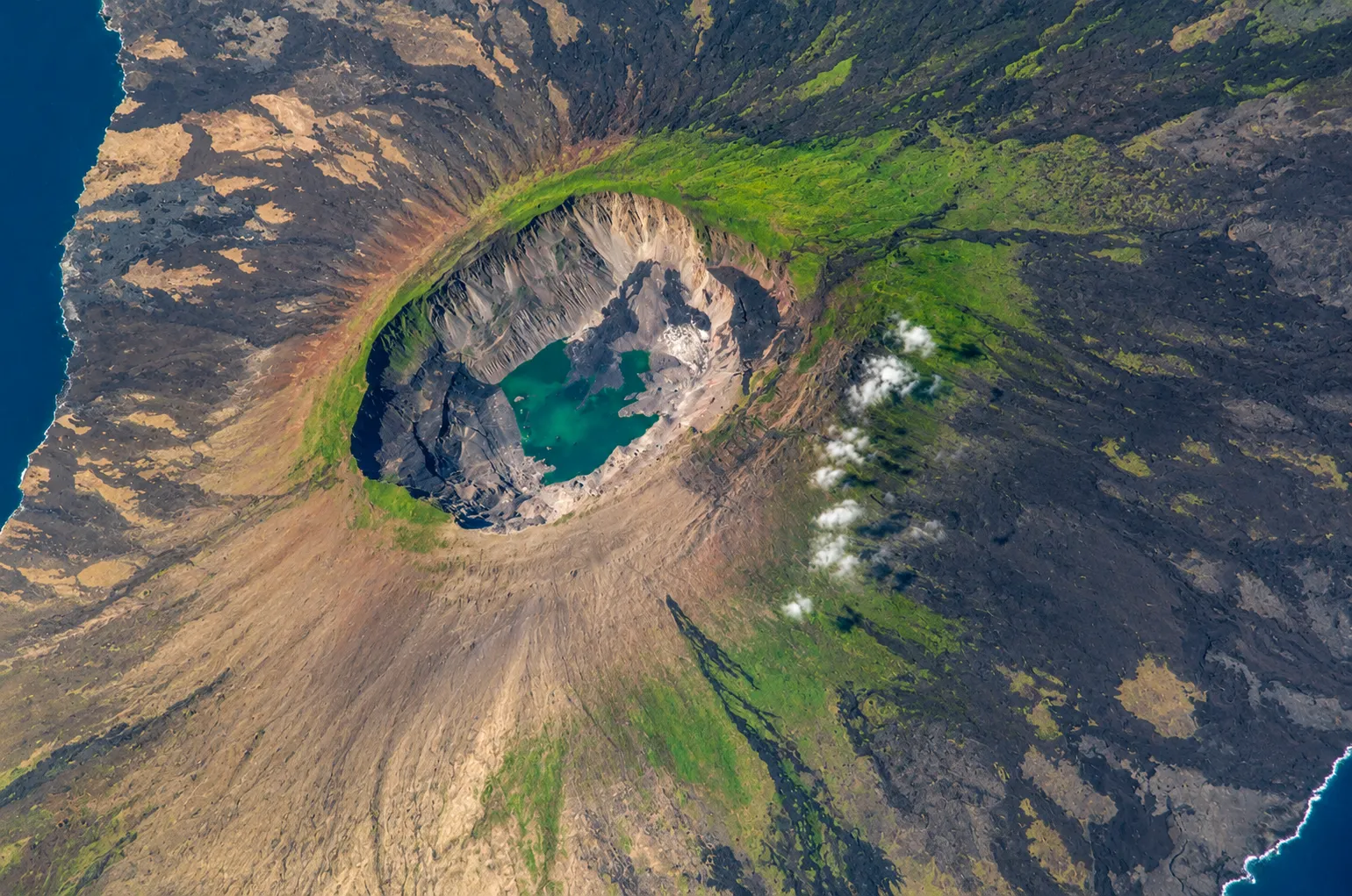
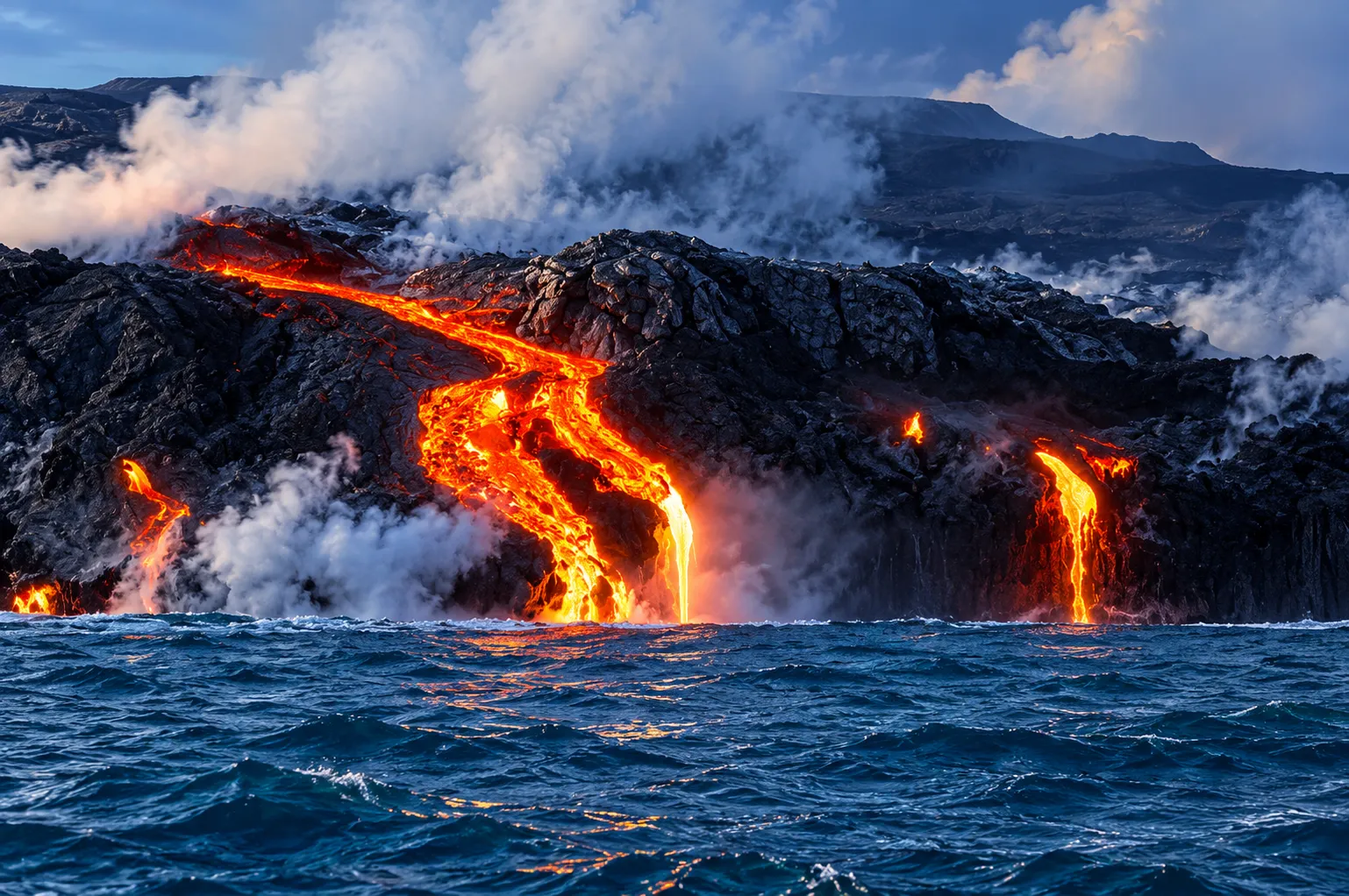
The relief of Fernandina is organized around La Cumbre, a broad-profiled shield volcano resembling the volcanoes of Hawaii. Its caldera, wide and deep, dominates the island’s interior; on its northern side a small lake appears intermittently, changing in size and outline with each eruptive episode. Eruptions occur both inside the caldera and on the outer flanks, and some of them have reached the sea, where lava meets the cold water.
Lava fields cover much of the surface with different types of flow, some smooth in texture and others rough and broken, where vegetation is sparse and mangroves settle along the coast. Fernandina is the island with the highest volcanic activity in Galápagos, and that vitality explains a landscape that renews itself constantly.
History
- The island’s Spanish name honours King Fernando of Spain, sponsor of Columbus’s voyage.
- Ambrose Cowley, a British buccaneer, included the island in his charts and named it Narborough, after Sir John Narborough, an English naval commander.
- Benjamin Morrell, captain of the schooner Tartar, described a violent eruption; early visitors repeatedly recorded a changing landscape and smoking craters.
- Rollo Beck, a member of the California Academy of Sciences expedition, collected a giant tortoise on Fernandina.
- During an explosive eruption, the caldera floor collapsed by about 350 m.
- Illegal fishing camps were observed on the island during the sea-cucumber boom.
Cold waters, abundant life
The Cromwell Current rises from the west and brings cold, nutrient-laden waters to the coasts of Fernandina. Together with western Isabela, the island belongs to the part of the archipelago where those waters rank among the richest: the flightless cormorant and the Galápagos penguin find their habitat there, while marine iguanas and sea lions rest on the lava shores. On the volcano’s heights, land iguanas complete the picture of a fauna adapted to extreme conditions.
A pristine island
Fernandina retains two endemic rice-rat species, a group that disappeared on most other islands after black and Norway rats arrived. Together with Genovesa, it is one of only two large islands in the archipelago that have never had introduced mammals, a condition that underpins the conservation state of its ecosystems.
The main threat to the island is the future introduction of exotic species. Protecting Fernandina depends on preventing new species from reaching its coasts, a condition that preserves the pristine character of its landscapes and wildlife.
Places and landscapes
La Cumbre and its caldera
La Cumbre concentrates the volcanic identity of Fernandina: a broad shield crowned by a wide caldera that dominates the island’s interior and reflects with clarity the geological origin of the territory.
Punta Espinoza
Punta Espinoza, on the north-east coast, is the island’s only visitor site. In a narrow strip between young lava and mangroves, marine iguanas, sea lions, and flightless cormorants live together in a landscape where different lava-flow types show recent volcanic activity.
The western coast
The western coast of Fernandina faces the cold, nutrient-rich waters that characterize the west of the archipelago. That meeting of recent lava and productive sea defines the island’s character and explains the life concentrated along its shores.