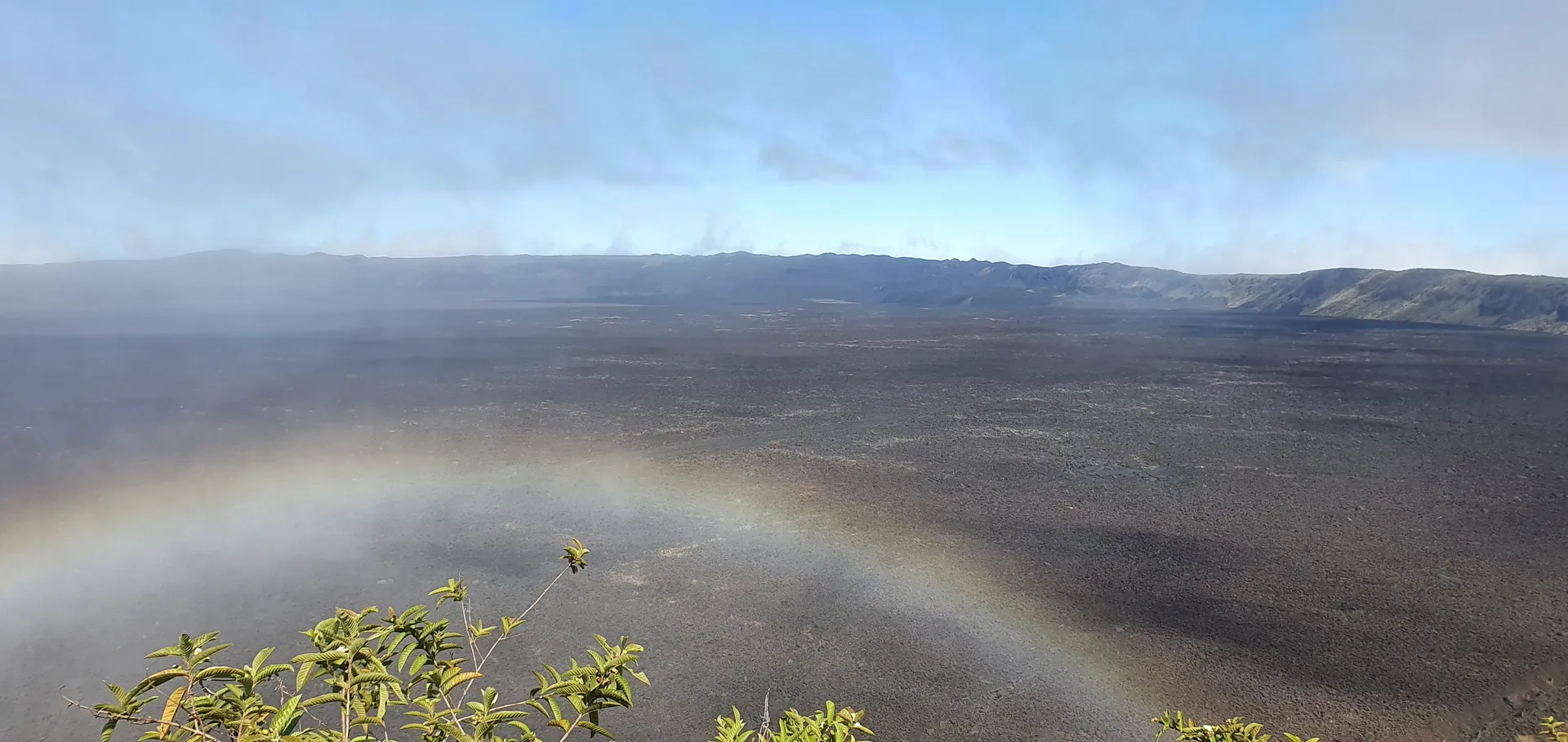
The visit climbs from the island's highlands to the rim of the caldera, which is walked with open views over the interior, where young flows appear as dark patches against the lighter terrain. On the volcano's flank, the Volcán Chico area shows landscapes of young lava almost without vegetation and fumaroles that reveal the volcanic activity of the site. On clear days, the view reaches other volcanoes of Isabela and Fernandina island, while the highlands sustain finches, mockingbirds, and, as ecological context, the giant tortoise.
A shield volcano on Isabela island
Sierra Negra Volcano is one of the six shield volcanoes whose lava flows merged to form Isabela island. Its broad shape and gentle slopes come from successive eruptions of very fluid lava, which spread in layers until they built a barely tilted shield. The name is no ornament: the dark colours of the old lava fields that cover its slopes and the interior of the caldera gave this volcano the name Sierra Negra.
The caldera and its rim
The volcano's caldera is one of its great scenes: a broad depression with a shallow floor. Its interior is a landscape that can be read directly: the younger lava flows stand out as dark patches against the lighter, older terrain, a record of the eruptions that marked its history. The contrast is completed by the rim, held by vegetation, looking into an interior where plant life finds almost no place.
The site's scale is felt before it can be explained: the caldera opens from side to side of the near horizon, and the eye needs time to travel it from rim to rim. That breadth, added to the shallow floor, makes the interior read as another terrain rather than as an abyss: a flat landscape of lava seen from above, with the feeling of standing at the edge of another land.
The ascent to the rim
The visit begins in the island's highlands and climbs steadily to the rim of the caldera. From there, the trail follows the rim and opens the view over the interior and the horizon. The landscape is enjoyed on foot and unhurried: looking into the caldera, following the patches of lava with the eye, taking in the scale of the volcano. The visit runs inside the protected area and shares the territory with natural processes that do not depend on it.
Volcán Chico, young lava, and fumaroles
On the volcano's flank, the Volcán Chico area shows another face of the site. It is a parasitic cone of the volcano itself, and its surroundings are a landscape of young lava, almost without vegetation, where the ground keeps the textures of the recent flows. There the fumaroles can be seen: openings through which the volcano releases vapours and gases, a visible expression of the volcanic activity of the site. The landscape invites watching from a distance and with attention, without moving away from the setting of the visit.
Volcán Chico changes the way the volcano is understood: if the caldera shows the scale, this area shows the youth of the terrain. The lava surfaces keep undulations, cracks, and edges that tell how the incandescent material advanced, and the mineral silence of the landscape accompanies the walk. It is one of the areas of the site where the geological force is felt most closely, and for that reason also where it matters most to stay within the intended setting of the visit.
The views from the rim
On clear days, the view from the rim reaches other volcanoes of Isabela and the silhouette of Fernandina island on the horizon. The views depend on each day's conditions: fog and haze are part of the volcanic landscape, and a clear sky is not guaranteed. That is why the best way to walk the rim is with time and without hurry, letting the mountain show what each moment allows to be seen.
Looking from the rim is also looking at geological time. The volcanoes seen on the horizon belong to the same family of shields that formed the island, and the shared landscape —lava fields, gentle slopes, clouds that open and close— is a reminder that Isabela remains a territory under construction. The visit does no more than peer into that long, silent process.
Life in the highlands
The volcano's highlands sustain a discreet life that accompanies the visit. In the vegetation move Darwin's finches and the mockingbirds; across the landscape the silhouette of the Galápagos hawk may pass, and lava lizards run between the stones. Land iguanas live in the drier zones, and on the slopes and highlands of the volcano lives the giant tortoise, the greater presence of this ecosystem. All wildlife is presented as a possibility: every visit shows a different combination, and no appearance is assured.
A visit inside the protected area
Sierra Negra Volcano is part of the Galápagos protected area. Staying on the trail, keeping distance from all wildlife, not feeding or touching the animals, not taking stones or fragments of lava, and not leaving waste is the expected conduct, so that the landscape keeps the strength that sets it apart and the wildlife remains owner of its territory.
Essential information
- Identity
- Sierra Negra Volcano, a shield volcano on Isabela island
- Location
- Isabela island, associated with the island's southern highlands
- Type
- Shield volcano formed by eruptions of very fluid lava
- Name
- Its name refers to the dark colours of the old lava fields
- Caldera
- Broad caldera with a shallow floor
- Lava flows
- Young flows that stand out as dark patches against the lighter, older terrain
- Interior and rim
- A rim with vegetation and a caldera interior where plant life finds almost no place
- Trail
- Trail that climbs from the island's highlands and follows the caldera rim
- Volcán Chico
- A parasitic cone on the volcano's flank, with landscapes of young lava almost without vegetation
- Fumaroles
- Fumaroles in the Volcán Chico area, a visible expression of the volcanic activity of the site
- Views
- On clear days, other volcanoes of Isabela and Fernandina island on the horizon
- Wildlife
- Darwin's finches, mockingbirds, the Galápagos hawk, lava lizards, and land iguanas, as a possibility
- Giant tortoise
- Giant tortoise on the volcano's slopes and highlands, as ecological context
- Visit
- A visit on foot inside the protected area, on trails and with careful conduct
Frequently asked questions
- One of the six shield volcanoes that formed Isabela island, recognisable by its dark lava fields and its broad caldera with a shallow floor.
- For the dark colours of the old lava flows that cover its slopes and the interior of the caldera.
- An open view over the interior, with the young flows as dark patches against the lighter terrain and, on clear days, other volcanoes of Isabela and Fernandina island on the horizon.
- It starts in the island's highlands and climbs steadily to the rim of the caldera, which is walked on foot with time and without hurry, inside the protected area.
- A parasitic cone on the volcano's flank, with a landscape of young lava almost without vegetation that keeps the textures of the recent flows.
- They are openings through which the volcano releases vapours and gases, a visible expression of the volcanic activity of the site, watched from a distance and without moving away from the setting of the visit.
- As a possibility and ecological context: Darwin's finches, mockingbirds, the Galápagos hawk, lava lizards, land iguanas, and, on the slopes and highlands, the giant tortoise.
- By staying on the trail, keeping distance from wildlife, not feeding or touching the animals, not taking stones or fragments of lava, and not leaving waste.