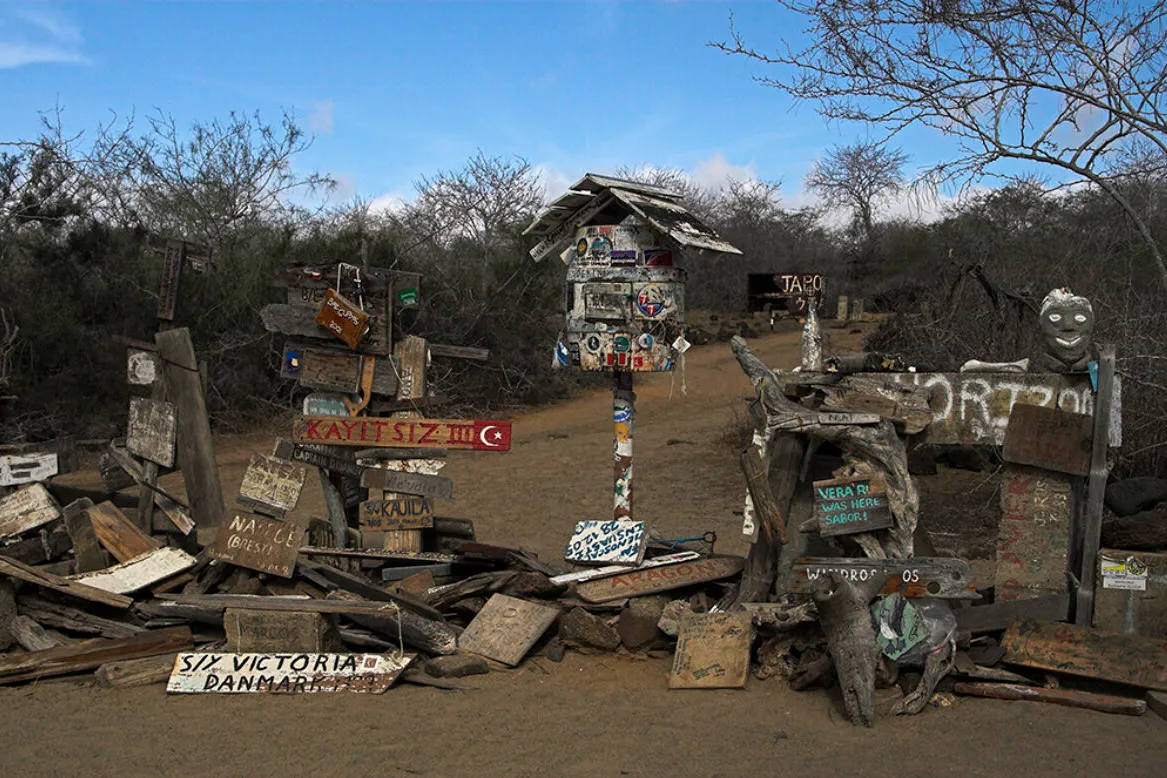
In the late eighteenth century, the whalers who sailed the Pacific left a wooden barrel here that worked as a post office: each sailor dropped off letters with the address written on them, and ships heading home collected the ones they could deliver. The tradition is still alive. Visitors leave their own postcards in the barrel, look through the ones waiting there, and take those they can deliver by hand. A short distance away there is a lava tube entered by a ladder. On the beach and in the water of the bay, sea lions, green turtles, and rays may appear, and among the vegetation, Darwin's finches, yellow warblers, and lava lizards, always as a possibility.
A mailbox in the middle of the Pacific
Most Galápagos sites are visited for their animals, their volcanoes, or their landscapes. Post Office Bay, on the north coast of Floreana island, is different: what people come to discover here is a human story. It is the story of a wooden barrel that, for generations, served as a post office for sailors who spent years away from home, and of a tradition that still passes from hand to hand today.
The whalers of the Pacific
In the late eighteenth century, British whaling ships, and later American ones, hunted sperm whales in the waters of the Pacific. Voyages lasted years, and Galápagos became their main base in that ocean: a place to take on water and food before returning to the hunting grounds.
For those sailors, the problem was distance. There was no way to send news home or to receive it, other than trusting another ship to set the right course.
A barrel, an address, and trust in a stranger
The solution was as simple as it was ingenious. In this bay on Floreana, a group of whalers placed a wooden barrel and called it a post office. Those passing through left their letters with the address written on them, with no stamp or postage. Those starting the journey home checked the barrel and took the letters bound for their port or homeland, to deliver them on arrival. In this way, letters travelled from ship to ship to Europe or North America, with no guarantee other than the word of a stranger.
For a long time, the creation of the barrel was credited to the British captain James Colnett, who sailed these waters in the late eighteenth century. However, British whalers were already working in Galápagos before his arrival, and the barrel belongs, above all, to that community of anonymous sailors.
The barrel in wartime
The barrel did not only hold family letters. In the early nineteenth century, during the war between Britain and the United States, an American frigate operating in Galápagos used the information gathered in the mailbox to track the movements of the British whalers. Those captures helped shift whaling in the region from British to American hands.
The price paid by the tortoises
The whalers' stopovers came at a cost to the islands. Giant tortoises became food for the crews. Floreana's native tortoise disappeared in the nineteenth century, and its story belongs to the same era that the barrel recalls.
Essential information
- Identity
- Post Office Bay, visitor site on Floreana island
- Location
- North coast of Floreana
- Site type
- Visitor site centred on the human history of Galápagos
- Origin
- Wooden barrel placed by whalers in the late eighteenth century
- How it worked
- Letters with an address and no stamp, collected by whoever was travelling towards their destination
- Current tradition
- Visitors leave postcards and take those they can deliver by hand
- Whaling era
- Galápagos was the whalers' main base in the Pacific
- Tortoises
- Floreana's native tortoise disappeared in the nineteenth century
- Settlement
- Setting of a Norwegian settlement attempt in the twentieth century that did not succeed
- Lava tube
- A short distance from the barrel, entered by a ladder
- Arrival
- By sea, with a landing on the beach
- Possible wildlife
- Sea lions, green turtles, rays, Darwin's finches, yellow warblers, and lava lizards
- Conduct
- Take only the postcards you will deliver; do not take stones, shells, or plants, and leave no waste
A tradition still in motion
Although the original barrel was replaced over time, the custom was never interrupted. Today it is visitors who keep it alive. Each person can leave a postcard with the address written on it and look through the ones waiting in the barrel, in search of one addressed to a place near their home.
The unwritten rule is the same as the whalers': whoever takes a letter takes on the commitment to deliver it by hand and, if possible, to tell how it got there. Putting a stamp on it and dropping it in a mailbox gets it delivered, but loses the meaning of the tradition. That is why no one knows when the postcard they leave in the barrel will arrive: it may travel right away or wait for the right traveller to come along.
A Norwegian attempt to put down roots
The bay holds another chapter of Floreana's human history. In the twentieth century, a group of Norwegian immigrants tried to settle in this area. The attempt was short-lived and did not succeed, but it is part of the long list of people who tried to put down roots on the island.
A lava tube beside the bay
A short distance from the barrel lies a lava tube, a natural cave that formed when the surface of a river of lava cooled and hardened while the lava inside kept flowing. When it drained, it left an underground tunnel. It is entered by a ladder, and inside, daylight soon fades into the darkness of the volcan
The beach and the water of the bay
The visit begins and ends on a sandy beach, where visitors land from the water. On the shore and in the bay, Galápagos sea lions, Zalophus wollebaeki, may appear, and in the water, green turtles, Chelonia mydas agassizii, and rays. When sea conditions allow, snorkelling off the beach is a way to see that life up close.
In the vegetation around the beach, Darwin's finches and yellow warblers may be seen, and among the rocks, lava lizards. None of these appearances is assured: they are possibilities of the place, which change from one visit to the next.
A visit inside the protected area
Post Office Bay is part of the Galápagos protected area. Something unusual for the islands happens here: taking a postcard from the barrel is part of the visit. Beyond that gesture, the usual conduct applies: do not take stones, shells, or plants, leave no waste, do not disturb the animals, and keep your distance from the sea lions.
Frequently asked questions
- A visitor site on the north coast of Floreana island, known for the wooden barrel that whalers used as a post office.
- Because in the late eighteenth century whalers placed a barrel there where they left letters for other ships to carry to their destination.
- Each sailor left letters with the address written on them and no stamp, and whoever was starting the journey home took those bound for their homeland to deliver them.
- Yes. Visitors leave postcards with the address written on them and take those they can deliver by hand near their home.
- A group of whalers. For a long time it was credited to Captain James Colnett, but British whalers were already working in Galápagos before his arrival.
- A sandy beach and, a short distance from the barrel, a lava tube entered by a ladder.
- Sea lions, green turtles, and rays on the beach and in the water, and Darwin's finches, yellow warblers, and lava lizards on land, always as a possibility.
- By sea, with a landing on the beach.