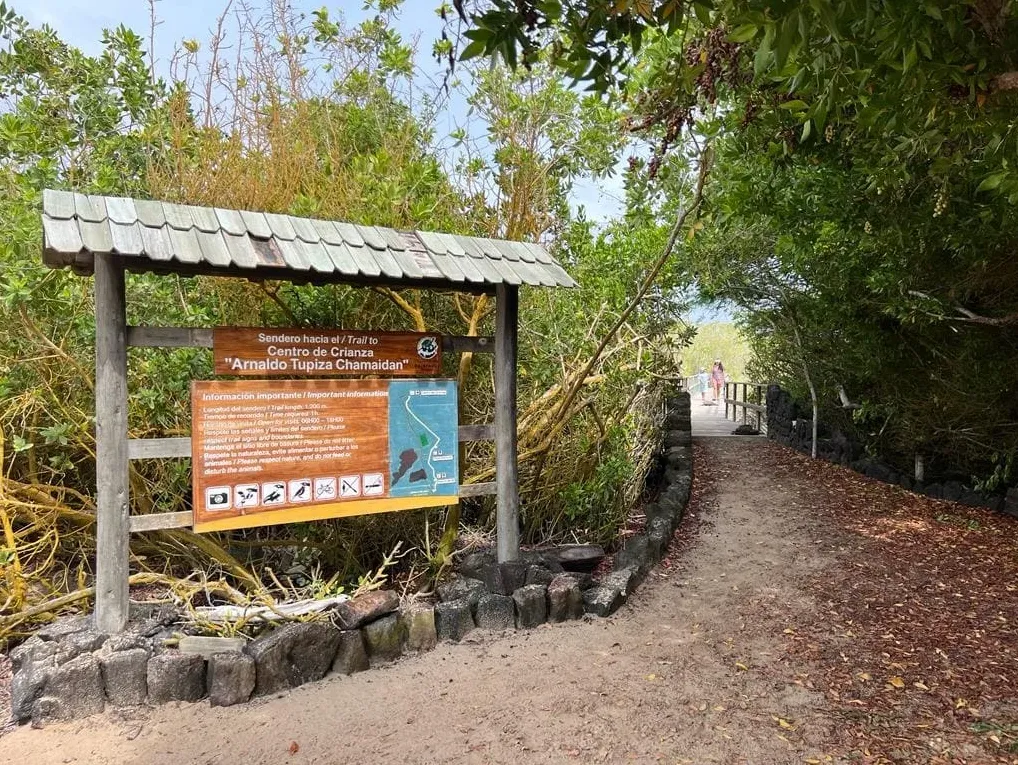
Eggs are incubated at the centre, hatchlings grow in pens under conditions similar to the wild during their first years, the most vulnerable ones, and the young tortoises later return to the volcanoes they come from. Tortoises of all ages, from hatchlings to breeding adults, can be seen in the pens. It is reached on foot by an interpretive trail that leaves Puerto Villamil and crosses wetlands, lagoons, and dry forest, where flamingos, waterbirds, and marine iguanas may appear, always as a possibility.
A centre for the giant tortoises of southern Isabela
The Arnaldo Tupiza Chamaidán Breeding and Rearing Centre lies on the outskirts of Puerto Villamil, on Isabela island. There, the Galápagos National Park authority breeds and rears in captivity the giant tortoises of the island's southern volcanoes, so that they can later return to their natural habitat. It is one of the breeding centres the park maintains in the archipelago, and the place on Isabela where this work can be seen up close.
Why the centre exists
The centre was created in response to a major fire in southern Isabela that threatened the tortoises' habitat, and to help rebuild their populations more quickly. The tortoises of the south of the island had also suffered from hunting, competition for food from introduced goats, the trampling of nests by feral donkeys, and volcanic eruptions.
Captive breeding is a management tool the park has applied in Galápagos for decades: protecting the tortoises during their first years, when they are most vulnerable, and then returning them to the place they come from.
Two species from two volcanoes
The centre rears the two giant tortoise species of southern Isabela. The Sierra Negra giant tortoise, Chelonoidis guntheri, comes from populations on that volcano such as Cazuela, Roca Unión, and Cerro Paloma. The Cerro Azul giant tortoise, Chelonoidis vicina, is endemic to Galápagos and lives on the Cerro Azul volcano. The centre also rears tortoises from the Cinco Cerros population, on the slopes of Cerro Azul.
Each volcano on Isabela has its own giant tortoise, and the centre's pens keep the groups apart according to their origin. Keeping that separation allows each tortoise to return to the population and volcano it belongs to.
Essential information
- Identity
- Arnaldo Tupiza Chamaidán Breeding and Rearing Centre, on Isabela island
- Location
- On the outskirts of Puerto Villamil
- Management
- Galápagos National Park
- Purpose
- Breeding and rearing giant tortoises of southern Isabela in captivity to return them to their habitat
- Origin
- Created in response to a major fire in southern Isabela that threatened the tortoises' habitat
- Sierra Negra tortoise
- Chelonoidis guntheri, from populations such as Cazuela, Roca Unión, and Cerro Paloma
- Cerro Azul tortoise
- Chelonoidis vicina, endemic to Galápagos, from the Cerro Azul volcano
- Rearing cycle
- Egg incubation, rearing in pens, health checks, and return to the volcanoes of origin
- What can be seen
- Tortoises of all ages, from hatchlings to breeding adults
- Access
- On foot, by an interpretive trail from Puerto Villamil that ends at the centre
- Trail landscape
- Wetlands, lagoons, mangroves, and dry forest
- Possible wildlife
- Flamingos, shorebirds and waterbirds, and marine iguanas along the trail
- Conduct
- Stay on the trail, do not feed or disturb the tortoises, and do not put hands into the pens
From egg to volcano
The cycle begins with the eggs, which are incubated at the centre in incubators. After hatching, the young tortoises spend their first years in pens that reproduce conditions similar to those of the wild, with water pools, ramps, and feeding areas. During that time, park rangers regularly record each tortoise's measurements and mark them for identification.
When the young tortoises reach a suitable size, they go through quarantine and a veterinary assessment, receive an identification chip, and are taken to their volcano of origin, sometimes by sea and on foot across rugged terrain. Once released, they remain there for the rest of their lives, and their adaptation is followed in later monitoring.
Gardeners of the ecosystem
Back on the volcanoes, giant tortoises play an essential role in the ecosystem. As they move and feed, they shape the landscape and disperse the seeds of the plants they eat. That is why they are called architects or engineers of the ecosystem, and their return helps maintain the natural dynamics of plant communities.
What can be seen on a visit
A visit allows you to see tortoises of all ages, from newly hatched young to the adults of the breeding groups, and to learn about the process of captive breeding and rearing. The pens for the different origins make it possible to compare tortoises from different volcanoes, whose shells do not have the same shape. The centre also has an environmental education area where the park welcomes students and community groups from Isabela.
The trail from Puerto Villamil
The centre is reached on foot by an interpretive trail that leaves Puerto Villamil and ends at the centre itself. The route includes a wooden walkway and crosses the wetlands and brackish lagoons near town, with mangroves, followed by a stretch of dry forest with cacti and native shrubs. The walk itself shows several landscapes of southern Isabela.
Native plants at the centre and along the way
Along the trail, black mangrove and white mangrove grow in the wet areas, and in the dry forest species such as palo santo, muyuyo, faique, and rodilla de caballo. At the centre itself, park rangers and Isabela students planted rodilla de caballo, Clerodendrum molle, as a living fence around the environmental education area.
Possible wildlife along the trail
In the lagoons along the route, flamingos may be seen feeding, together with shorebirds and waterbirds, and on the rocky areas near the coast, marine iguanas. None of these appearances is assured: they are possibilities of the trail, not an offer the walk fulfils on every visit.
A visit inside the protected area
The centre and the trail that leads to it are part of the work of the Galápagos protected area. Staying on the trail, not feeding or disturbing the tortoises, not putting hands into the pens, following the site's guidance, and leaving no waste is the expected conduct, so that the care of the tortoises continues without interference.
Frequently asked questions
- A Galápagos National Park centre on the outskirts of Puerto Villamil, on Isabela island, where the giant tortoises of the south of the island are bred and reared in captivity.
- The Sierra Negra giant tortoise, Chelonoidis guntheri, and the Cerro Azul giant tortoise, Chelonoidis vicina, the two species of southern Isabela.
- In response to a major fire in southern Isabela that threatened the tortoises' habitat, and to help rebuild their populations.
- Eggs are incubated at the centre, hatchlings grow in pens during their first years and, after quarantine and a veterinary assessment, return to their volcano of origin.
- Tortoises of all ages, from hatchlings to breeding adults, in pens separated according to their origin.
- As they move and feed, they shape the landscape and disperse seeds, which is why they are considered engineers of the ecosystem.
- On foot, by an interpretive trail that leaves Puerto Villamil, crosses wetlands, lagoons, and dry forest, and ends at the centre.
- Stay on the trail, do not feed or disturb the tortoises, do not put hands into the pens, and leave no waste.