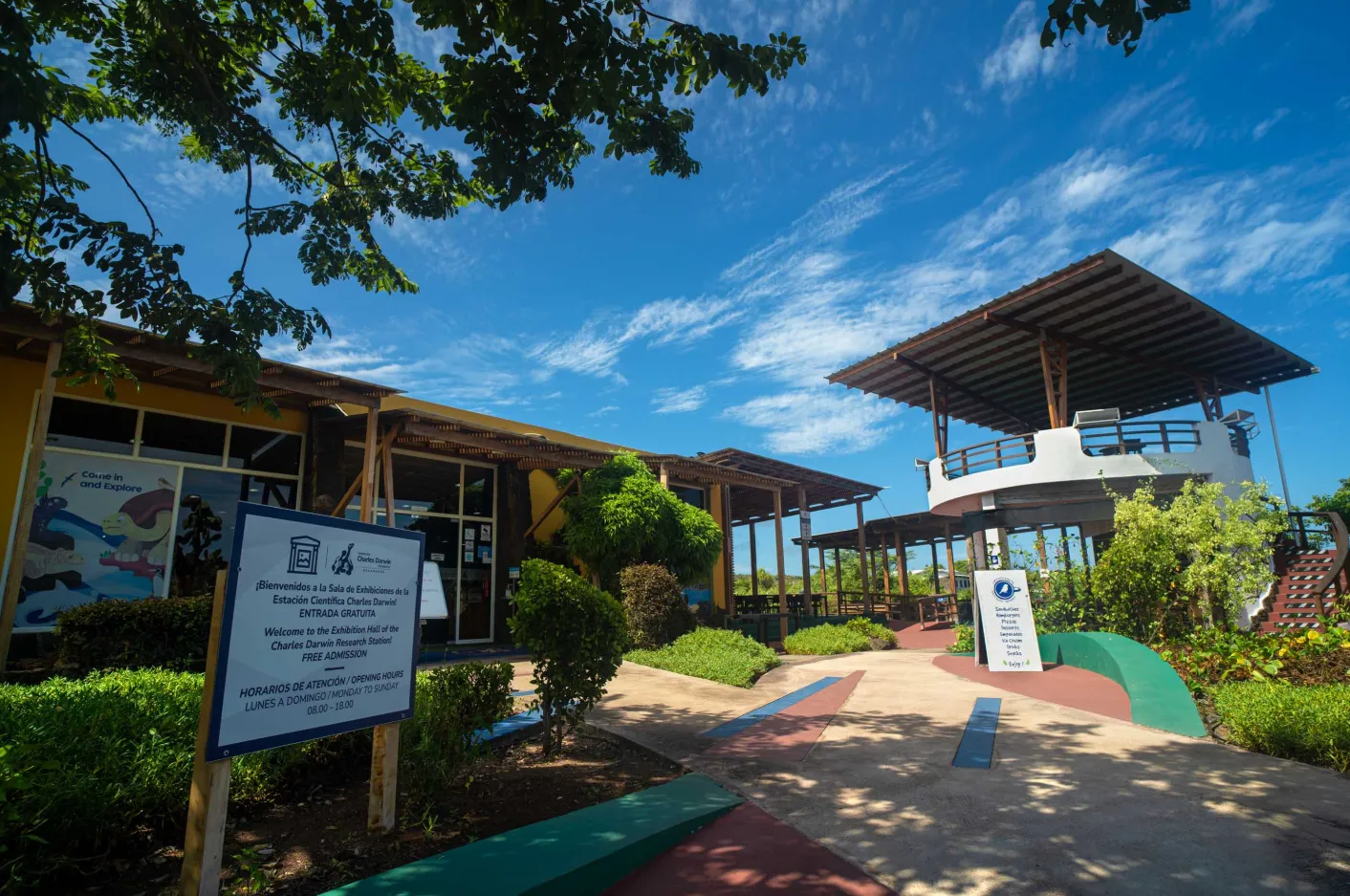
The public route includes the Charles Darwin Exhibition Hall, the Van Straelen Interpretation Center with its "Marine World" theme on sharks and marine pollution, the Native Gardens and Shade House with endemic flora such as Scalesia affinis, and the G. T. Corley Smith Library, Archive, and Museum. As the largest scientific station in Galapagos, it is a strategic ally for researchers, welcoming 95 visiting scientists from 17 countries in 2022. Behind those areas, the institution holds a natural history collection of more than 135,000 specimens, sustains an Inspiration Complex with research laboratories, and maintains the dataZone, an open platform with more than 60 years of scientific data on the archipelago. The campus also keeps the memory of Lonesome George, the last known giant tortoise of his subspecies, who lived at the nearby Breeding Center until his death in 2012, without achieving reproduction despite the breeding programme's attempts.
A research campus open to the public
In Puerto Ayora, following Avenida Charles Darwin, visitors reach the campus of the Charles Darwin Research Station (CDRS), the headquarters of the Charles Darwin Foundation on Santa Cruz island. The campus address is Avenida Charles Darwin 854, Puerto Ayora 200350.
Entry to the campus is free and the opening hours run continuously every day from 8am to 6pm, including holidays. It receives more than 125,000 visitors each year, on top of sustaining the research work that gives it its purpose.
A foundation born alongside the national park
The Charles Darwin Foundation (CDF) was founded in 1959 by a group of scientists, researchers, and conservationists, with support from UNESCO and the IUCN, the same year Ecuador declared the Galapagos National Park. It is an international non-profit organisation established under Belgian law.
The Charles Darwin Research Station opened in 1964 in Puerto Ayora, as a physical base for scientific research in Galapagos. Since then, the campus has combined that research function with receiving visitors who walk through its public areas.
Essential information
- Identity
- Charles Darwin Research Station (CDRS), in Puerto Ayora, Santa Cruz
- Address
- Avenida Charles Darwin 854, Puerto Ayora 200350, Ecuador
- Foundation
- Charles Darwin Foundation (CDF), founded in 1959 with support from UNESCO and the IUCN
- CDRS opening
- 1964, in Puerto Ayora, Santa Cruz island
- Hours
- Every day from 8am to 6pm, including holidays
- Annual visitors
- More than 125,000
- Scientific collection
- More than 135,000 natural history specimens, available to qualified researchers
The campus's public areas
The public route through the campus includes the Charles Darwin Exhibition Hall, which gathers more than 60 years of research in natural history collections and rotating exhibitions, with a donation point inside the same space. The hall also offers the chance to take a photo next to a figure of Charles Darwin, as part of the same must-see visit.
Next to it, the Van Straelen Interpretation Center develops the "Marine World" theme on Galapagos marine ecosystems, the ecological role and vulnerability of sharks, and the scientific methods used to study them. The center also raises awareness about ocean pollution from plastics, and opens Monday to Friday from 8am to 3:30pm.
The campus also keeps the Native Gardens and the Shade House, with endemic flora such as Scalesia affinis, a critically endangered species native to Puerto Ayora, recognisable by its heart-shaped leaves and fragrant flowers, within the work of the Galapagos Verde 2050 programme to restore the islands' ecological balance. The G. T. Corley Smith Library, Archive, and Museum completes the public route, dedicated to managing documents, archival materials, and objects of historical, institutional, and cultural value for the CDRS and the communities of Galapagos, and is open to those visiting the campus.
The research partner scientists prefer
As the largest scientific station in Galapagos, standing next to the Galapagos National Park Directorate, the CDRS serves as a strategic ally for collaborating and associated scientists and visitors seeking to advance their research in the archipelago. In 2022, it welcomed a total of 95 visiting scientists from 17 different countries.
Behind the public areas, the campus sustains an Inspiration Complex with offices and marine and terrestrial research laboratories, along with a conference room seating up to 70 people with a view of Academy Bay. That scientific work draws on the natural history collection of more than 135,000 specimens, described as the largest of its kind in the world, available to qualified researchers seeking to contribute to the knowledge of the distribution, ecology, and diversity of Galapagos biota.
The Foundation also maintains the dataZone, a collection of web-based databases, virtualisation tools, and interactive digital platforms, accessible online or on the campus, providing access to data and knowledge from more than 60 years of scientific research in the Galapagos Islands. That initiative reflects the open-source mindset the CDRS adopts to widen the reach of information related to the archipelago.
Its research and conservation work extends beyond what visitors walk through directly on the campus, in ongoing collaboration with the Galapagos National Park Directorate as its main partner. Alongside its main headquarters in Santa Cruz, the Foundation maintains a presence on Isabela and San Cristóbal islands, and a short walk from the campus lies the Fausto Llerena Giant Tortoise Breeding Center, mentioned here only as a nearby location reference.
The memory of Lonesome George
Lonesome George was found on Pinta island in 1971 and lived at the Station's Breeding Center, near the campus, from 1972-1973 until his death on 24 June 2012. He was the last known individual of his subspecies.
Under the breeding programme, George was allowed to share his pen with two females from Wolf volcano, on Isabela island, chosen for being genetically close to his subspecies, but the attempt did not produce successful results. Decades of that effort ended without achieving his reproduction.
His story is part of the campus's institutional memory, as acknowledged by the Foundation's own database. It is remembered as a verified fact of research and conservation in Galapagos, needing no dramatisation to hold its place.
Frequently asked questions
- The campus is open every day from 8am to 6pm, including holidays, with no interruption. The Van Straelen Interpretation Center has its own schedule, Monday to Friday from 8am to 3:30pm.
- The Charles Darwin Foundation was founded in 1959 and the Charles Darwin Research Station opened in 1964 in Puerto Ayora.
- The Charles Darwin Exhibition Hall, the Van Straelen Interpretation Center, the Native Gardens and Shade House, and the G. T. Corley Smith Library, Archive, and Museum.
- The natural history collection, of more than 135,000 specimens, is available to qualified researchers, not to the general public.
- The last known giant tortoise of his subspecies, found on Pinta in 1971, who lived at the Breeding Center near the campus until his death in 2012.
Leaving the campus
The walk through the campus ends where it began, on Avenida Charles Darwin, heading back towards Puerto Ayora. What remains of the visit does not depend on a promise of a fixed schedule, transport, or service: the Exhibition Hall, the gardens, the library, and the memory of Lonesome George are all part of the same research campus open to the public, sustained by more than sixty years of scientific work.