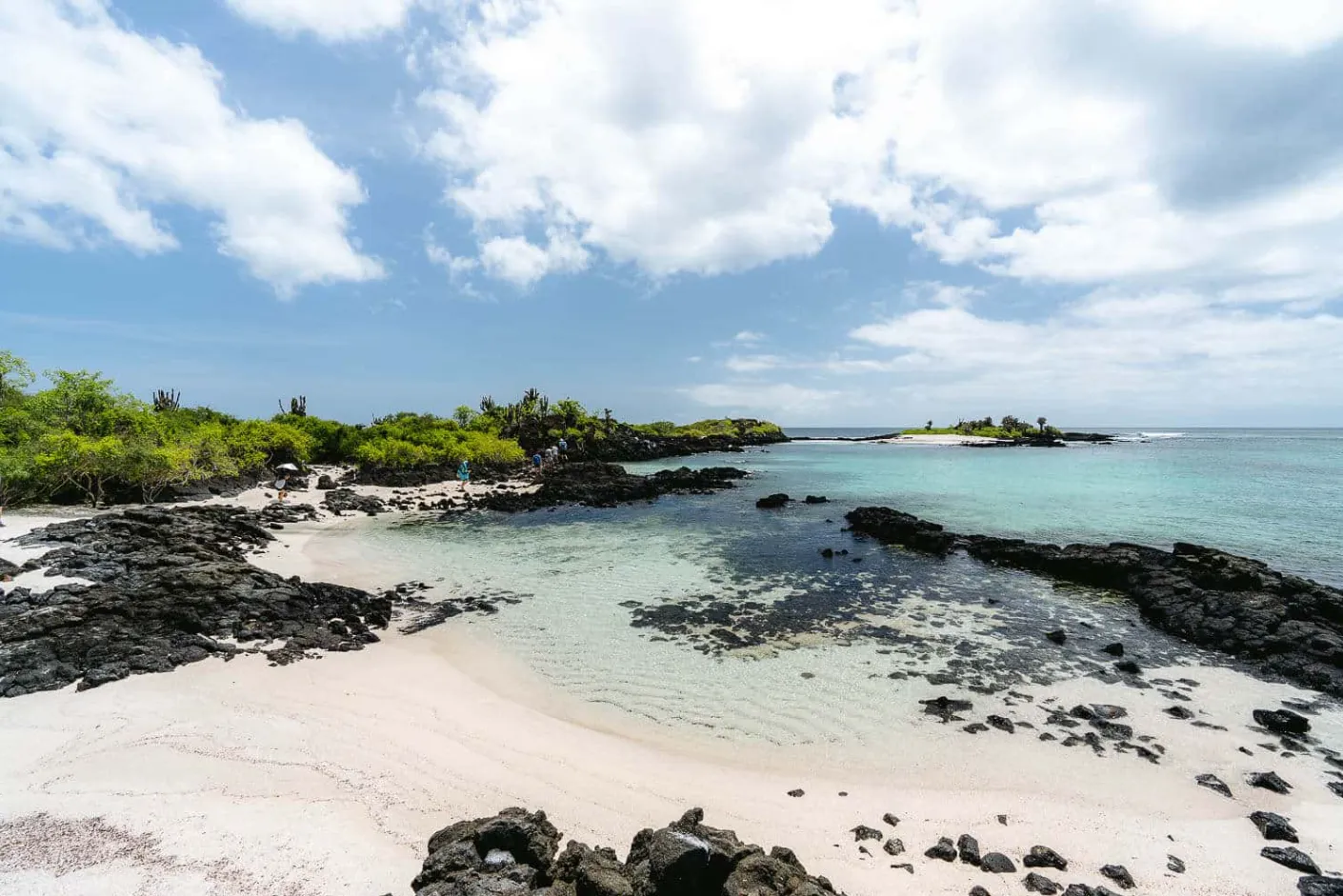
A sandy-bottomed water inlet runs across it, and at high tide the point is cut off from the rest of the island. It is reached on foot along a coastal trail, over sand and rock, that leaves town and looks out over the bay. Its name comes from the Galápagos sea lions that rest on the sand and swim in the bay. Marine iguanas may be seen on the rocky shore, and in the water, green turtles, rays, and fish, always as a possibility. It is also a spot where Floreana's residents come to spend the day by the sea.
A walk from town to the sea lions' shore
The way to La Lobería starts in Puerto Velasco Ibarra. From town, a coastal trail heads south through the dry vegetation of Floreana's lowlands, at times over sand and at times over volcanic rock. As you go, the bay opens up beside the path and the sound of the sea accompanies every step, until the coast becomes a point of dark rock and white sand.
A point of rock, sand, and tide
The point brings three landscapes together in very little space: the black volcanic rock that forms the shore, the small white-sand beaches that open up within it, and the arid vegetation that covers its tip. A sandy-bottomed water inlet crosses it, and when the tide rises the sea fills it and the point is cut off from the rest of the island.
On the other side lies the bay, with its rocky and sandy floors, which can be taken in from the top of the rocks and from different points along the trail.
Essential information
- Identity
- La Lobería, visitor site on Floreana island
- Location
- South of Puerto Velasco Ibarra
- Landscape
- Point of volcanic rock with white-sand beaches and arid vegetation at its tip
- Tide
- At high tide, a sandy-bottomed water inlet separates the point from the rest of the island
- Access
- On foot, by a coastal trail of sand and rock that leaves Puerto Velasco Ibarra
- Sea lion
- Galápagos sea lion (Zalophus wollebaeki), on the beach and in the bay
- Marine iguana
- Marine iguana (Amblyrhynchus cristatus), endemic to Galápagos, along the shore
- Green turtle
- Green turtle (Chelonia mydas agassizii), the Galápagos green turtle, in the rocky bay
- Other species
- Rays, fish, lava lizards, finches, mockingbirds, pelicans, frigatebirds, and shorebirds
- Activities
- Walking, wildlife watching, photography, and snorkelling or kayaking when the sea allows
Community
A place of recreation for Floreana's residents
Essential information
- Conduct
- Keep your distance from the sea lions, especially the males, and do not disturb the animals
The place of the sea lions
The name of the site comes from the Galápagos sea lions, Zalophus wollebaeki. They can be seen resting on the white sand, lying on the rocks, or swimming in the water of the bay. Their calls are part of the place's soundscape, and they may be heard before they are seen.
Adult males may defend their stretch of shore if someone comes too close. That is why it is best to watch without approaching, give them space, and let them set the distance.
Iguanas on the lava, turtles in the bay
Along the rocky shore, marine iguanas, Amblyrhynchus cristatus, endemic to Galápagos, may appear. Their dark skin blends into the lava, and they are often only noticed when they move.
From the top of the rocks, the eye turns to the water of the bay, where green turtles, Chelonia mydas agassizii, the Galápagos green turtle, may surface as they swim over the rocky floors. Rays and fish complete the life that can be seen from the shore.
Life along the trail
The path has its own residents too. Among the stones and the dry vegetation, lava lizards, finches, and mockingbirds may be seen, and along the coast, pelicans, frigatebirds, and shorebirds working the shoreline. None of these appearances is assured: wildlife changes from one day to the next, and each visit shows a different combination.
Snorkelling and kayaking when the sea allows
When sea conditions are favourable, the bay offers the possibility of snorkelling and of exploring it by kayak, within what the protected-area rules allow. Under the water, green turtles, sea lions, rays, and coastal fish may appear. The tide, the swell, and the visibility change, and it is the conditions of each moment that decide whether it is wise to go into the water.
A corner of Floreana's community
La Lobería is not only a site for visitors. Floreana's residents use it as a place of recreation, to walk, look out to sea, and spend the day by the coast. Visiting it means sharing, for a while, a space that is part of the everyday life of Floreana's community.
A visit inside the protected area
La Lobería is part of the Galápagos protected area. Staying on the trail, keeping your distance from the sea lions, especially the males, not touching or disturbing the animals, and leaving no waste is the expected conduct, so that life at the site continues without interference.
Frequently asked questions
- A coastal visitor site on Floreana island, south of Puerto Velasco Ibarra: a point of volcanic rock with white-sand beaches and arid vegetation, frequented by sea lions.
- On foot, by a coastal trail of sand and rock that leaves Puerto Velasco Ibarra heading south and looks out over the bay.
- After the Galápagos sea lions that rest on its sand and rocks and swim in the bay; "lobería" is the Spanish word for a sea lion colony.
- A sandy-bottomed water inlet crosses the point, and at high tide the sea separates it from the rest of the island.
- Sea lions, marine iguanas, green turtles, rays, and fish, as well as lava lizards, finches, mockingbirds, pelicans, frigatebirds, and shorebirds, always as a possibility.
- Walk, watch wildlife, and take photographs, and snorkel or kayak when sea conditions allow.
- Watch without approaching, give them space, especially the males, and do not touch or disturb them.