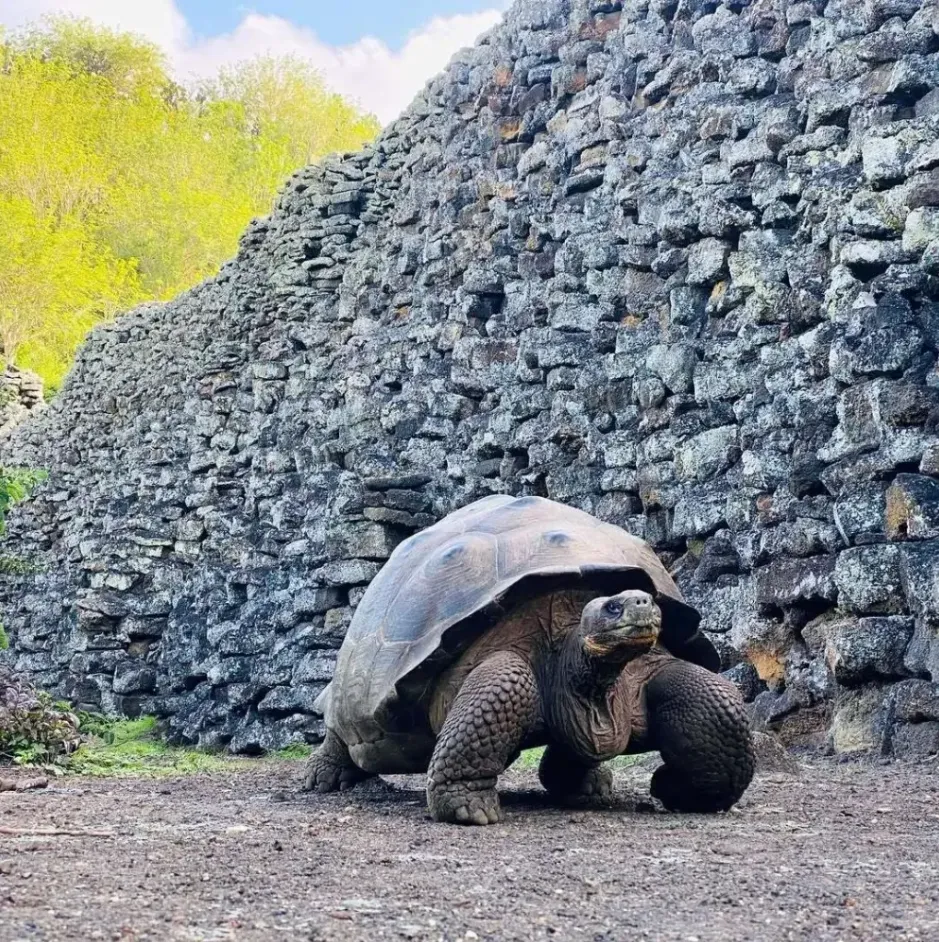
Today it is a place of memory that recalls a period of cruelty in the human history of the archipelago. It is reached by a trail that leaves Puerto Villamil, passes the town cemetery, crosses the southern Isabela wetlands, with white-sand beaches, lagoons, and mangroves, and continues through the dry zone to the wall. Steps climb to the Cerro Radar viewpoint, with a wide view of the coast. Along the way, giant tortoises, marine iguanas, shorebirds, and Darwin's finches may appear, always as a possibility.
A wall raised by prisoners
The Wall of Tears is a historical site on Isabela island, west of Puerto Villamil. It is a long wall of rough black lava blocks, raised by hand by the prisoners of the penal colony that operated on the island in the mid-twentieth century. Its name recalls the suffering of those who were forced to build it.
The Isabela penal colony
The penal colony was established by decision of the government of President José María Velasco Ibarra, in an area of Isabela where facilities of a United States military base from the Second World War remained. At the time, the mainland saw Galápagos as a remote edge of the world, and banishment to the islands was understood as one of the harshest punishments.
The prisoners were subjected to forced labour. Part of it was building the wall: they had to cut and carry large lava blocks by hand, without machinery, under the sun of the island's dry zone. The wall enclosed and protected nothing; its only purpose was to keep the inmates busy. Conditions were extremely harsh, and the work cost lives.
Revolt and closure
Towards the end of its existence, the prisoners revolted and tried to escape. The account passed down on Isabela tells that the revolt began during a theatre play the inmates performed for their guards, and that the scene served to surprise and disarm them. Shortly afterwards, the penal colony ceased to operate and its facilities were abandoned.
A place of memory
Of the former penal colony, what still stands is, above all, the wall. Today it is a visitor site of the protected area and a testament to a period of cruelty in the human history of Galápagos, a history not often associated with the archipelago. For some Isabela residents it is also a place of personal memories and family stories.
A local legend says that, as evening falls, the laments of those who died building it can be heard beside the wall. It is a legend, not a fact, but it is part of the way the island remembers this place.
Essential information
- Identity
- Wall of Tears, on Isabela island
- Location
- West of Puerto Villamil
- Site type
- Historical site and place of memory
- Construction
- Lava blocks cut and carried by hand by the prisoners, without machinery
- Purpose
- Keeping the inmates busy; the wall enclosed and protected nothing
- Period
- Isabela penal colony, in the mid-twentieth century
- Origin
- Established by decision of the government of José María Velasco Ibarra, on abandoned military facilities
- Closure
- After a revolt and an escape attempt by the prisoners
- Viewpoint
- Steps up to the Cerro Radar viewpoint, with a wide view of the coast
- Trail
- From Puerto Villamil, on foot or by bicycle, through wetlands, mangroves, beaches, and the dry zone
- Wetlands
- Southern Isabela wetlands, recognised as a wetland of international importance
- Mangroves
- Red, black, white, and button mangrove
- Possible wildlife
- Giant tortoises, marine iguanas, lava lizards, shorebirds, flamingos, Darwin's finches, and mockingbirds
- Conduct
- Stay on the trail, do not disturb the animals, and respect the wall as a place of memory
The trail from Puerto Villamil
The wall is reached by a sand and stone trail that leaves Puerto Villamil heading west and follows the coast. It can be walked or cycled. Shortly after leaving town, the route passes the Puerto Villamil cemetery, where some of the island's first settlers rest.
Further on, the trail crosses the southern Isabela wetlands, recognised as a wetland of international importance. It is a landscape of white-sand beaches, lagoons, and mangrove forest, with corners such as El Estero and Playa del Amor, and with the Cerro Orchilla viewpoint opening over the coast. The route then leaves the mangroves behind and enters the island's dry zone, with arid vegetation and volcanic rock, until it reaches the wall.
Mangroves along the way
In the lagoons around the beach along the route grow the mangrove species found in Galápagos: red mangrove, black mangrove, white mangrove, and button mangrove. Together they form a coastal forest that shelters birds, fish, and reptiles, and that contrasts with the bare rock of the dry zone that follows.
The Cerro Radar viewpoint
The wall stands at the foot of Cerro Radar. Steps climb to the viewpoint on its summit, which opens onto a wide view of the southern Isabela coast, the Puerto Villamil bay, and the wall itself, which from above shows its full length across the dry landscape.
Possible wildlife along the way
Along the trail, giant tortoises may appear beside the path, marine iguanas on the coastal rock, and lava lizards among the stones. In the lagoons and along the shore, shorebirds, flamingos, and other waterbirds may be seen, and in the vegetation, Darwin's finches and Galápagos mockingbirds.
None of these appearances is assured: they are possibilities of the route, not an offer the trail fulfils on every visit.
A visit inside the protected area
The Wall of Tears and the trail that leads to it are part of the Galápagos protected area. Staying on the trail, not touching or disturbing the animals, and respecting the wall as a place of memory is the expected conduct, so that wildlife continues its activity without interference and the site keeps its meaning.
Frequently asked questions
- A historical site on Isabela island: a long wall of lava blocks raised by hand by the prisoners of the penal colony that operated on the island in the mid-twentieth century.
- Its name recalls the suffering of the prisoners forced to build it in exhausting forced labour that cost lives.
- To keep the inmates busy. The wall enclosed and protected nothing.
- After a revolt and an escape attempt by the prisoners, the colony ceased to operate and its facilities were abandoned.
- By a trail that leaves Puerto Villamil heading west, on foot or by bicycle, through wetlands, mangroves, beaches, and the dry zone.
- From the Cerro Radar viewpoint, reached by steps, you can see the southern Isabela coast, the Puerto Villamil bay, and the wall along its full length.
- Giant tortoises, marine iguanas, lava lizards, shorebirds, flamingos, Darwin's finches, and mockingbirds, always as a possibility.
- Stay on the trail, do not disturb the animals, and respect the wall as a place of memory.