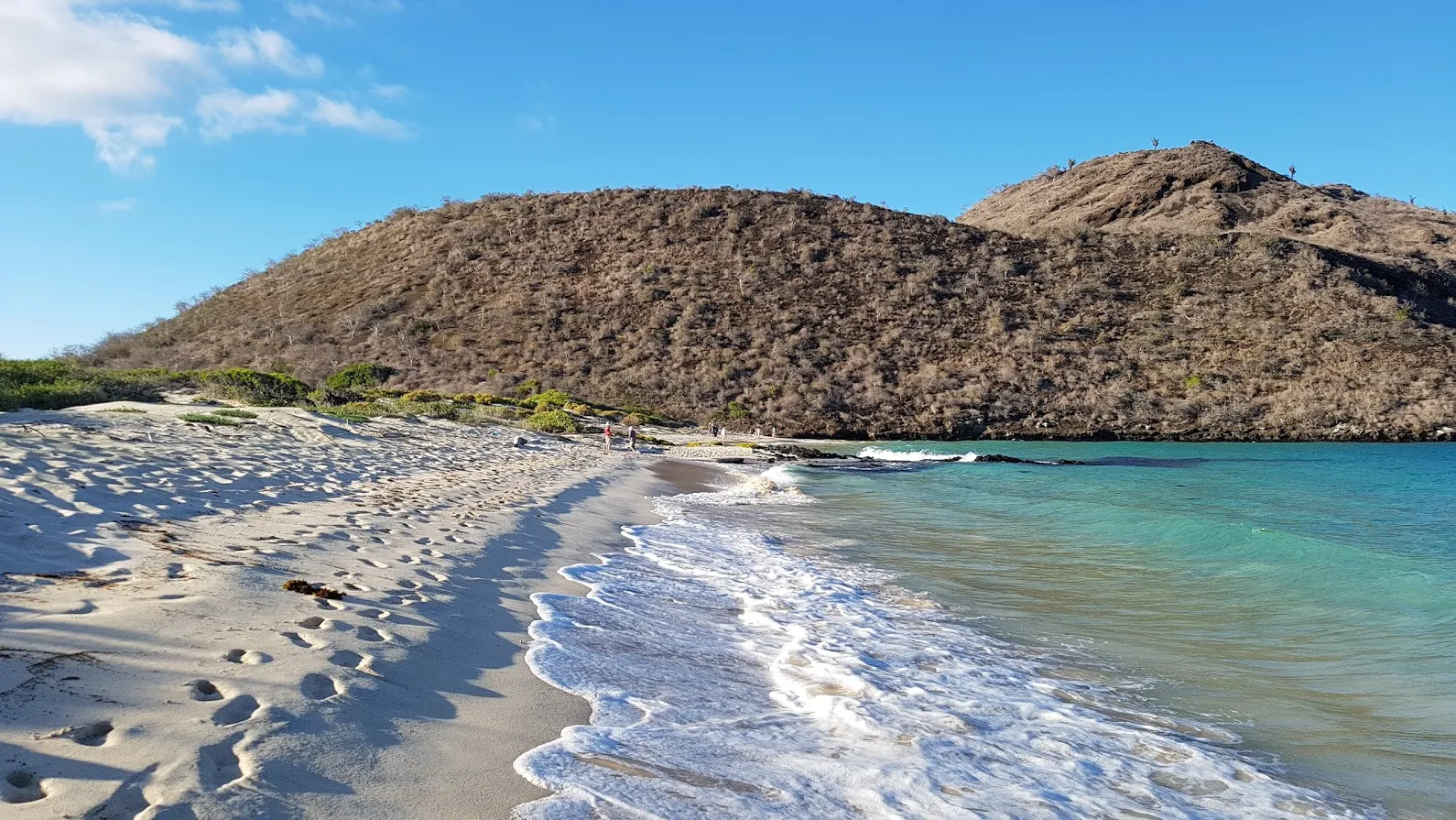
Behind it lies a brackish lagoon where flamingos sift the bottom for tiny shrimp, joined by white-cheeked pintails, stilts, and shorebirds. The trail then climbs a low slope among palo santo trees and comes down to Flour Beach, whose white coral sand is so fine it feels like powder. Green turtles nest there, and rays glide through the shallow water. It is also one of the places in Galápagos with the greatest diversity of plants, some of them endemic to this part of Floreana.
Two beaches, two origins
Punta Cormorant occupies the northern tip of Floreana island. On a short walk, the site brings together two beaches that have nothing in common: one of greenish sand, born deep inside a volcano, and another of white, extremely fine sand, made of coral. Between them, a brackish lagoon and a low slope complete one of the most varied landscapes on the island.
The green beach
The visit begins on the beach where visitors land. Its sand has an olive-green tone. That colour comes from olivine crystals, a mineral rich in magnesium and iron that forms deep underground while the magma is still below the surface.
Seen up close, the sand reveals small green grains among darker ones: a visible trace of the island's volcanic origin.
The flamingo lagoon
Behind the green beach lies a brackish lagoon fed by the tides. It is the site's main attraction: here, flamingos, Phoenicopterus ruber, may be seen wading through the shallow water and sifting the mud on the bottom for tiny shrimp. Their pink colour stands out against the dry vegetation along the shore.
The flamingos of Galápagos are few and are spread across a handful of lagoons in the archipelago, and this is one of the best for seeing them. Around them, the lagoon gathers other birds: white-cheeked pintails, long-legged stilts, and shorebirds working the shoreline. Watching quietly from the trail allows them to carry on undisturbed.
Essential information
- Identity
- Punta Cormorant, visitor site on Floreana island
- Location
- Northern tip of Floreana
- Green beach
- Olive-green sand from olivine crystals of volcanic origin
- Lagoon
- Brackish lagoon fed by the tides, frequented by flamingos
- Flamingo
- Flamingo (Phoenicopterus ruber), which sifts the lagoon bottom for tiny shrimp
- Lagoon birds
- White-cheeked pintails, stilts, and shorebirds
- Trail
- Short trail linking the green beach, the lagoon, a slope with palo santo, and Flour Beach
- Plants
- One of the places in Galápagos with the greatest diversity of plants, some endemic to this part of Floreana
- Flour Beach
- White sand of polished coral, so fine it feels like flour
- Green turtle
- Green turtle (Chelonia mydas agassizii), which nests on Flour Beach
- Rays
- Several species of rays in the shallow water of Flour Beach
- Arrival
- By sea, with a landing on the green beach
- Conduct
- lour Beach and do not step on the sand above the high-tide line
A slope of palo santo
From the lagoon, the trail climbs a low slope of volcanic earth, among pale-trunked palo santo trees and other dry-zone shrubs. Punta Cormorant is one of the places in Galápagos with the greatest diversity of plants, and some of them grow only in this part of Floreana. Finches, yellow warblers, and flycatchers may appear in the vegetation, and from higher up the lagoon can be seen with the two beaches on either side of the point.
Flour Beach
On the other side of the slope, the second beach appears, completely different from the first. Its sand is white and so fine that it feels like flour to the touch. It does not come from a volcano but from the sea: it is made of pulverised, polished coral.
Watching from the shore
Flour Beach is enjoyed from the shore. Visitors do not go into the water, so as not to step on the rays resting buried in the sand, and do not walk above the high-tide line, where the turtles' nests may be. From the water's edge, the silhouettes of rays may be seen moving over the pale bottom.
The water of the green beach
Back on the green beach, when sea conditions allow, the water offers the possibility of snorkelling near the shore. Green turtles, sea lions, and reef fish may appear. Out of the water, blue-footed boobies may be seen diving into the sea from the air. None of these appearances is assured: each visit shows a different combination.
A visit inside the protected area
Punta Cormorant is part of the Galápagos protected area. Staying on the trail, watching the flamingos quietly and from a distance, not going into the water at Flour Beach, not stepping on the sand above the high tide, not touching or pulling up plants, and neither taking sand nor leaving waste is the expected conduct, so that the place keeps the life that sets it apart.
Frequently asked questions
- A visitor site at the northern tip of Floreana island, with a green-sand beach, a flamingo lagoon, and a white coral-sand beach, linked by a short trail.
- Because of olivine crystals, a mineral of volcanic origin that forms deep underground while the magma is below the surface.
- A beach of white sand made of pulverised coral, so fine that it feels like flour to the touch.
- Flamingos sifting the bottom for tiny shrimp, as well as white-cheeked pintails, stilts, and shorebirds, always as a possibility.
- No. It is enjoyed from the shore, so as not to step on the rays buried in the sand or disturb the turtles' nests.
- Because green turtles bury their eggs there, above the high-tide line.
- Palo santo and other dry-zone species; the site has one of the greatest plant diversities in Galápagos, with some species endemic to this part of Floreana.
- By sea, with a landing on the green beach.